The Complete Study OS Stack: From Brain to Behavior
 Manoj Ganapathi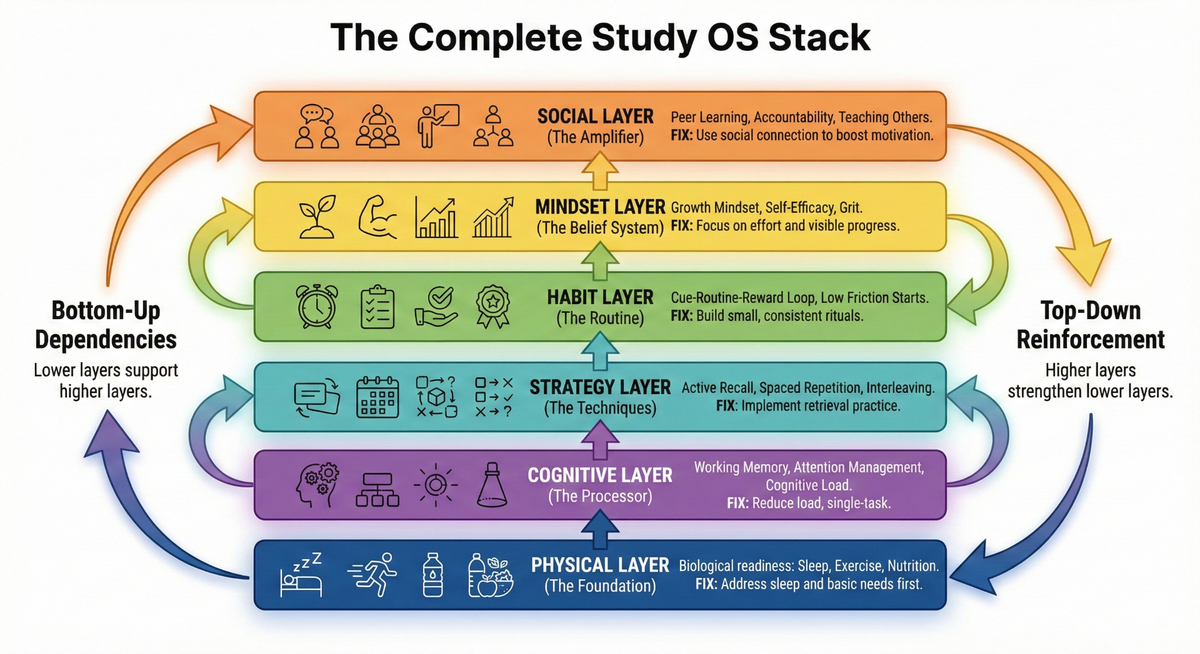
Why fixing one study problem often creates another—and how to see the full system that makes learning actually work.
Every parent has seen this pattern: you solve one problem, and another appears.
Your child starts using flashcards (good!), but they're exhausted and can't focus. They get more sleep (good!), but now they're studying alone and losing motivation. They join a study group (good!), but the group just chats and nobody actually retrieves anything.
It feels like whack-a-mole. Fix the memory problem, and the energy problem pops up. Fix the energy problem, and the habit problem emerges.
That's because learning isn't one skill. It's a stack of interconnected layers—and when any layer breaks down, the layers above it struggle.
This post introduces The Study OS Stack: a framework that shows how all the pieces fit together, from the physical foundation of your brain to the social environment where learning compounds.
The named pattern: The Study OS Stack
The Study OS Stack: A six-layer model showing how learning infrastructure works from bottom to top. Like a computer's operating system, each layer must function for the layers above it to run smoothly.
When students struggle, we often treat the visible symptom (the top layer) while ignoring the foundation (the bottom layers). The Stack reveals why "more studying" fails when the real problem is sleep, or why "try harder" fails when the real problem is cognitive overload.
Quick diagnosis: why isolated fixes don't last
Symptoms families often see:
- "They're using flashcards but still forgetting everything."
- "They have good study habits but freeze on tests."
- "They understand when we explain it, but can't do it alone."
- "They work hard for two weeks, then burn out."
What's usually happening:
A layer lower in the stack is broken, but we're treating a layer higher up.
| If the problem looks like... | The real issue might be... | Layer to check |
|---|---|---|
| "Can't remember despite trying" | Not enough retrieval practice | Strategy Layer |
| "Understands but can't perform" | Cognitive overload during practice | Cognitive Layer |
| "Good techniques, no consistency" | Missing cue-routine-reward loop | Habit Layer |
| "Works hard, then gives up" | No visible progress to sustain belief | Mindset Layer |
| "Studies alone, loses motivation" | No social accountability or explanation | Social Layer |
| "Too tired to focus" | Sleep, exercise, or basic energy deficits | Physical Layer |
The Study OS principle: Fix the lowest broken layer first. The layers above will often self-correct.
The science: six layers that make learning work
Layer 1: Physical Layer (The Foundation)
What it does: Provides the biological readiness for learning—energy, focus, and memory consolidation.
Key components:
- Sleep: Memory consolidation happens during sleep. Without adequate rest, the brain can't transfer learning from short-term to long-term storage.
- Exercise: Physical movement boosts BDNF (brain-derived neurotrophic factor), which supports learning and memory.
- Basic regulation: Hunger, hydration, and stress levels all affect cognitive performance.
When it breaks down: Students feel foggy, forget material overnight, and can't sustain attention even with good intentions.
Named pattern from this layer: The Night Shift—your brain's overnight memory consolidation job. Skip sleep, and you skip the most important part of studying.
Layer 2: Cognitive Layer (The Processor)
What it does: Manages working memory capacity—the "RAM" that handles active thinking.
Key components:
- Working memory limits: You can only hold 3-7 chunks of information at once. Exceed this, and learning stalls.
- Cognitive load types: Intrinsic (complexity of material), extraneous (wasted effort from poor design), and germane (effort that builds understanding).
- Attention management: Where attention goes, learning flows.
When it breaks down: Students feel overwhelmed, read without comprehending, and freeze when problems look different from examples.
Named pattern from this layer: The Tab-Switch Trap—studying with constant context-switching (video --> notes --> messages --> back) that burns cognitive fuel on navigation instead of learning.
Related reading: Cognitive Load Management
Layer 3: Strategy Layer (The Techniques)
What it does: Provides evidence-based methods for encoding, retaining, and retrieving knowledge.
Key components:
- Active recall: Practicing retrieval (pulling information out) instead of passive review (looking at information).
- Spaced repetition: Reviewing at increasing intervals to strengthen memory before it fades.
- Interleaving: Mixing problem types to build flexible, transferable knowledge.
When it breaks down: Students "study" by re-reading and highlighting, feel confident, then go blank on tests.
Named pattern from this layer: The Friday-Monday Gap—you feel confident on Friday after studying, but by Monday it's surprisingly fuzzy because no retrieval happened in between.
Related reading: Active Recall + Spaced Repetition
Layer 4: Habit Layer (The Routine)
What it does: Converts good intentions into automatic, repeatable behavior.
Key components:
- Cue-Routine-Reward loop: A specific trigger, a small repeatable action, and immediate feedback.
- Low friction starts: Making the routine smaller than your excuses.
- Metacognitive checkpoints: Brief reflection that improves the routine over time.
When it breaks down: Students know what to do but can't get started, study in exhausting bursts instead of calm rhythms, and restart from scratch after every break.
Named pattern from this layer: The 9:30 PM Fire-Drill Loop—panic-driven studying the night before tests that creates effort without reliable retention.
Layer 5: Mindset Layer (The Belief System)
What it does: Determines how students interpret struggle, mistakes, and setbacks.
Key components:
- Growth mindset: Believing ability can develop through effort + strategy + feedback.
- Self-efficacy: Task-specific confidence built through accumulated evidence of success.
- Grit: Strategic persistence—stick with the goal, adjust the method.
When it breaks down: Students avoid challenging material, interpret mistakes as proof of inability, and quit after the first hard week.
Named patterns from this layer:
- The Restart Spiral—one bad score triggers "I'm not good at this," leading to avoidance, cramming, and worse performance.
- The Week-3 Wall—motivation slump when novelty fades and the material gets harder.
- The Receipt Gap—working hard without collecting visible proof of progress, so the brain concludes "my effort doesn't work."
Related reading: Growth Mindset, Self-Efficacy, Grit
Layer 6: Social Layer (The Amplifier)
What it does: Uses peer interaction to deepen understanding, maintain accountability, and multiply motivation.
Key components:
- The protege effect: Teaching others forces clarity and reveals gaps in your own understanding.
- Scaffolded learning: Working in your stretch zone with peer support.
- Accountability structures: Making commitments visible to others.
When it breaks down: Students study in isolation, lose motivation without external feedback, and never test their understanding against real questions.
Named pattern from this layer: The Hangout Study Trap — sitting together feels productive, but without structure, it's just shared space, not shared discovery.
The stack in action: how layers interact
The power of the Stack model is seeing how layers depend on each other.
Bottom-up dependencies
- Physical --> Cognitive: Sleep deprivation reduces working memory capacity by up to 40%. No amount of strategy can compensate for a brain that can't hold information.
- Cognitive --> Strategy: Active recall only works if there's cognitive capacity available. A student drowning in extraneous load can't do meaningful retrieval.
- Strategy --> Habit: Even the best techniques fail without consistent application. Knowing about spaced repetition isn't the same as doing it.
- Habit --> Mindset: Growth mindset requires evidence. Without visible progress from consistent practice, belief erodes.
- Mindset --> Social: Healthy peer learning requires psychological safety. Students with fragile self-efficacy may avoid explaining to peers.
Top-down reinforcement
The upper layers also strengthen the lower ones:
- Social --> Habit: Accountability to peers makes habits stick.
- Mindset --> Strategy: Growth mindset encourages trying harder techniques (like retrieval) even when they feel uncomfortable.
- Habit --> Physical: Consistent sleep routines improve physical readiness.
A concrete Tuesday example (what this looks like in real life)
Grade 7 Science (Photosynthesis), Tuesday 4:30-4:45 pm (15 minutes)
Let's see how a complete Study OS session addresses multiple layers:
1. Physical Layer check (1 minute):
- Quick snack and water before sitting down.
- Desk cleared, phone in another room.
2. Cognitive Layer setup (1 minute):
- Single target written: "Explain photosynthesis inputs and outputs."
- One resource open (not five tabs).
3. Strategy Layer execution (8 minutes):
- Retrieval sprint (6 min): Answer 6 questions from memory:
- What does photosynthesis produce?
- What are the inputs?
- Where does it happen in the cell?
- What role does sunlight play?
- What happens to the glucose?
- How is it different from respiration?
- Repair pass (2 min): Check notes, correct errors in different color.
4. Habit Layer ritual (2 minutes):
- M.R.C. check: "I missed the difference from respiration. I'll add one comparison flashcard."
- Schedule next review: Thursday, same time, 10 minutes.
5. Mindset Layer reinforcement (1 minute):
- Write: "Today I proved I can explain inputs and outputs."
- Note one area for growth: "Respiration comparison is my 'not yet.'"
6. Social Layer extension (2 minutes, optional):
- Text study partner: "Quiz me on photosynthesis Thursday?"
- Or: explain to parent in 60 seconds (protege effect).
Output at the end:
- 6 retrieval answers completed
- 1 error identified and turned into a flashcard
- Next review scheduled
- 1 "I can" statement recorded
- 1 social accountability commitment
This isn't "studying harder." This is studying systematically—with each layer supporting the others.
Try this today (15 minutes): The Stack Check Routine
Use this routine to diagnose which layer needs attention and take one action at each level.
Total time: 15 minutes
Output: Diagnosis at each layer + one micro-fix + next review scheduled
Step 1: Physical Check (1 min)
- Did I sleep 7+ hours? (Yes/No)
- Am I hydrated and fed? (Yes/No)
- Is my study space clear? (Yes/No)
- If any "No": Fix the easiest one now (get water, clear desk).
Step 2: Cognitive Check (1 min)
- Is my target specific? Write: "By the end, I can explain ___."
- Are distractions removed? (One tab, phone away)
Step 3: Strategy Execution (8 min)
- Retrieval sprint (6 min): Answer 6 questions without notes.
- Repair pass (2 min): Check and correct the weakest answer.
Step 4: Habit Lock-in (2 min)
- M.R.C. reflection: Mistake / Reason / Change
- Schedule next review (write it down or add to calendar)
Step 5: Mindset Receipt (2 min)
- Write: "Today I proved I can ___."
- Write: "I'm still working on ___ (not yet)."
Step 6: Social Spark (1 min)
- Text one person: "Quiz me on ___ tomorrow?"
- Or: Explain today's topic to someone for 60 seconds.
Success metric: You ran all six layers, produced outputs, and scheduled the next session.
For parents: how to support the whole stack
Layer-by-layer guidance:
| Layer | What to support | What to avoid |
|---|---|---|
| Physical | Consistent sleep times, light exercise | Letting devices disrupt sleep |
| Cognitive | Clear, quiet study space | Adding more resources when overwhelmed |
| Strategy | Ask "Can you explain it without looking?" | Praising re-reading or highlighting |
| Habit | Ask "What's your cue and routine?" | Nagging without structure |
| Mindset | Praise process: "You kept going." | Praising intelligence: "You're smart." |
| Social | Facilitate study partners | Forcing group work without structure |
The diagnosis question:
When your child is struggling, ask: "Which layer is actually broken?"
- Tired but using good techniques? --> Physical Layer
- Alert but overwhelmed? --> Cognitive Layer
- Knows what to do but doesn't do it? --> Habit Layer
- Doing the work but losing belief? --> Mindset Layer
Fix the lowest broken layer first. The rest often follows.
Gentle CTA: build your complete Study OS
The Study OS Stack isn't about adding more to your child's plate. It's about seeing the whole system so you can fix the right layer at the right time.
EaseFactor is built to support all six layers:
- Physical: Sleep tracking reminders, study session length limits
- Cognitive: Clean interfaces, one-task-at-a-time design
- Strategy: Built-in retrieval practice, spaced repetition scheduling
- Habit: Streak tracking, cue-routine-reward loops, M.R.C. prompts
- Mindset: Growth mindset surveys, visible progress receipts
- Social: Discussion forums, peer explanation prompts, accountability features
The goal isn't perfect performance. It's calm, visible, repeatable progress—because that's what builds both learning and confidence over time.
TL;DR
- The Study OS Stack is a six-layer model: Physical Layer (foundation) --> Cognitive Layer --> Strategy Layer --> Habit Layer --> Mindset Layer --> Social Layer (amplifier).
- Each layer depends on the ones below it. You can't build strong habits on top of cognitive overload, and you can't sustain a growth mindset without visible progress.
- A complete Study OS addresses all layers—not just the one that's currently breaking.
Citations
Physical Layer
- Matthew Walker: Sleep and memory consolidation; Why We Sleep
- Robert Stickgold: Sleep-dependent memory reactivation
- John Ratey: Exercise and BDNF; Spark
Cognitive Layer
- John Sweller: Cognitive Load Theory
- Richard Mayer: Cognitive Theory of Multimedia Learning
- Chandler & Sweller: Split-attention effect
Strategy Layer
- Roediger & Karpicke (2006): Retrieval practice / test-enhanced learning
- Cepeda et al. (2006): Spacing effect meta-analysis
- Bjork & Bjork: Desirable difficulties
- Dunlosky et al. (2013): Effective learning techniques review
Habit Layer
- Duhigg: Habit loop model (cue-routine-reward)
- Lally et al.: Habit formation timelines
- Flavell: Metacognition monitoring/control
Mindset Layer
- Carol Dweck: Growth mindset theory
- Albert Bandura: Self-efficacy and its four sources
- Angela Duckworth: Grit as passion + perseverance
Social Layer
- Johnson & Johnson: Cooperative learning research
- Vygotsky: Zone of Proximal Development
- Roscoe & Chi: Protege effect (learning by teaching)

Manoj Ganapathi
Founder and Builder of EaseFactor. Passionate about evidence-based learning and helping students build effective study habits through cognitive science principles.
Ready to Study Smarter?
EaseFactor uses these learning science principles to help you build lasting knowledge.