Growth Mindset Isn't Motivation. It's Your Study OS Upgrade.
 Manoj Ganapathi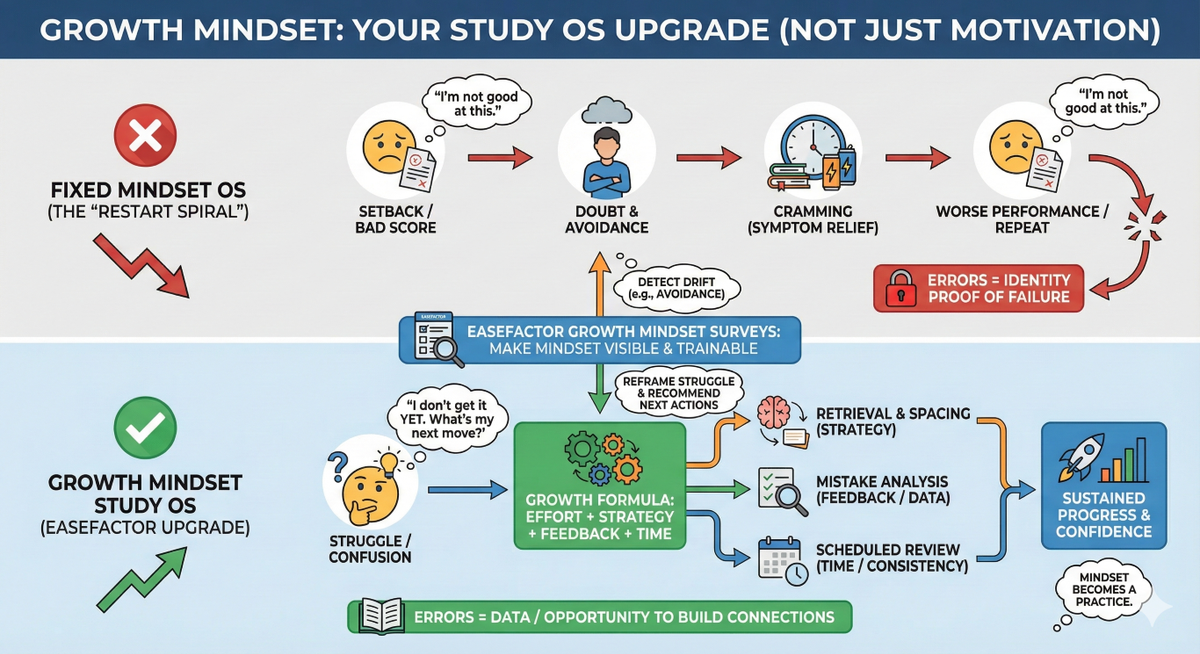
The emotional truth (and why it matters)
When school gets hard, students don't just feel confused. They feel exposed.
That's why the same moment ("I don't get this") can produce two completely different reactions:
- Fixed mindset reaction: "I'm not a math/science/English person."
- Growth mindset reaction: "I don't get it yet. What's my next move?"
That one word — yet — isn't a slogan. It's an operating instruction for your brain.
Diagnosis: what's really going wrong
Many students (and families) mistake symptoms for the problem.
Common symptoms
- Low confidence before tests
- Avoiding difficult topics
- "I studied for hours but forgot everything"
- Emotional shutdown after mistakes
The infrastructure problem underneath
A student may not lack effort. They may lack a repeatable system for how to respond when learning feels difficult.
Think of mindset like an operating system:
- A fixed mindset OS treats mistakes as "proof" and triggers shutdown.
- A growth mindset OS treats mistakes as "data" and triggers iteration.
The named pattern: The Restart Spiral
The Restart Spiral is when one setback resets the whole plan:
Bad score → "I'm not good at this" → avoid → cram later → worse performance → repeat.
It's not laziness. It's a predictable loop triggered by threat and uncertainty.
A growth mindset doesn't magically remove the loop. It changes the default response so the loop doesn't get reinforced.
The science (in plain language)
Growth mindset research, popularized by Carol Dweck, shows that students who believe ability can develop are more likely to:
- choose harder tasks,
- persist through setbacks,
- use feedback to improve,
- and sustain effort over time.
But here's the critical nuance: growth mindset works best when paired with effective learning behaviors. Praising effort alone can backfire ("I tried, so I should succeed") — that's the false growth mindset trap.
The practical formula
If any part is missing, students may feel like:
- "I tried hard but still failed" → which can strengthen fixed mindset beliefs.
Myth vs reality: what growth mindset is (and isn't)
Effort
- Myth: "Just try harder."
- Reality: Try smarter: pick strategies that actually work (retrieval, spacing, practice).
Struggle
- Myth: "Struggle means I'm bad at this."
- Reality: Struggle often means your brain is building new connections.
Talent
- Myth: "Some kids are just gifted."
- Reality: Ability often reflects practice quality + consistency over time.
Praise
- Myth: "Good job for working hard."
- Reality: Praise the process: strategy, revisions, asking good questions.
Why a Study OS beats "more studying"
More hours can temporarily boost performance, especially before a test. That's symptom relief.
A Study OS improves performance reliably over time by standardizing what happens after confusion.
Symptoms vs infrastructure
- Tutoring can help a lot (symptom relief + skill repair) — but it works best when paired with a Study OS.
- A Study OS ensures the student knows what to do between sessions: review rhythm, retrieval practice, feedback loops, reflection.
This is where mindset becomes operational, not motivational.
How EaseFactor makes growth mindset trainable
Your mindset is often invisible until something goes wrong. EaseFactor's approach makes it measurable and actionable by embedding reflection into the learning workflow.
The Growth Mindset Survey (why it's different)
EaseFactor's Growth Mindset Survey is triggered at the end of learning units to do three things:
- Detect mindset drift (e.g., "I avoid hard topics," "Mistakes feel like failure")
- Reframe struggle as a normal signal of learning
- Recommend next actions that connect mindset to study behaviors
Instead of "You can do it!", the system nudges students toward specific behaviors:
- re-attempting missed questions,
- scheduling a short review,
- naming one confusion,
- selecting a new strategy.
That's the key shift: mindset becomes a practice, not a personality trait.
A concrete Tuesday example (what this looks like in real life)
Grade 7 Science | Tuesday 6:20 pm | 12 minutes after dinner
Topic: Photosynthesis (student keeps mixing up inputs/outputs)
- 2 minutes — Retrieval warm-up (no notes): Write answers to 4 prompts: What is photosynthesis for? What are the inputs? What are the outputs? Where does it happen in the plant?
- 5 minutes — Check and correct: Compare with notes/textbook and mark: correct, wrong, or unsure.
- 3 minutes — Mistake-to-plan step: Create a "confusion list" with exactly two items: "I confuse glucose vs oxygen output." and "I forget the role of sunlight."
- 2 minutes — Growth Mindset Survey reflection (EaseFactor): Prompt: "When I got stuck, I…" Student selects: "I felt frustrated and wanted to stop." Feedback: "That frustration is a growth signal. Do one small retry now."
Output at the end:
- 4 retrieval answers completed
- 2 misconceptions identified
- Next review scheduled (3–5 minutes tomorrow)
That's compounding: small sessions that add up.
Try this today (10 minutes): The "Yet Loop" Routine
A short routine to break the Restart Spiral immediately.
Total time: 10 minutes
Output: 6 answered retrieval questions + 1 confusion list + 1 scheduled review
- 1 minute — Name the "yet": Write: "I can't do ____ yet."
- 4 minutes — Active recall (no notes): Answer 6 quick questions from the topic (or generate them yourself): 2 definitions, 2 "how/why" questions, 2 example questions.
- 3 minutes — Mark and learn: For each wrong/unsure answer, write one line: "I missed this because ____."
- 1 minute — Choose one strategy: Pick the next move: re-attempt 2 questions, or create 3 flashcards, or do 1 worked example.
- 1 minute — Schedule a tiny review: Put a 5-minute review on tomorrow's plan.
A Calm Next Step
If your child (or you) keeps "resetting" after setbacks, don't aim for perfect motivation. Aim for a better system. EaseFactor is built as a Study OS: it turns effort into advantage by combining learning science, structured practice, and AI-guided reflection—so progress is calm, visible, and repeatable.
TL;DR
- A growth mindset is not "try harder"; it's struggle + strategy + feedback repeated on purpose.
- Most students get stuck in the Restart Spiral (one bad score → doubt → avoidance → cramming → repeat). A Study OS breaks the loop.
- EaseFactor's Growth Mindset Surveys make mindset visible and trainable, not just inspirational.
Citations
- Carol S. Dweck — implicit theories of intelligence (fixed vs growth mindset)
- Blackwell, Trzesniewski, & Dweck (2007) — mindset and academic transition outcomes
- Yeager & Dweck (2012) — mindsets and resilience
- Retrieval practice (testing effect): Roediger & Karpicke
- Spacing effect: Cepeda et al.
- Desirable difficulties: Bjork & Bjork
- Feedback and formative assessment: Hattie & Timperley

Manoj Ganapathi
Founder and Builder of EaseFactor. Passionate about evidence-based learning and helping students build effective study habits through cognitive science principles.
Ready to Study Smarter?
EaseFactor uses these learning science principles to help you build lasting knowledge.