Building Self-Efficacy: The Foundation of Academic Confidence
 Manoj Ganapathi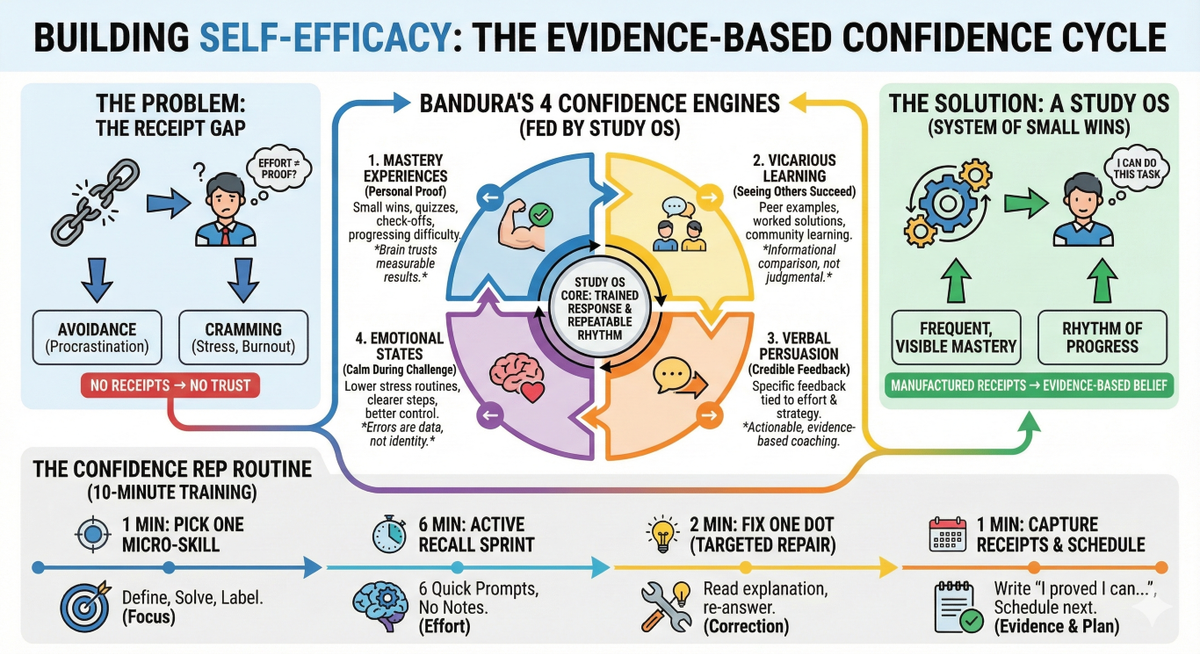
Confidence doesn't come from pep talks. It comes from receipts: repeated proof that "I can do this."
If you've ever watched a student say, "I'm just not good at math" after one tough worksheet, you've seen the real problem: not intelligence, not effort - belief under pressure.
Most students don't lack ability. They lack a reliable system that produces enough small wins to make ability feel real.
That's what self-efficacy is: your belief that you can succeed at a specific task - not a general "I feel good about myself," but "I can solve this kind of problem."
EaseFactor exists to turn effort into advantage by combining learning science, AI, and disciplined practice - so students build evidence-based confidence that compounds over time.
Diagnosis: Why "More Studying" Often Fails
When confidence is low, students usually try one of two things:
- Avoid (skip the subject, procrastinate, "I'll do it later")
- Cram (more hours, more notes, more stress)
Both are symptom relief, not infrastructure.
Symptom: "I don't feel confident."
Infrastructure gap: "I don't have a system that produces frequent, visible mastery."
A Study OS fixes the infrastructure: it creates a rhythm where progress is measurable and repeatable - like training in a gym.
Self-Efficacy vs Self-Confidence (A Useful Distinction)
Self-confidence is a general feeling. Self-efficacy is task-specific belief.
Self-confidence is general self-belief: "I feel okay about myself."
Self-efficacy is the belief you can do this task: "I can solve 2-step fraction problems if I follow my steps."
A student can feel nervous overall but still have high self-efficacy in science diagrams. And that matters - because task-specific belief predicts effort, persistence, and performance.
The Named Pattern: The "Receipt Gap"
Receipt Gap (definition): A student works hard, but doesn't collect proof of progress - so their brain concludes, "My effort doesn't work."
No receipts → no trust.
No trust → avoidance or panic-cramming.
Avoidance/cramming → weak results → even fewer receipts.
The solution is not "more motivation." It's a system that manufactures receipts - small wins that are visible and frequent.
The Science: Bandura's Four Sources of Self-Efficacy
Psychologist Albert Bandura described four main sources of self-efficacy. Think of them like four "confidence engines" your Study OS should activate.
- Mastery Experiences — You succeed yourself. In a Study OS: small wins, quizzes, check-offs, progressing difficulty.
- Vicarious Learning — You see someone like you succeed. In a Study OS: peer examples, worked solutions, community learning.
- Verbal Persuasion — Credible feedback and encouragement. In a Study OS: specific feedback tied to effort + strategy.
- Emotional States — You feel calmer during challenge. In a Study OS: lower stress routines, clearer steps, better control.
The key idea: confidence isn't a personality trait. It's a result of repeated experiences that teach the brain, "My actions lead to success."
The System: A Study OS That Builds Confidence Like a Training Plan
Here's the metaphor to keep in mind:
Self-efficacy is not a mood. It's a trained response. Like strength in a gym, it grows through repeated reps - small, structured, progressively harder.
1) Mastery Experiences: "Small Wins, Big Belief"
Mastery is the strongest builder of self-efficacy because it's personal proof.
In EaseFactor terms, that means:
- a short quiz that proves recall is improving
- spaced repetition sessions that keep wins frequent
- tasks broken down so "done" happens daily
Why it works: your brain trusts results it can measure.
2) Vicarious Learning: "If They Can, I Can"
When students see peers succeed with similar struggles, ability feels more reachable.
In EaseFactor terms:
- discussion posts showing how others solved the same type of question
- sample solutions, "explain your method" threads
- guided peer learning that normalizes struggle as part of learning
Important nuance: This works best when comparison is informational ("How did they do it?"), not judgmental ("Why am I behind?").
3) Verbal Persuasion: "Feedback That's Actually Believable"
Generic praise ("You're smart!") often fails because it isn't actionable.
Believable persuasion sounds like:
- "You used the right steps for Q3 - next time, slow down on the sign."
- "Your streak shows consistency; that's why your recall improved."
This is where a Study OS shines: feedback becomes tied to evidence.
4) Emotional States: "Calm Brains Learn Better"
When students are anxious, working memory gets crowded. Even known material feels harder.
A Study OS reduces stress by:
- giving a clear next step (no decision overload)
- keeping sessions short and winnable
- showing progress visually so effort feels safe
Symptoms vs Infrastructure (A Practical Lens for Parents & Teachers)
Tutoring, extra worksheets, and more hours can help - when paired with a system.
Tutoring helps with explanation and clarity. Risk if used alone: becomes dependency. Best paired with: retrieval practice + review rhythm.
More notes helps with comfort, "I studied" feeling. Risk if used alone: illusion of learning. Best paired with: active recall checks.
More hours helps with time on task. Risk if used alone: burnout, low ROI. Best paired with: small, planned reps + feedback.
Bottom line: Tutoring can be a great tool. A Study OS makes it stick.
A Concrete Tuesday Example (Grade + Subject + Timeframe)
Grade 7 Math (Fractions), 12 minutes after school on Tuesday
Goal: Build self-efficacy for "adding fractions with unlike denominators."
- 2 minutes — Warm start (easy win)
Solve 1 problem you can do fast (same denominators). Output: 1 correct answer.
- 6 minutes — Confidence reps (active recall)
Do 3 problems with unlike denominators without looking at notes. After each one, check steps: common denominator → convert → add → simplify. Output: 3 attempts + corrections.
- 2 minutes — "Receipt capture"
Write: "I can do: ______" and "I'm stuck on: ______" (one sentence). Output: 1 strength + 1 confusion sentence.
- 2 minutes — Schedule the next rep
Put one micro-review on the calendar for Thursday (same 12 minutes). Output: 1 scheduled review.
This is how a Study OS builds self-efficacy: short reps, visible receipts, repeatable rhythm.
Try This Today: The 10-Minute "Confidence Rep" Routine
No cramming. No drama. Just training.
Total time: 10 minutes
Required output: 6 retrieval answers + 1 confusion list item + next review scheduled
- 1 minute — Pick one micro-skill
Example: "Define 3 key terms," "Solve 2 equation problems," "Label 5 parts of a diagram."
- 6 minutes — Active recall sprint (no notes)
Answer 6 quick retrieval prompts. If you blank, mark it with a dot and keep going.
- 2 minutes — Fix one dot (targeted repair)
Choose one missed item. Read the explanation, then answer it again.
- 1 minute — Capture your receipts
Write: "Today I proved I can: ______" and "Next I need: ______" Schedule a review in 48 hours.
This routine trains the brain to associate effort with results—and that's the heart of self-efficacy.
TL;DR
- Self-efficacy = confidence with evidence (task-specific belief built through repeated proof).
- The fastest way to build it is a Study OS: small, trackable wins + feedback loops + review rhythm.
- Your next step: a 10-minute "Confidence Rep" routine that turns confusion into progress today.
Citations
- Bandura, A. — Self-efficacy theory; sources of efficacy beliefs
- Schunk, D. H. & Pajares, F. — Self-efficacy in school learning and motivation
- Zimmerman, B. J. — Self-regulated learning and efficacy beliefs
- Usher, E. L. & Pajares, F. — Review of efficacy sources in academic settings
- Retrieval practice & spacing effects (learning science foundations for "confidence receipts")

Manoj Ganapathi
Founder and Builder of EaseFactor. Passionate about evidence-based learning and helping students build effective study habits through cognitive science principles.
Ready to Study Smarter?
EaseFactor uses these learning science principles to help you build lasting knowledge.