Grit Isn't "Toughness." It's a System You Can Train.
 Manoj Ganapathi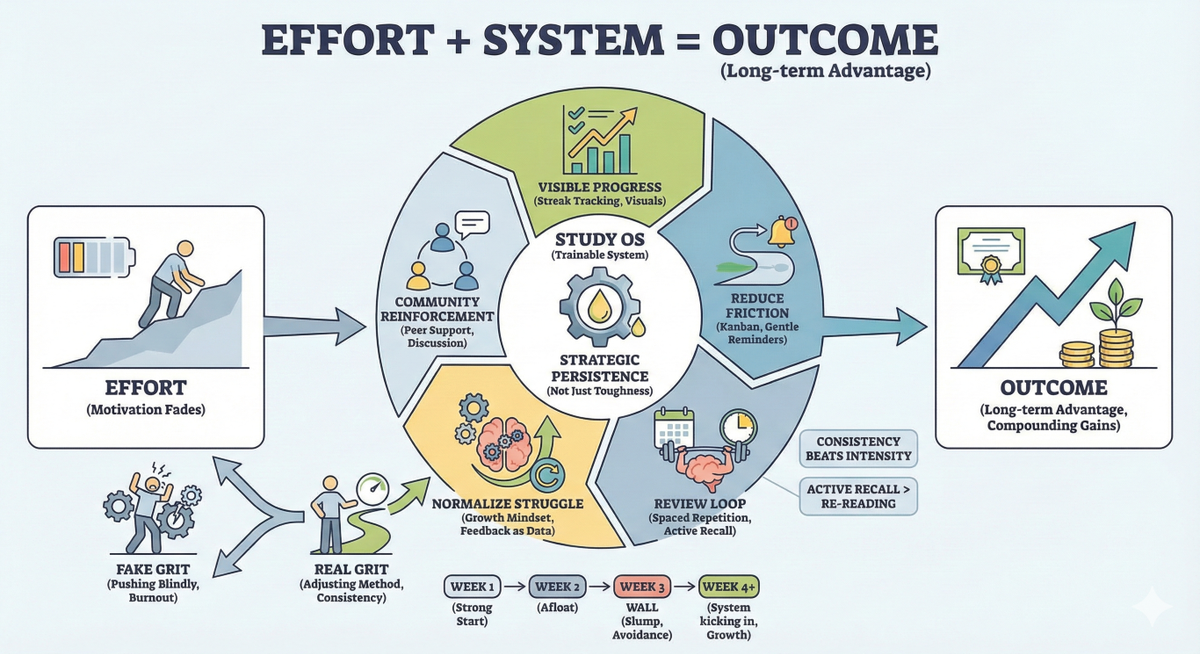
The emotional truth: motivation fades, and that's normal
Most students don't "give up" in one dramatic moment. They drift.
A few missed practice sessions. A confusing chapter. A low quiz score. Then a subtle story forms: "Maybe I'm not good at this."
That's not laziness. It's what happens when effort isn't connected to a structure that makes progress visible.
The named pattern: The Week-3 Wall
The Week-3 Wall is when a student starts strong (Week 1), stays afloat (Week 2), and then hits a slump (Week 3) because the work stops feeling rewarding. The novelty is gone, the material gets harder, and the brain's default response is avoidance.
Grit matters most right here—but grit isn't a personality trait you either have or don't. It's something you can train.
Quick diagnosis: why grit breaks down
Think of grit like fitness. If you sprint randomly, you'll burn out. If you train with a plan, you get stronger.
Common grit "symptoms"
- Starts well, then stalls after the first setback
- Studies in bursts (long sessions) instead of rhythm (short sessions)
- Confuses "I understand it now" with "I'll remember it later"
- Avoids the hardest topics (where learning is actually happening)
What's usually missing
- Low friction starts (so it's easy to begin)
- Proof of progress (so effort feels worth it)
- A review loop (so learning compounds)
- A reset ritual (so setbacks don't become identity)
What grit really is (and what it isn't)
Angela Duckworth's research popularized grit as passion + perseverance for long-term goals. In school terms, grit looks less like heroic willpower and more like showing up consistently—even when progress is slow.
The grit misconception (important)
Grit is not "never changing direction" or "pushing blindly."
Grit is strategic persistence: stick with the goal, adjust the method.
Here's the practical translation:
When scores drop: "Fake grit" says "I'll just study longer." Real grit says "I'll change the practice method."
When a topic feels confusing: "Fake grit" leads to avoidance. Real grit means targeted retrieval + help-seeking.
When a streak breaks: "Fake grit" thinks "I ruined it." Real grit says "Reset today with a smaller session."
The science: why consistency beats intensity
Two learning realities matter for grit:
1) The brain forgets quickly without review
Forgetting isn't failure; it's biology. Without revisiting information, memory traces weaken. That's why "I studied yesterday" doesn't guarantee "I can do it next week."
2) Recalling strengthens memory more than re-reading
Students often feel productive when they re-read notes. But that comfort can be an illusion. Active recall (trying to remember without looking) is harder—and that difficulty is often the point. It's like lifting a weight: the strain is the stimulus.
3) Spacing turns effort into compounding gains
A few minutes of review spaced over days tends to outperform one big cram session for long-term retention. Spacing also builds grit because it teaches the student: "Small steps count."
Symptoms vs infrastructure: why "more hours" isn't the answer
A tutor, more worksheets, or extra hours can improve performance today (symptom relief).
A Study OS improves performance reliably over time (infrastructure).
Nuance: tutoring works best when paired with a Study OS—so the student knows what to practice, when to review, and how to measure progress.
The Study OS approach: how EaseFactor turns effort into advantage
EaseFactor treats grit like a trainable capability: Effort → System → Outcome. The platform builds an environment where persistence is the default.
1) Make progress visible (so students believe effort works)
- Streak tracking + performance visuals turn "I worked" into "I can see growth."
- This reduces the Week-3 Wall because effort feels connected to outcome.
2) Reduce friction (so starting isn't a battle)
- Kanban scheduling breaks big goals into small, doable cards.
- Gentle reminders nudge without nagging, keeping autonomy intact.
3) Build the review loop (so learning compounds)
- Spaced repetition turns review into a calendar-backed habit rather than a willpower test.
- Students don't have to guess what to study; the system surfaces what matters.
4) Normalize struggle (so difficulty becomes data)
- Growth mindset surveys + feedback reinforce: "Errors are data, not identity."
- After a setback, the next action is clear: adjust the practice, not the self-story.
5) Add community reinforcement (so persistence isn't lonely)
- Discussion forums reward meaningful engagement and reflective thinking—not just participation.
- Peer support helps students stay loyal to goals when motivation dips.
A concrete Tuesday example (what this looks like in real life)
Grade 7 Science (Photosynthesis), Tuesday 6:15–6:27 pm (12 minutes)
Goal: strengthen memory and train strategic perseverance.
- 2 min — Start ritual (low friction)
- Open EaseFactor → Today's review queue
- Write one line: "Today I'm training consistency."
- 6 min — Active recall (the "weight lifting" part)
- Answer 6 retrieval questions without notes:
- "What is the equation for photosynthesis?"
- "Where does it occur in the plant cell?"
- "Why is chlorophyll important?" (etc.)
- Mark confidence: High / Medium / Low
- Answer 6 retrieval questions without notes:
- 2 min — Fix one weak point
- Pick the lowest-confidence question
- Create 1 micro-card (question front, short answer back)
- 2 min — Schedule the next rep
- Kanban: move "Photosynthesis review" to the next due date
- End with: "Streak protected."
Output: 6 answered questions + 1 new micro-card + next review scheduled.
That's not just studying. That's grit training.
Try this today (10 minutes): The Grit Micro-Workout
Use this when a student is resistant, tired, or behind. The point is to keep the chain alive and protect confidence.
Total time: 10 minutes. Output is non-negotiable.
- 1 min — Name the moment
- "This is the Week-3 Wall. It passes."
- 6 min — Retrieval sprint
- Answer 5 questions from memory (no notes).
- If stuck, write "I'm not sure yet" and keep going.
- 2 min — One targeted repair
- Review only what you missed. Create 1 correction note:
- "I confused X with Y because... Next time I'll check..."
- Review only what you missed. Create 1 correction note:
- 1 min — Schedule the next review
- Put it on the system (spaced repetition / planner / Kanban).
For parents: how to support grit without hovering
- Praise process, not identity: "You kept going even when it was hard."
- Ask for outputs, not hours: "Show me your 5 questions and 1 fix."
- Use calm resets: If they miss a day, don't dramatize it. Help them restart small.
- Avoid: "You're smart, you'll figure it out." (Comforting, but not actionable.)
- Better: "Let's reduce the task to 10 minutes and protect your streak."
Make grit easier to practice
Grit grows fastest when a student has a structure that:
- reduces start friction,
- makes progress visible,
- and schedules review so learning compounds.
That's the heart of EaseFactor: a Personal Study OS that turns effort into advantage—without panic, hacks, or pressure.
TL;DR
- Grit isn't toughness; it's strategic persistence—and it can be trained with the right structure.
- Consistency + active recall + spacing turns effort into compounding learning.
- A Study OS (EaseFactor) reduces friction, schedules review, and makes progress visible—so students keep going.

Manoj Ganapathi
Founder and Builder of EaseFactor. Passionate about evidence-based learning and helping students build effective study habits through cognitive science principles.
Ready to Study Smarter?
EaseFactor uses these learning science principles to help you build lasting knowledge.