Cognitive Load Management: The Hidden Reason "More Studying" Stops Working
 Manoj Ganapathi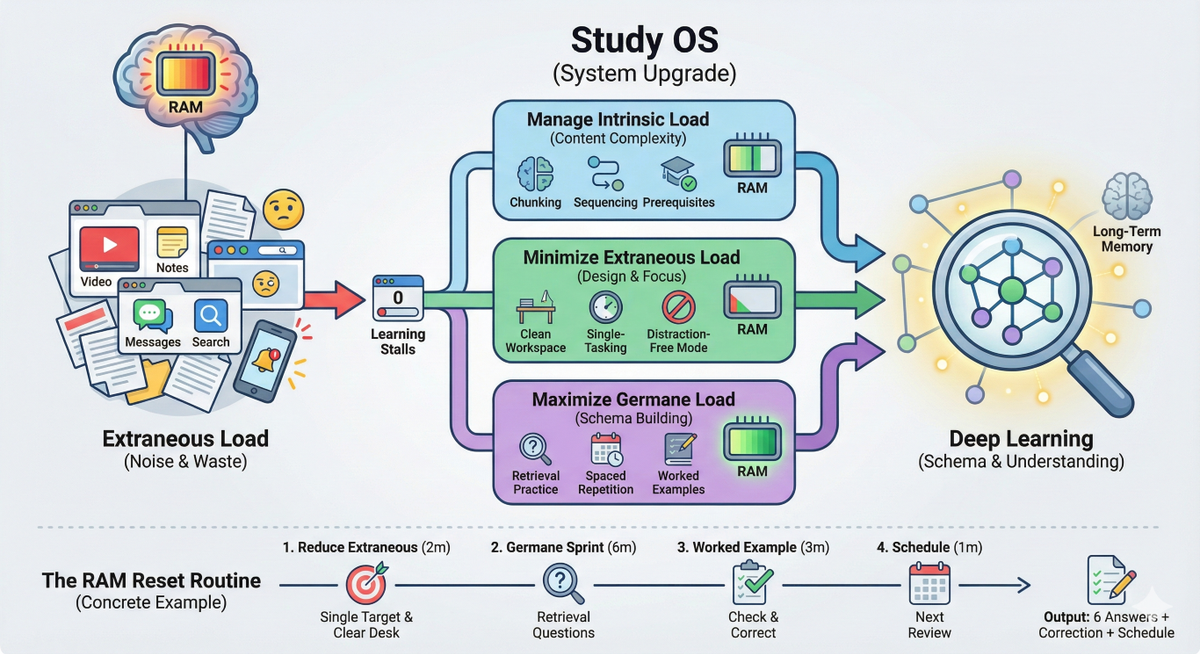
The emotional truth (what families actually see)
A child sits down to study and… stalls. Not because they don't care. Because their brain is trying to juggle too many new pieces at once: instructions, definitions, diagrams, past mistakes, time pressure, and distractions.
When that happens, even an extra hour won't help much. The system is saturated.
Primary metaphor (we'll use it throughout): Your brain's working memory is like limited RAM. If too many processes run at once, performance drops—not because the computer is "bad," but because the workload is poorly managed.
Diagnosis: symptoms vs infrastructure
Symptoms families notice
- "I read it, but I can't explain it."
- "I'm studying a lot, but marks don't move."
- "I freeze when problems look different."
Infrastructure issue underneath
- Cognitive load is exceeding working memory capacity, leaving too little capacity for the thinking that actually builds understanding.
Nuance: Tutoring, notes, and more practice can help—but they work best when paired with a Study OS that controls cognitive load so learning can compound.
The named pattern: The Tab-Switch Trap
The Tab-Switch Trap: studying with constant context-switching—video → notes → worksheet → messages → "quick search" → back again.
Every switch costs mental RAM. The student feels "busy," but their working memory is burning fuel on navigation, not learning.
The science in one clean model: 3 kinds of cognitive load
Cognitive Load Theory (Sweller) separates mental effort into three types:
Intrinsic Load
What it is: The complexity of the content itself
What it feels like: "This topic has many parts"
What to do: Sequence, chunk, build prerequisites
Extraneous Load
What it is: Effort wasted due to poor design (confusing layout, distractions, split attention)
What it feels like: "I'm lost and annoyed"
What to do: Simplify, integrate, remove noise
Germane Load
What it is: Effort that builds schemas (mental models)
What it feels like: "This is hard, but it's clicking"
What to do: Use retrieval, worked examples, reflection
Why "more information" can reduce learning
A common mistake is to respond to confusion with more explanations, more pages, more videos. That often increases extraneous load (new wording, new formats, extra details) and pushes the student further past capacity.
A better approach is to:
- Reduce extraneous load (clean presentation, one task at a time)
- Manage intrinsic load (right-sized steps)
- Spend the freed capacity on germane load (active recall + schema building)
This is exactly the difference between symptom relief and infrastructure:
- Symptom relief: "Let's rewatch the video again."
- Infrastructure: "Let's reduce clutter and use retrieval so the brain builds a stable model."
What this looks like on a Tuesday (concrete example)
Grade 7 Science | Photosynthesis | 12 minutes after school
Goal: understand the process well enough to explain it without the book.
Step 1: Reduce extraneous load (2 minutes)
- Put away everything except one page or one screen.
- Write today's target: "Explain photosynthesis in 4 steps."
Step 2: Build the schema via retrieval (6 minutes)
Close notes. Answer 6 quick questions from memory:
- What does photosynthesis produce?
- What does it need (inputs)?
- Where in the plant does it happen?
- What role does sunlight play?
- What happens to oxygen?
- Why is this important for life on Earth?
Step 3: Worked example (3 minutes)
- Check answers against notes. Correct in a different color.
- Add one missing link: "Light energy helps convert CO₂ + water into glucose."
Step 4: Schedule the next review (1 minute)
- Write: "Review in 2 days: repeat the 6 questions + add 2 new ones."
Output: 6 retrieval answers + one corrected mental model + next review scheduled.
That's not cramming. That's a system upgrade.
How a Study OS (EaseFactor philosophy) manages cognitive load
Think of EaseFactor as a Study Operating System that controls your cognitive "processes" so learning can run smoothly.
1) Reduce extraneous load (stop wasting RAM)
- Distraction-lite flow: fewer switches, clearer prompts, less searching mid-study.
- Integrated explanations (avoid split attention): keep the "what" and "why" together so the student isn't mentally stitching sources.
2) Manage intrinsic load (right-sized steps)
- Chunking: break complex topics into workable segments.
- Sequencing: prerequisites first, then complexity (so the brain isn't juggling too many new pieces).
3) Maximize germane load (the only load that pays you back)
- Retrieval practice as the default: the student practices remembering, not just recognizing.
- Spaced repetition: the system schedules reviews so knowledge compounds.
4) Adapt over time (expertise reversal effect)
What helps a beginner (more scaffolding, more examples) can annoy an advanced learner. A real system reduces scaffolds as competence grows—freeing the student to handle higher intrinsic load without overwhelm.
De-shaming reframe (non-negotiable)
Errors are data, not identity.
If a student blanks out, the next action is not self-criticism. It's a simple diagnostic:
- "What part did I forget: the inputs, the sequence, or the purpose?"
- Then do one micro-fix: answer two retrieval questions again.
Identity doesn't improve performance. Feedback loops do.
Try this today (10–12 minutes): The RAM Reset Routine
1 min — Set a single target
- "By the end, I can explain ___ in 3–5 steps."
2 min — Remove extraneous load
- One resource only. One tab. Phone away.
6 min — Retrieval sprint
- Write 6 questions (or use teacher questions) and answer from memory.
2 min — Fix the weakest link
- Check notes, correct, and write one "missing connection" sentence.
1 min — Schedule
- Decide the next review date (2 days is a good default) and what you'll do (repeat + add 2 questions).
Specific output: 6 answered questions + 1 "missing connection" sentence + next review scheduled.
TL;DR
- Working memory is limited "RAM"; overwhelm often means the system is overloaded, not that the student is incapable.
- Reduce extraneous load, manage intrinsic load, and spend capacity on germane load (retrieval + schemas).
- A Study OS creates rhythm and compounding via short, repeatable routines and spaced reviews.
Citations
- John Sweller — Cognitive Load Theory (foundational papers; instructional design implications)
- Chandler & Sweller — Split-attention effect; format of instruction
- Richard Mayer — Cognitive Theory of Multimedia Learning (modality, coherence, redundancy principles)
- Paas, Renkl, Sweller — Instructional design and cognitive load measurement
- Van Merriënboer & Sweller — Complex learning, scaffolding, and fading guidance
- Worked examples effect (math/science learning literature)
- Spaced repetition + retrieval practice (Roediger & Karpicke; Bjork & Bjork concepts)

Manoj Ganapathi
Founder and Builder of EaseFactor. Passionate about evidence-based learning and helping students build effective study habits through cognitive science principles.
Ready to Study Smarter?
EaseFactor uses these learning science principles to help you build lasting knowledge.