Active Recall + Spaced Repetition: The "Study OS" That Turns Effort Into Memory
 Manoj Ganapathi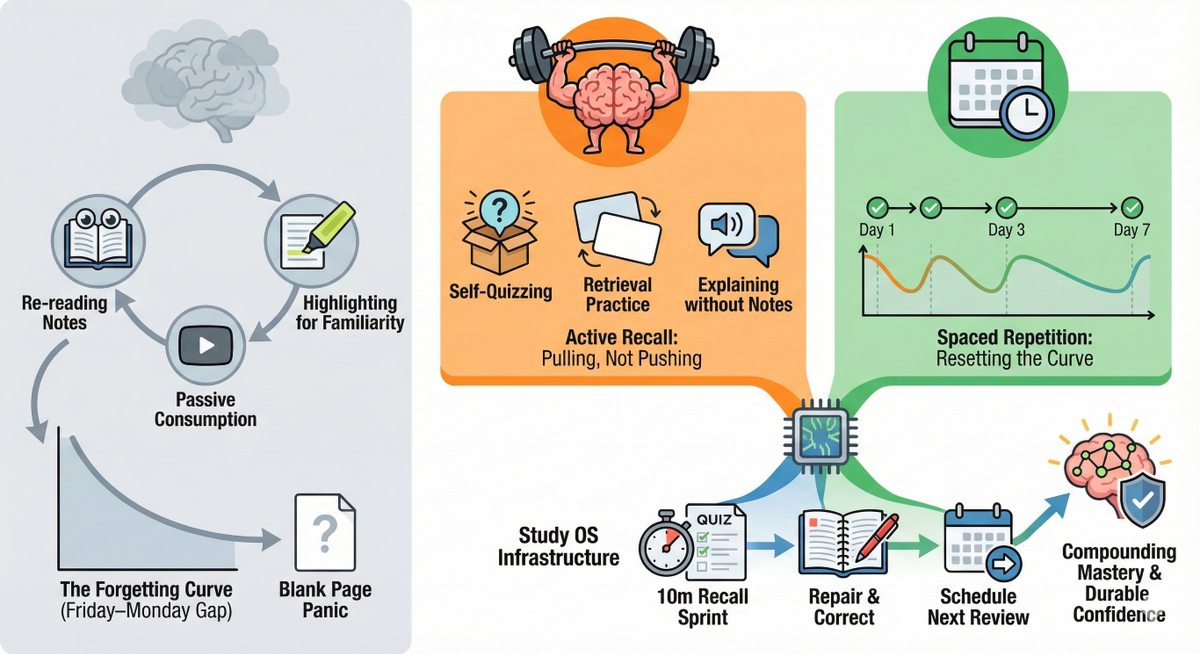
The problem: "I studied… so why can't I remember?"
Most students don't fail because they didn't study. They fail because they studied in ways that create familiarity, not retrieval ability.
Re-reading notes, highlighting, and watching videos can make the brain say: "Yep, I know this." But that's often an illusion of fluency—recognition masquerading as mastery. On test day, you don't get recognition. You get a blank page and a prompt that demands retrieval.
A named pattern: The Friday–Monday Gap
Friday–Monday Gap: You feel confident on Friday after studying, then by Monday it's surprisingly fuzzy—so you restart from scratch and lose time.
This isn't laziness. It's biology. Memory weakens when it isn't retrieved and refreshed.
Quick diagnosis: symptoms vs infrastructure
Symptoms you may notice
- "I understand it when I read it."
- "I remember it for homework, but not for tests."
- "I keep restarting chapters."
What's missing
- A way to practice retrieval (active recall)
- A way to schedule retrieval so it sticks (spaced repetition)
Tutoring, extra notes, and more hours can help—but they work best when paired with infrastructure. A Study OS makes progress reliable, not accidental.
The science: why these two methods work
Active recall (retrieval practice): memory gets built by pulling, not pushing
Active recall means you try to bring the answer to mind before you look:
- self-quizzing
- flashcards (done correctly)
- explaining in your own words
- solving problems without looking at the solution
Every retrieval attempt strengthens the "path" to that knowledge. Even when it feels hard, that difficulty is often a sign you're doing the right kind of work.
Spaced repetition: the brain remembers what it's asked to remember repeatedly over time
Spaced repetition takes advantage of the forgetting curve: instead of cramming once, you revisit at increasing intervals (e.g., 1 day → 3 days → 7 days → 14 days). Each successful retrieval "resets" forgetting and makes the memory more durable.
Put simply:
- Cramming: fast gains, fast decay
- Spacing: slower gains, long-lasting retention
The system: turn two techniques into a Study OS
Think of learning like physical training:
- Reading is like watching workout videos. Helpful, but it doesn't build strength.
- Active recall is lifting the weight.
- Spacing is your training schedule so you don't lose progress between sessions.
A Study OS does three jobs:
- Creates prompts that force retrieval (questions, flashcards, explanations)
- Schedules prompts at the right time (spacing)
- Tracks progress so you know what to do next (visibility)
Passive vs active (what changes in practice)
Here's how passive habits compare to Study OS habits:
Goal: "Know the chapter"
- Passive: Re-read notes
- Study OS: Write 6–10 questions from memory, then answer them
Goal: "Be ready for tests"
- Passive: One long session
- Study OS: Short sessions repeated across days
Goal: "Feel confident"
- Passive: Familiarity ("I've seen this")
- Study OS: Evidence ("I can retrieve it without looking")
Goal: "Fix weak areas"
- Passive: More reading
- Study OS: Targeted retrieval on the cards/questions you miss
What this looks like on a Tuesday evening
Grade 7 Science (Photosynthesis), 12 minutes after school
- 2 min – Brain dump: Write everything you remember about photosynthesis (no notes).
- 6 min – Retrieval questions: Answer 6 questions (example below).
- 2 min – Check + correct: Open notes, fix only what was wrong/missing.
- 2 min – Schedule: Mark the next review: tomorrow (3 min) and in 3 days (6 min).
Example retrieval questions (Grade 7)
- What is the word equation for photosynthesis?
- What do chloroplasts do?
- Why is sunlight necessary?
- What happens to glucose in a plant?
- How is photosynthesis different from respiration?
- If a plant is kept in the dark for a week, what changes and why?
This is small on purpose. The goal is compounding: short sessions that don't feel heavy, but add up to real mastery.
Try this today: the 10-minute "Recall → Repair → Schedule" routine
Total time: 10 minutes. Output: 6 answered questions + 1 scheduled review.
- (1 min) Pick one micro-topic
Example: "Fractions: adding unlike denominators" or "Causes of the French Revolution."
- (4 min) Active recall sprint
- Write 6 questions (or use 6 flashcards).
- Answer them without looking.
- (3 min) Repair pass
Open notes/textbook and correct your answers in a different color. Create 1 "confusion line": "I'm still unclear about ___."
- (2 min) Spacing plan
Schedule the next two reviews:
- Tomorrow: 3 minutes (re-answer the 6 questions)
- In 3 days: 6 minutes (same questions + 2 new ones)
Where EaseFactor fits
Doing this manually is possible—but many families struggle with consistency, tracking, and "what should I do today?"
EaseFactor is designed to behave like a Study OS:
- prompts that encourage retrieval (quizzes, flashcards, explain-like-I'm-5)
- scheduling that reinforces spacing (reviews at the right time)
- visibility that reduces overwhelm (streaks, progress, next actions)
The promise is not "effortless learning." It's effort that compounds—with structure that makes consistency easier to maintain.
TL;DR
- Active recall = practice retrieving from memory (not re-reading). That struggle is what strengthens learning.
- Spaced repetition = review right before you forget, so memory keeps getting "re-saved" stronger.
- Together, they form a Study OS: less panic, more consistency, and knowledge that actually shows up on test day.
References
- Retrieval Practice / Test-Enhanced Learning — Roediger & Karpicke (2006)
- Spacing Effect / Distributed Practice — Cepeda et al. (2006) meta-analysis
- Forgetting Curve (historical foundation) — Ebbinghaus (1885)
- Effective Learning Techniques review — Dunlosky et al. (2013)
- Desirable Difficulties — Bjork & Bjork (conceptual framework)
- Personalized/Adaptive review scheduling — work on adaptive spacing (e.g., Pashler/Mozer lines)
- Illusions of Competence — Koriat & Bjork (2005): explains why re-reading "feels productive but fades"
- Generation Effect — Slamecka & Graf (1978): foundational support for "pulling vs pushing" metaphor
- Interleaved Practice — Kornell & Bjork (2008): learning concepts through varied practice
- Critical Role of Retrieval — Karpicke & Roediger (2008): deeper exploration of why retrieval strengthens memory
- Encoding Variability — Glenberg (1979): component-levels theory explaining why spacing works neurally
- Graduated Interval Recall — Pimsleur (1967): historical foundation for spaced repetition algorithms
- Psychology of Forgetting — Wixted (2004): modern research on forgetting curve mechanisms

Manoj Ganapathi
Founder and Builder of EaseFactor. Passionate about evidence-based learning and helping students build effective study habits through cognitive science principles.
Ready to Study Smarter?
EaseFactor uses these learning science principles to help you build lasting knowledge.