Project Work Without "Poster Grades"
 Manoj Ganapathi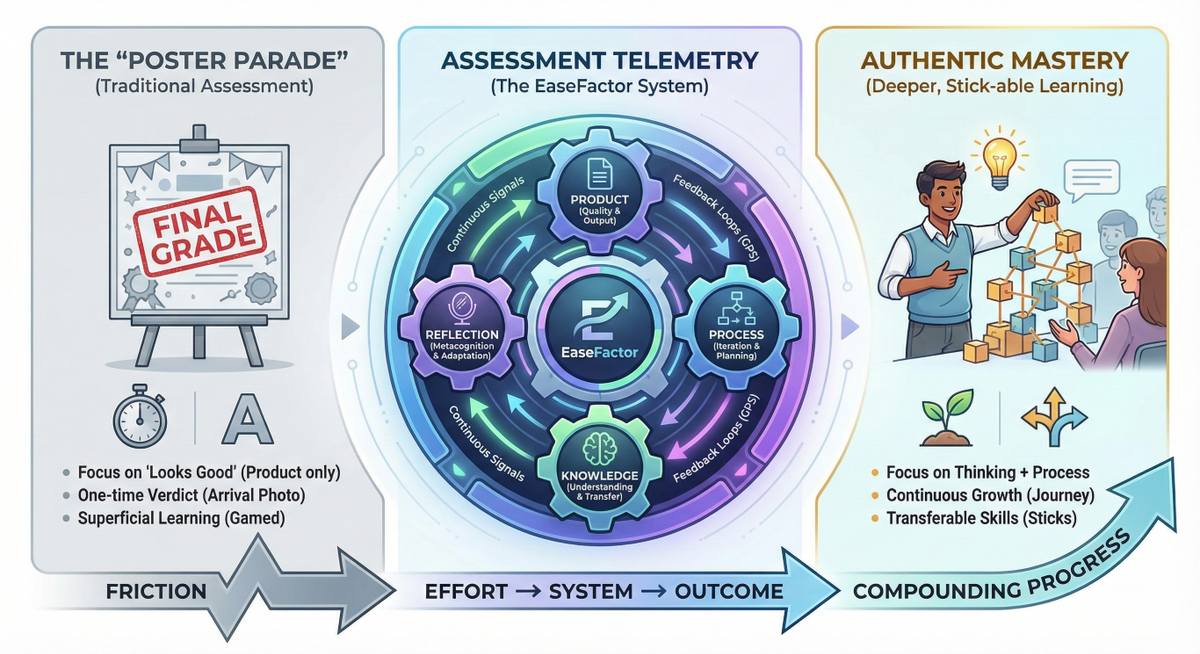
The friction nobody says out loud
A student can spend two weeks on a project, present something polished, and still forget half the science the next month.
Parents sense it too: "They worked so hard… why doesn't it show up in tests?" Teachers feel stuck: "If I grade only the final poster, I'm grading craft — not learning."
This is the Assessment Gap: traditional tests are optimized for memorization and recognition, while project work is designed to build research, collaboration, communication, and transfer. When assessment doesn't match the learning method, students adapt by gaming the visible scoreboard.
A named pattern: The Poster Parade
The Poster Parade is when projects become "decorate and present," and assessment becomes "looks good = good grade." Students learn an unintended lesson: presentation is performance; thinking is optional.
Projects don't fail because projects are bad. They fail because the assessment infrastructure is missing.
The core insight: assessment should be the servant of learning
In strong Project-Based Learning (PBL), the project is not an "activity." It's the vehicle for deep understanding — because students must generate, connect, apply, and explain knowledge in authentic contexts.
But that only happens when assessment is designed to do two jobs at once:
- Measure learning (what changed in understanding and skill)
- Drive learning (what students do next because of feedback)
This is why the most useful project assessments are continuous and formative — they guide the work while it's happening.
The science: why PBL works (and when it doesn't)
PBL aligns with several well-supported learning principles:
- Elaborative processing: projects force students to connect ideas, not just copy them.
- Generation effect: creating explanations, artifacts, or solutions strengthens memory more than recognition-based studying.
- Contextual learning & transfer: authentic tasks provide richer retrieval cues and make application more likely.
But there's a catch: implementation quality matters. Without structure and scaffolding, projects can drift into confusion or superficial coverage.
Assessment is a major part of that scaffolding. If you only grade the final outcome, students rationally ignore the deeper work.
The system: treat assessment like "telemetry," not a verdict
A helpful metaphor for families: A project is like a long road trip. A final grade is the "arrival photo." Assessment telemetry is the GPS: check-ins, signals, and course-corrections that keep you on track.
In a Study OS mindset, assessment isn't a punishment or prize. It's feedback infrastructure.
The 4-lens rubric (simple, scalable, student-friendly)
Instead of one giant rubric that overwhelms everyone, assess projects through four lenses:
- Product — Quality of the final deliverable. Evidence: Clear, accurate, audience-ready output.
- Process — How work was planned, iterated, improved. Evidence: Milestones met, drafts improved, teamwork visible.
- Knowledge — Subject understanding in use. Evidence: Explanations, correct reasoning, transfer to new examples.
- Reflection — Metacognition: "How did I learn?" Evidence: What changed, what was hard, what they'll do next.
This is multi-dimensional evaluation: it captures the complexity of project learning without pretending learning equals a single score.
The "don't shame" reframe (non-negotiable)
When a student underperforms on a lens (say, Knowledge), the message must be:
Errors are data, not identity.
Next action: "Let's write 3 things you can explain, 2 things you're unsure about, and 1 question you'll test tomorrow."
That turns weakness into a plan.
What this looks like on a Tuesday
Grade 7 Science (Ecosystems), 12 minutes after school
Goal: keep the project from becoming a Poster Parade.
- 4 minutes – Retrieval Sprint (Knowledge lens) — Student answers 6 quick recall questions from memory (no notes).
- 4 minutes – Milestone Check (Process lens) — Confirm today's micro-deliverable: "Add one data source + summarize in 3 bullets."
- 2 minutes – Peer/Parent mini-audience (Product lens) — Student explains the "one best slide/section" aloud. Listener asks: "Why?" once.
- 2 minutes – Reflection tag (Reflection lens) — Student writes: "Today I improved ___ by doing ___. Tomorrow I will ___."
Output is concrete: 6 answered questions + one micro-deliverable + one reflection tag.
That's how you get progress every session—without adding hours.
Where EaseFactor fits (without replacing effort)
A well-designed system makes project assessment easier to do consistently:
- Milestone check-ins reduce last-minute panic and make progress visible.
- Performance rubrics + portfolios make growth trackable across weeks (not just a final score).
- Peer review workflows train students to evaluate quality—an underrated learning multiplier.
- Metacognitive prompts build self-awareness so students don't become passengers in their own learning.
The point is not "more assessment." It's better signals — so projects reliably build mastery.
Try this today (10 minutes): "Rubric Telemetry Check"
Use this mid-project, not at the end.
Materials: a notebook or notes app.
- 2 min – Define today's "win" — "By the end of today, we will have ___."
- 3 min – 4-lens quick score (1–3 scale) — Product, Process, Knowledge, Reflection (no debating; quick gut-check).
- 3 min – Fix the lowest lens
- If Knowledge is lowest: write 5 recall questions and answer them.
- If Process is lowest: pick one micro-task and schedule it.
- If Product is lowest: improve one section for clarity (headline + example).
- If Reflection is lowest: write "I used to think ___. Now I think ___."
- 2 min – Set the next check-in — Put a reminder for the next 10-minute telemetry check.
Output: a 4-lens snapshot + one improvement action + next review scheduled.
A Calm Next Step
Traditional tests are snapshots. Projects are journeys. If you want projects to produce confident, transferable learning — not just impressive presentations — assessment must shift from judging at the end to guiding throughout.
That's the heart of EaseFactor's philosophy: effort → system → outcome, repeated until progress compounds.
TL;DR
- Projects build deeper learning when we assess process + thinking, not just the final product.
- The best project assessment works like "learning telemetry": frequent signals that guide improvement, not a one-time verdict.
- A simple 4-lens rubric (Product, Process, Knowledge, Reflection) turns projects into repeatable mastery.
Citations
- Dylan Wiliam: formative assessment and "assessment for learning"
- Black & Wiliam (1998): assessment and classroom learning
- Shepard (2000): assessment in a learning culture
- Darling-Hammond & Adamson: performance assessment for 21st-century skills
- Krajcik & Blumenfeld: PBL foundations
- Barron et al.: project/problem-based learning research
- Deci & Ryan (Self-Determination Theory): autonomy/competence/relatedness
- Herrington & Oliver: authentic learning design

Manoj Ganapathi
Founder and Builder of EaseFactor. Passionate about evidence-based learning and helping students build effective study habits through cognitive science principles.
Ready to Study Smarter?
EaseFactor uses these learning science principles to help you build lasting knowledge.