Building 21st Century Skills Through Projects: Future-Ready Learning
 Manoj Ganapathi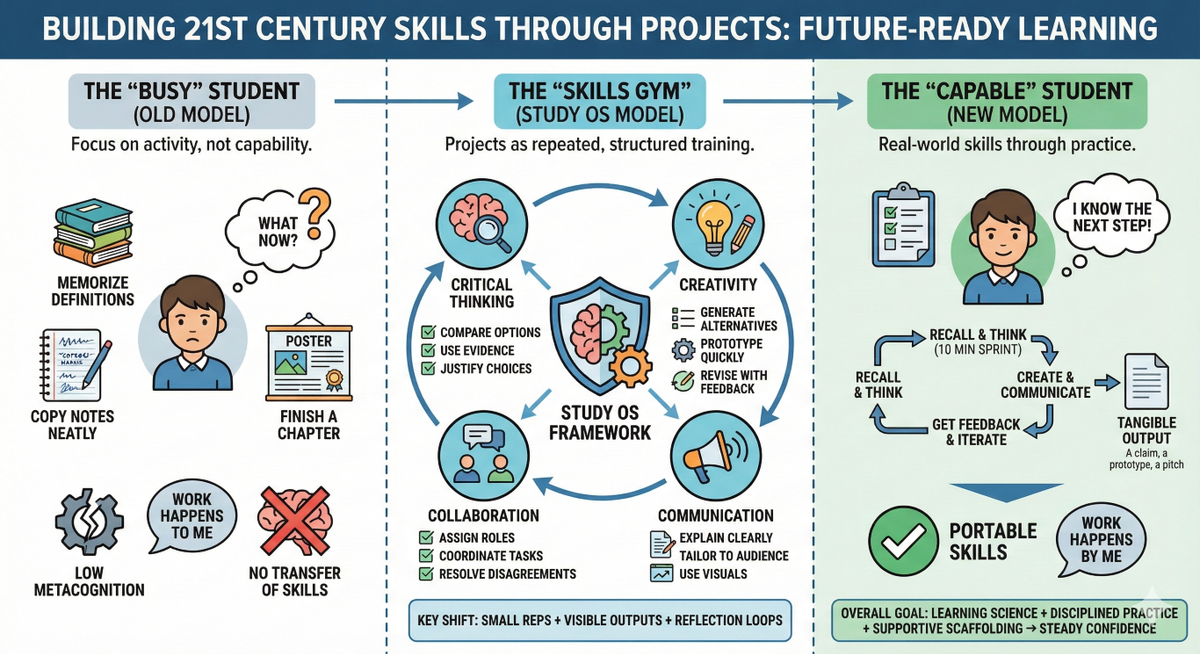
Most students are not "lazy." They're stuck in a system that rewards looking busy more than getting capable.
They can:
- memorize definitions
- finish a chapter
- copy notes neatly
…and still freeze when asked:
- "What should we do with this information?"
- "How do you know that source is trustworthy?"
- "Can you explain your reasoning to someone else?"
That gap is exactly what 21st century skills are about.
Diagnosis: what's really breaking
Common learning gaps behind weak 21st century skills:
- Illusion of fluency: "I read it, so I know it."
- Passenger problem (low metacognition): work happens to the student, not by the student (no planning, no monitoring, no adjusting).
- Performance-only habits: doing tasks to finish, not to improve.
- Cognitive overload: students don't know what to do next, so they do the easiest visible thing.
The recognizable pattern: The Poster Project Trap
A project becomes decoration instead of thinking:
- lots of cutting/pasting, formatting, coloring
- little evidence, reasoning, iteration, or reflection
It looks impressive, but the skill-growth is shallow.
Projects are not automatically powerful. Projects become powerful when they're run like training.
Refer to our previous blog for more details.
The insight: skills are outcomes of repeated behaviors, not "topics"
You don't teach "collaboration" the way you teach "photosynthesis."
Collaboration is a set of repeatable actions:
- assign roles
- coordinate tasks
- resolve disagreements
- merge work into one coherent output
Same for the other Cs. Skills emerge when students repeatedly practice the behaviors with feedback.
The science (lightweight, practical)
A few well-established learning principles matter here:
- Transfer is hard. Students often struggle to apply knowledge in new situations unless practice includes application and variation.
- Active recall beats passive review. If students must retrieve, explain, and defend ideas, they build stronger understanding.
- Feedback + iteration builds quality. One-shot work produces fragile learning; cycles produce durable skill.
Projects work when they force retrieval, decision-making, iteration, and explanation — not when they're just "make something."
The system: a "Skills Gym" inside a Study OS
Think of projects as a Skills Gym. The 4Cs are not posters on the wall — they are the workout plan.
EaseFactor's angle (and the bigger Study OS philosophy) is simple:
Effort becomes advantage when it's structured into repeatable sessions with clear outputs.
So instead of "Do a project on climate," the system becomes:
- small reps (short, specific tasks)
- visible outputs (something you can check)
- reflection loops (what worked, what didn't, what's next)
The 4Cs as "observable reps"
Here's how to turn the 4Cs into concrete student actions (and measurable outcomes):
Critical Thinking: Students compare options, use evidence, justify choices, and identify assumptions. Evidence includes a claim + 2 reasons + 1 counterpoint, source notes, and decision logs.
Creativity: Students generate alternatives, prototype quickly, and revise based on feedback. Evidence includes 3 solution drafts and "version 1 → version 2" improvements.
Collaboration: Students assign roles, split tasks, do check-ins, resolve conflicts, and merge work. Evidence includes role sheets, weekly 5-min standup notes, and peer feedback.
Communication: Students explain clearly, tailor to audience, and use visuals appropriately. Evidence includes a 2-minute explanation, a one-page brief, or a simple infographic.
This is the key shift:
- Symptom relief: "Do more projects."
- Infrastructure: "Run projects with a Study OS so skills compound."
Meaningful examples that don't depend on a specific "chapter"
21st-century skills examples land best when they feel like life, not like school pretending to be life.
Below are examples designed to be usable by students, educators, and parents — with explicit behaviors and outputs.
Example 1: Grade 4 — "The Playground Fix" (Collaboration + Communication)
Prompt: Our class wants one playground improvement. Choose one idea and persuade the principal.
Student actions:
- brainstorm 5 ideas (creativity)
- vote using 3 criteria (critical thinking)
- assign roles: researcher, designer, speaker, writer (collaboration)
- write a short proposal and present it (communication)
Outputs:
- a simple criteria table (safety, cost, fun)
- 1-page proposal
- 90-second pitch
Example 2: Grade 7 Science — "Microplastics: What should our school do?"
Time: Tuesday, 12 minutes after school (short session; not overwhelming)
Task (skills gym style):
- 2 min – Retrieval warm-up: Write 4 things you already know about plastics and pollution (no notes).
- 6 min – Evidence sprint: Find two sources (one article, one infographic/video transcript). For each: one claim it makes, one piece of evidence, one question you still have.
- 2 min – Decision: Choose one action the school could try (e.g., water refill stations, awareness campaign, waste audit).
- 2 min – Communicate: Record or write a 6-sentence message for a school audience.
Outputs:
- 2-source evidence notes
- 1 recommended action + reason
- 6-sentence message
Example 3: Grade 9 English/Social Studies — "Two sides, one solution" (Critical Thinking + Communication)
Prompt: Choose a community issue (screen time, traffic, plastic use). Write two opposing viewpoints fairly, then propose a balanced solution.
Student actions:
- steelman both sides (critical thinking)
- identify values behind arguments (metacognition)
- propose a compromise (creativity)
- present to a real audience (communication)
Outputs:
- "best argument for side A / side B" paragraph
- final recommendation with trade-offs
- short presentation slide or letter
How EaseFactor fits (without turning AI into a crutch)
A well-designed system uses AI the way a good coach uses questions:
- "What's your claim?"
- "What would change your mind?"
- "What's the counter-argument?"
- "How would you explain this to a younger student?"
AI should not replace thinking. It should structure thinking, reduce start-up friction, and increase practice reps.
That is the core EaseFactor idea:
Learning science + disciplined practice + supportive scaffolding → steady confidence.
Assessment that matches the goal
If the goal is the 4Cs, the assessment must look like performance, not only recall.
Good project assessment includes:
- rubrics with observable indicators (e.g., "uses evidence," "responds to feedback")
- portfolios showing improvement over time (versions matter)
- self-reflection ("What did I do when I got stuck?")
- peer feedback with specific prompts (not "good job")
When students can name what they practiced, skills become portable.
Try this today (10 minutes): the "4C Mini Sprint"
Use this when you want a project to build real skills, fast.
Choose any topic (from class or life): a chapter concept, a school issue, a news item.
- 2 min – Recall: Write 5 facts/ideas you remember (no notes).
- 3 min – Think: Write 1 claim + 2 reasons + 1 doubt/counterpoint.
- 3 min – Create: Draft 2 different ways to solve/explain it (two formats: diagram + paragraph, or story + bullet plan).
- 2 min – Communicate: Explain it in 4 sentences for a specific audience (friend, parent, younger student).
Specific output: one page containing Recall list + Claim block + Two drafts + Four-sentence explanation.
This routine is small, repeatable, and it compounds.
TL;DR
- 21st century skills don't grow from worksheets alone; they grow when students must use knowledge to solve meaningful problems.
- Projects are the "training ground" where Critical Thinking, Creativity, Collaboration, and Communication (the 4Cs) become observable behaviors.
- A Study OS makes projects reliable: smaller steps, clear outputs, and reflection loops that compound over time.
Citations
- Partnership for 21st Century Learning (P21) — Framework for 21st century learning
- Tony Wagner — The Global Achievement Gap (skills and "new survival skills")
- Trilling & Fadel — 21st Century Skills: Learning for Life in Our Times
- Bransford, Brown & Cocking (NRC) — How People Learn (transfer, deep understanding)
- Research on retrieval practice (e.g., Roediger & Karpicke) — why recall strengthens learning

Manoj Ganapathi
Founder and Builder of EaseFactor. Passionate about evidence-based learning and helping students build effective study habits through cognitive science principles.
Ready to Study Smarter?
EaseFactor uses these learning science principles to help you build lasting knowledge.