Building Your Word Power: Vocabulary Strategies That Stick
 Manoj Ganapathi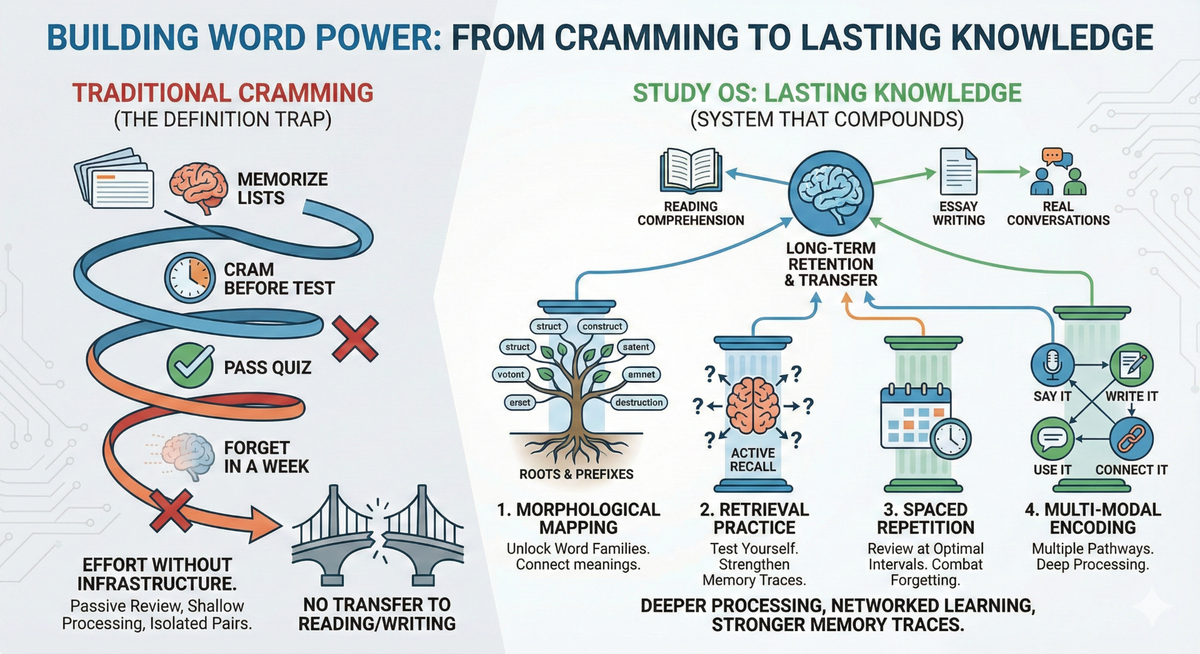
Why you can study vocabulary for hours and still blank on the test — and what actually makes words stick.
If you've ever memorized a word list the night before a quiz, aced it, and then forgotten everything by the following week, you've experienced the vocabulary paradox: effort without infrastructure.
Most students treat vocabulary like a sprint — cram the definitions, pass the quiz, move on. But words learned that way rarely show up when you need them most: in reading comprehension, essay writing, or real conversations.
The problem isn't your memory. It's your method.
EaseFactor exists to turn vocabulary learning from a forgettable chore into a system that compounds — where every word you learn connects to others, sticks longer, and actually becomes part of how you think.
The named pattern: The Definition Trap
The Definition Trap: A student memorizes "definition = word" pairs in isolation, passes the quiz, but can't recognize or use the word in a new context —because the word was never connected to anything meaningful.
The Definition Trap looks like this:
- "I knew it on the quiz but forgot it by the unit test."
- "I can define the word but don't understand it when I read it in a sentence."
- "I studied for an hour but still got confused by the reading passage."
The solution isn't more definitions. It's deeper processing — connecting words to roots, contexts, and other words you already know.
Quick diagnosis: why vocabulary cramming fails
When vocabulary learning struggles, students usually try one of two things:
- More repetition (write the word 10 times, stare at the flashcard longer)
- More lists (add more words to the pile, hoping volume will work)
Both are symptom relief, not infrastructure.
Symptom: "I can't remember vocabulary words."
Infrastructure gap: "I don't have a system that connects words to meanings in multiple ways."
| Passive approach | Why it feels productive | Why it fails |
|---|---|---|
| Re-reading definitions | Familiar = feels learned | No retrieval = weak memory trace |
| Writing words repeatedly | Effort = feels effective | Shallow processing = quick forgetting |
| Cramming before tests | Short-term recall works | No spacing = gone in a week |
| Matching columns | Easy success | No deep understanding = no transfer |
A Study OS fixes the infrastructure: it creates multiple pathways to each word— through roots, contexts, and retrieval — so vocabulary becomes part of your mental network.
The science: how vocabulary actually sticks
Research on vocabulary acquisition reveals three key principles that matter for students:
1) The Morphological Advantage
Morphological awareness — understanding word parts like roots, prefixes, and suffixes — is one of the most powerful vocabulary strategies. A 2025 meta-analysis found a reciprocal relationship: vocabulary knowledge builds morphological awareness, and morphological awareness accelerates vocabulary growth.
Here's why it matters: if you know that "bio" means life and "graph" means write, you can decode "biography," "biology," "biosphere," and dozens of other words — even ones you've never studied.
| Word part | Meaning | Example words |
|---|---|---|
| bio- | life | biology, biography, biodegradable |
| -graph/-graphy | write/writing | biography, geography, autograph |
| tele- | far/distant | telephone, television, telescope |
| -ology | study of | biology, psychology, geology |
| pre- | before | preview, predict, prepare |
| un- | not | unhappy, unclear, unfair |
Learning word parts is like getting master keys — one root unlocks many doors.
2) The Retrieval Advantage
Re-reading definitions feels productive. But research consistently shows that active retrieval — trying to remember without looking — creates stronger memory traces than passive review.
This is why flashcard apps that force you to recall before showing the answer outperform highlight-and-review methods. The mental effort of retrieval is the signal that builds memory.
3) The Spacing Advantage
Cramming works for tomorrow's quiz. Spacing works for next month's test — and for life.
Spaced repetition systems (like those built into EaseFactor) stretch the time between reviews just enough to make retrieval challenging but achievable. Each successful retrieval at a longer interval strengthens the memory trace more than multiple reviews crammed together.
Research on vocabulary retention shows students using spaced retrieval significantly outperform those using massed practice — even when total study time is the same.
The Study OS approach: building vocabulary networks
Here's how a Study OS transforms vocabulary learning from isolated definitions to connected knowledge:
1) Morphological Mapping (learn roots, unlock families)
Instead of learning words one at a time, group them by roots. Learn "struct" (build) once, and you've unlocked "construct," "destruct," "structure," "instruction," and "infrastructure."
EaseFactor surfaces word families together, so your brain builds networks instead of isolated points.
2) Context Anchoring (see words in action)
Definitions are starting points, not endpoints. True vocabulary knowledge means recognizing and using words in multiple contexts.
A Study OS provides:
- Example sentences showing the word in use
- Fill-in-the-blank practice in context
- Connections to reading passages where the word appears
3) Retrieval Rhythm (test yourself before you forget)
The best time to review a word is right before you'd forget it. Spaced repetition algorithms calculate this automatically, surfacing words at optimal intervals.
This means:
- New words appear frequently at first
- Well-known words space out to weekly, then monthly
- Struggling words get extra attention
4) Multi-Modal Encoding (multiple pathways, stronger memory)
Words stick better when processed multiple ways:
- Say it: pronunciation matters
- Write it: spelling reinforces recognition
- Use it: create your own sentence
- Connect it: link to synonyms, antonyms, or related words
A concrete Tuesday example (what this looks like in real life)
Grade 7 English (Unit vocabulary), Tuesday 5:00-5:12 pm (12 minutes)
Goal: Learn 5 new vocabulary words with lasting retention.
- 2 minutes — Root discovery (morphological mapping)
Today's root: "rupt" (break)
Write the root and meaning at the top of your page.
Output: 1 root with meaning noted.
- 4 minutes — Word family exploration
Find 3-4 words with this root: interrupt, erupt, rupture, corrupt
For each word, write: word + how "break" connects to the meaning
- Interrupt = break into (a conversation)
- Erupt = break out (like a volcano)
- Rupture = a break (in a pipe or organ)
Output: 3-4 words with root connections.
- 4 minutes — Retrieval practice (active recall)
Cover your notes. For each word, try to:
- Define it from memory
- Use it in a sentence
Mark confidence: High / Medium / Low
Output: 3-4 retrieval attempts with confidence ratings.
- 2 minutes — Schedule and connect
Add your lowest-confidence word to tomorrow's review queue.
Write one connection: "This word reminds me of ______ because ______."
Output: 1 scheduled review + 1 connection.
This is how a Study OS builds vocabulary: roots + context + retrieval + spacing. Twelve minutes, and the words have multiple anchors.
Try this today (10 minutes): The Word Power Routine
No cramming. No endless lists. Just strategic word learning.
Total time: 10 minutes
Required output: 1 root learned + 3 words connected + 3 retrieval attempts + 1 sentence created
- 2 minutes — Pick one root or prefix
Examples: un-, re-, pre-, -tion, bio-, graph-, port-, struct-
Write it down with its meaning.
- 3 minutes — Build the word family
Find 3 words that use this root.
For each word, explain how the root connects to the meaning.
- 3 minutes — Retrieval sprint (no peeking)
Cover your notes. For each word:
- Try to recall the definition
- Try to use it in a sentence
If you blank, put a dot next to it.
- 2 minutes — Deep process one word
Take your hardest word (the one with a dot).
Write your own sentence using it.
Schedule it for review in 2 days.
De-shaming reframe:
The dots aren't failures—they're targets. Every dot is a word your brain is ready to strengthen.
For parents: how to support vocabulary growth without drilling
- Ask for connections, not just definitions: "What root is that word from?" or "What other words share that part?"
- Use new words in conversation: When your child learns "interrupt," use it naturally: "Sorry to interrupt, but dinner's ready."
- Praise the process: "I like how you connected that word to other words you know."
- Avoid: Quizzing definitions in isolation ("What does 'benevolent' mean?").
- Better: "Can you think of a time someone was benevolent?"
Calm Next Step: make vocabulary learning compound
Vocabulary growth happens fastest when students have a structure that:
- connects words through roots and patterns,
- requires active retrieval instead of passive review,
- and spaces practice so learning compounds over time.
That's the heart of EaseFactor: a Study OS that transforms vocabulary from forgettable lists into lasting word power — where every word connects, every retrieval strengthens, and progress is visible.
Citations
- Nation, I.S.P. (2022): Vocabulary learning research, Learning Vocabulary in Another Language
- Cheng, Yin, & Zhang (2025): Meta-analysis on morphological awareness and vocabulary knowledge
- Sasao & Webb (2017): Morphological awareness and vocabulary learning
- Roediger & Karpicke (2006): Testing effect and retrieval practice
- Cepeda et al. (2006): Spacing effect meta-analysis
- Mayer multimedia learning principles: Dual coding and vocabulary
- Nagy, Carlisle, & Goodwin (2014): Morphological awareness research
- Dunlosky et al. (2013): Effective learning techniques review
TL;DR
- The Definition Trap keeps students memorizing isolated word-definition pairs that don't stick and don't transfer.
- Morphological awareness (learning roots and word parts) unlocks word families, making vocabulary learning exponentially more efficient.
- Retrieval practice + spaced repetition transforms vocabulary from short-term cramming to long-term knowledge.
- A Study OS connects all three — so every word you learn becomes part of a growing network, not an isolated fact.
- Vocabulary isn't about memorizing lists — it's about building mental networks where words connect to meanings, roots, and contexts.
- The fastest way to make words stick is a Study OS: retrieval practice + morphological awareness + spaced repetition.
- Your next step: a 10-minute "Word Power" routine that transforms vocabulary from cramming to lasting knowledge.

Manoj Ganapathi
Founder and Builder of EaseFactor. Passionate about evidence-based learning and helping students build effective study habits through cognitive science principles.
Ready to Study Smarter?
EaseFactor uses these learning science principles to help you build lasting knowledge.