The Transfer Triangle: From Understanding to Application to Adaptation
 Manoj Ganapathi
Why does a student who aced the unit test freeze when the same concept appears in a different context?
You've seen it happen. A student can perfectly recite the formula for calculating area. They score 95% on the rectangles worksheet. Then you ask them to figure out how much paint covers the wall - and they stare blankly.
This isn't a memory problem. They haven't "forgotten" the formula.
It's a transfer problem. The knowledge exists, but it's locked inside the specific format where it was learned. Change the wording, the context, or the application - and suddenly the student can't access what they know.
Most studying stops too early. Students learn to understand something in one context, maybe even apply it to familiar problems - but never develop the ability to adapt that knowledge when the situation changes.
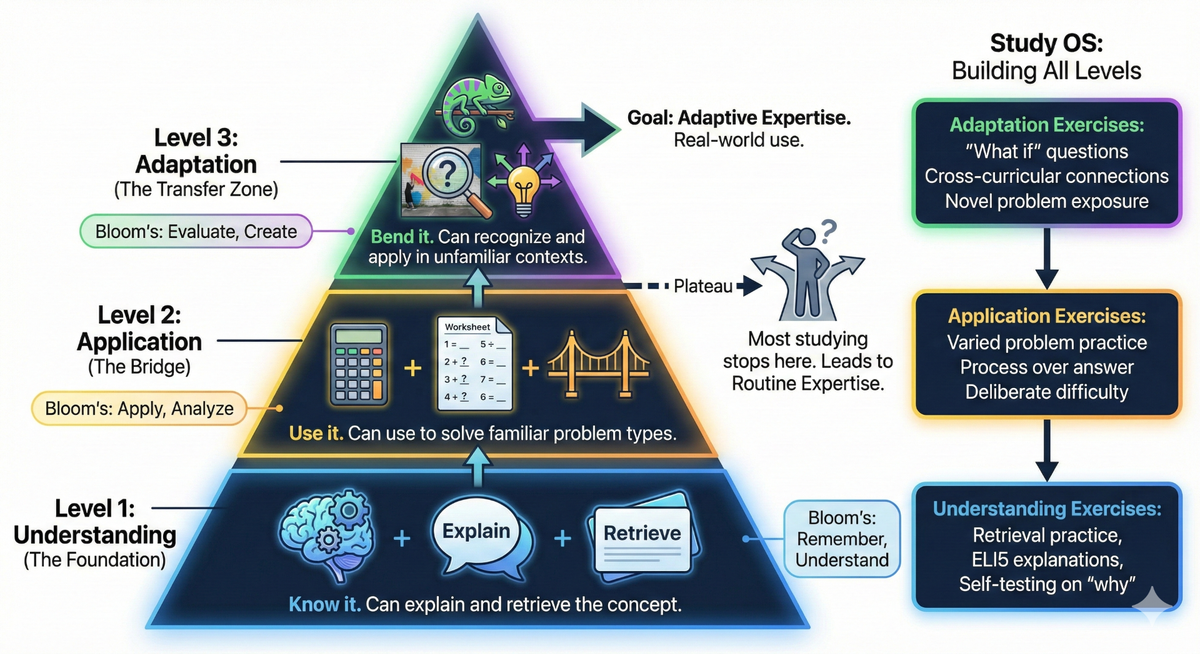
This post introduces a framework called The Transfer Triangle - a progression model that takes learning from understanding through application to adaptation. It connects three powerful learning science ideas: Bloom's Taxonomy levels, adaptive expertise research, and cross-curricular thinking.
Because the goal of learning isn't just to pass the test. It's to actually use what you know.
The named pattern: The Transfer Triangle
The Transfer Triangle: A progression model where learning advances through three stages:
(1) Understanding - you can explain and retrieve the concept;
(2) Application - you can use it to solve familiar problem types;
(3) Adaptation - you can recognize and apply the concept in unfamiliar contexts where it wasn't explicitly taught.
Most studying focuses heavily on Understanding (definitions, notes, recall) and some Application (practice problems that look like the examples). But the third stage - Adaptation - is where real expertise lives. And it's almost never trained.
Think of it as a triangle because each level supports the ones above it. You can't adapt what you don't understand. You can't apply what you can't retrieve. But understanding alone isn't the goal - it's the foundation.
Quick diagnosis: why students plateau at "I knew it but couldn't use it"
Students frequently describe a frustrating pattern: they studied hard, they understood the material, they could do the homework - but when the test asked the question differently, or when they needed the concept in another class, they couldn't access it.
| Symptom | What it looks like | What's actually missing |
|---|---|---|
| "I studied this but blanked" | Knows concept in one format, fails in another | Application practice - varied problem exposure |
| "I didn't know that counted" | Doesn't recognize concept in new contexts | Adaptation - cross-context recognition |
| "The test was unfair" | Problems differed from homework format | Transfer training - practice with novel contexts |
| "I can do it but not explain it" | Procedural without conceptual | Understanding - the "why" behind the "how" |
The hidden truth: Traditional studying optimizes for recognition in familiar formats. But exams, competitions, and real life require production in unfamiliar formats. That's a completely different skill - and it has to be trained.
The science: why transfer is hard and how to train it
Hatano & Inagaki: Routine vs. Adaptive Expertise
The distinction between two kinds of expertise was first identified by researchers Giyoo Hatano and Kayoko Inagaki. They noticed that some experts could perform procedures with great speed and accuracy, but struggled when conditions changed. Other experts could adapt their knowledge to new situations.
| Type | Characteristics | Limitation |
|---|---|---|
| Routine Expertise | Fast, accurate, automatic | Can only handle familiar problem formats |
| Adaptive Expertise | Flexible, conceptual, transferable | Slower to develop, requires deliberate practice |
The key difference? Adaptive experts understand why procedures work, not just how to execute them. This conceptual understanding allows them to modify their approach when the situation changes.
Three factors develop adaptive expertise:
- Varied contexts - Encountering problems that require adaptation
- Low-pressure exploration - Freedom to experiment without fear of failure
- Emphasis on understanding over speed - Prioritizing why over how fast
Bloom's Taxonomy: A Progression Map
Bloom's Taxonomy provides a useful map for the Transfer Triangle:
| Bloom Level | Transfer Triangle Stage | What it means |
|---|---|---|
| Remember, Understand | Understanding | Can define, explain, retrieve |
| Apply, Analyze | Application | Can use in familiar contexts |
| Evaluate, Create | Adaptation | Can modify, combine, transfer to new contexts |
The problem is that most studying stays at the first two levels. Students practice remembering and understanding, maybe some application - but rarely train the higher-order thinking that enables transfer.
Why Transfer Fails: The "Same Clothes" Problem
Research on transfer shows that knowledge is often encoded with its context. Students learn "area = length x width" in the context of math worksheets with clearly labeled rectangles. The knowledge becomes bound to that format.
When the same concept appears wearing different clothes - a word problem about painting, a science problem about cell surfaces, a design challenge about floor plans - the brain doesn't recognize it. The student has the knowledge but can't access it because the retrieval cues are missing.
The solution: Train recognition across contexts. Make the concept wear different clothes during practice.
The System: Building all three levels of the Transfer Triangle
Level 1: Understanding (The Foundation)
Understanding means you can retrieve and explain the concept - not just recognize it when you see it.
Study OS approach:
- Retrieval practice (not just rereading): Can you explain it without looking?
- ELI5 explanations: Can you teach it to someone younger?
- Self-testing on "why": Why does this work? What would happen if...?
Checkpoint question: "If someone asked me to explain this without notes, could I do it clearly?"
Level 2: Application (The Bridge)
Application means you can use the concept to solve problems - but still in recognizable formats.
Study OS approach:
- Varied problem practice: Don't just repeat the same type - mix formats
- Process over answer: Focus on why you chose each step
- Deliberate difficulty: Practice problems slightly harder than comfortable
Checkpoint question: "Can I solve problems that look different from the examples?"
Level 3: Adaptation (The Transfer Zone)
Adaptation means you can recognize and apply the concept when it appears in unfamiliar contexts - even contexts where no one told you to use this concept.
Study OS approach:
- Cross-curricular questions: Where else does this concept appear?
- "What if" variations: What if this variable changed? What if the context was different?
- Novel problem exposure: Practice problems you've never seen before
- Concept disguise training: Find the same concept in different "clothing"
Checkpoint question: "Could I use this if no one told me which concept applies?"
The Transfer Triangle Workout: Three exercise types
To train all three levels, use these exercise types in every study session:
1. Understanding Exercises (2-3 minutes)
- Retrieve and explain the core concept from memory
- Answer "why does this work?" in your own words
- Identify the conditions where this concept applies
2. Application Exercises (5-7 minutes)
- Solve 2-3 problems in varied formats
- For each, explain your reasoning (not just the answer)
- Identify which concepts you used and why
3. Adaptation Exercises (3-5 minutes)
- Answer one "what if" question that changes the context
- Find one connection to another subject
- Create one problem that uses this concept in a new way
This progression ensures you're not just memorizing - you're building the kind of flexible knowledge that actually transfers.
A concrete Tuesday example (what this looks like in real life)
Grade 7 Math (Percentages), Tuesday 5:00-5:12 pm (12 minutes)
Goal: Build transfer ability for percentage calculations.
1. Understanding (3 min)
Write from memory:
- What is a percentage? (definition)
- Formula for finding a percentage of a number
- Why does multiplying by 0.25 give you 25%?
Output: 3 retrieval answers + 1 "why" explanation
2. Application (5 min)
Solve three varied problems:
- "Find 15% of 80" (standard format)
- "A shirt costs $45 and is 20% off. What's the sale price?" (word problem)
- "Jake scored 36 out of 45 on a test. What percentage did he get?" (reverse calculation)
For each, write one sentence explaining your approach.
Output: 3 solutions + 3 reasoning sentences
3. Adaptation (4 min)
- What if: "A population grows by 15% each year. If it's 1000 now, what will it be in 2 years?" (compound percentage - new context)
- Cross-curricular: "Where do percentages appear in science?" (concentration, efficiency, growth rates)
- Concept connection: "How is finding 25% similar to finding 1/4?"
Output: 1 novel problem attempt + 2 connections
Total output: 3 understanding answers + 3 varied solutions + 1 transfer problem + 3 connections
Try this today (10 minutes): The Transfer Triangle Workout
A complete session that trains all three levels.
Total time: 10 minutes
Output: Understanding check + 3 varied applications + 1 transfer attempt
1. Pick one concept you're learning (1 min)
Something from this week's class. Write it at the top of your page.
2. Understanding check (2 min)
Without looking at notes:
- Write a one-sentence definition
- Write why this concept matters (when would you need it?)
If you can't do this, stop and study the concept first. Understanding is the foundation.
3. Three applications (5 min)
Solve three problems that use this concept:
- One easy (confidence builder)
- One medium (standard format)
- One different format (word problem, backwards, or visual)
Write one sentence after each: "I used [concept] because [reason]."
4. One transfer challenge (2 min)
Answer one of these:
- "What if [variable] was different? How would my approach change?"
- "What's another subject where this same idea appears?"
- "Create a problem using this concept that looks different from your homework."
De-shaming reframe:
If the transfer question was hard, that's exactly right. Transfer is supposed to feel harder than application - that's the desirable difficulty that builds adaptive expertise. You're training your brain to recognize concepts in disguise.
For parents: how to support transfer learning
Most homework practice stays at the Application level. Parents can help push toward Adaptation.
Questions that build transfer:
- "Where else might you use this?" (cross-context thinking)
- "What would change if [variable] was different?" (variation training)
- "Can you explain why this works, not just what to do?" (conceptual depth)
- "Is this similar to anything you learned in another class?" (cross-curricular)
Questions to avoid:
- "Did you get the right answer?" (focuses on product, not process)
- "That's not how they showed you" (discourages adaptation)
- "Just follow the steps" (trains routine expertise, not adaptive)
The parent's role:
You don't need to know the content. You just need to ask questions that push beyond "can you do the homework" to "could you use this if the situation changed."
The best question: "What would happen if...?"
Why this matters: The Olympiad Principle
Competition math, science olympiads, and challenging exams share one feature: they test transfer, not just application.
A student who has only trained Understanding + Application will feel blindsided. "We never learned this!" But the concepts were there - just wearing unfamiliar clothes.
The students who succeed aren't necessarily smarter. They've trained the third level. They've practiced recognizing concepts in disguise, modifying approaches for new contexts, and connecting ideas across domains.
This is adaptive expertise. And it's not a talent - it's a trained skill.
A Study OS that includes Transfer Triangle training doesn't just prepare students for tests. It prepares them for the kind of thinking that real challenges require.
Calm next step: Build knowledge that travels
The Transfer Triangle isn't about studying more. It's about studying across all three levels so your knowledge can actually go somewhere.
EaseFactor builds this progression into every learning session:
- Understanding: Active recall and self-explanation
- Application: Varied practice problems with reasoning
- Adaptation: Cross-curricular connections and "what if" challenges
A Personal Study OS turns knowledge into capability: not just what you can remember, but what you can actually use - in any context, under any conditions.
Because the goal isn't to pass the test. It's to own the knowledge.
Citations
- Hatano, G. & Inagaki, K. (1986): Two courses of expertise; routine vs. adaptive expertise
- Bloom, B. et al. (1956): Taxonomy of educational objectives; cognitive domain levels
- Anderson & Krathwohl (2001): Revised Bloom's Taxonomy
- Bransford & Schwartz (1999): Rethinking transfer; preparation for future learning
- Perkins & Salomon (1988): Teaching for transfer; low-road and high-road transfer
- Barnett & Ceci (2002): When and where do we apply what we learn? A taxonomy for far transfer
- Kapur (2008): Productive failure in learning mathematical concepts
- Chi, Feltovich & Glaser (1981): Categorization and representation of physics problems by experts and novices
TL;DR
- The Transfer Triangle is a three-stage progression: Understanding (know it) -> Application (use it) -> Adaptation (bend it to new contexts).
- Most students plateau at Application because studying rarely requires them to transfer knowledge to unfamiliar situations.
- A Study OS builds all three stages: retrieval practice for understanding, varied problems for application, and "what if" questions for adaptation.

Manoj Ganapathi
Founder and Builder of EaseFactor. Passionate about evidence-based learning and helping students build effective study habits through cognitive science principles.
Ready to Study Smarter?
EaseFactor uses these learning science principles to help you build lasting knowledge.