Thinking Like a Scientist: Inquiry Strategies for Science Class
 Manoj Ganapathi
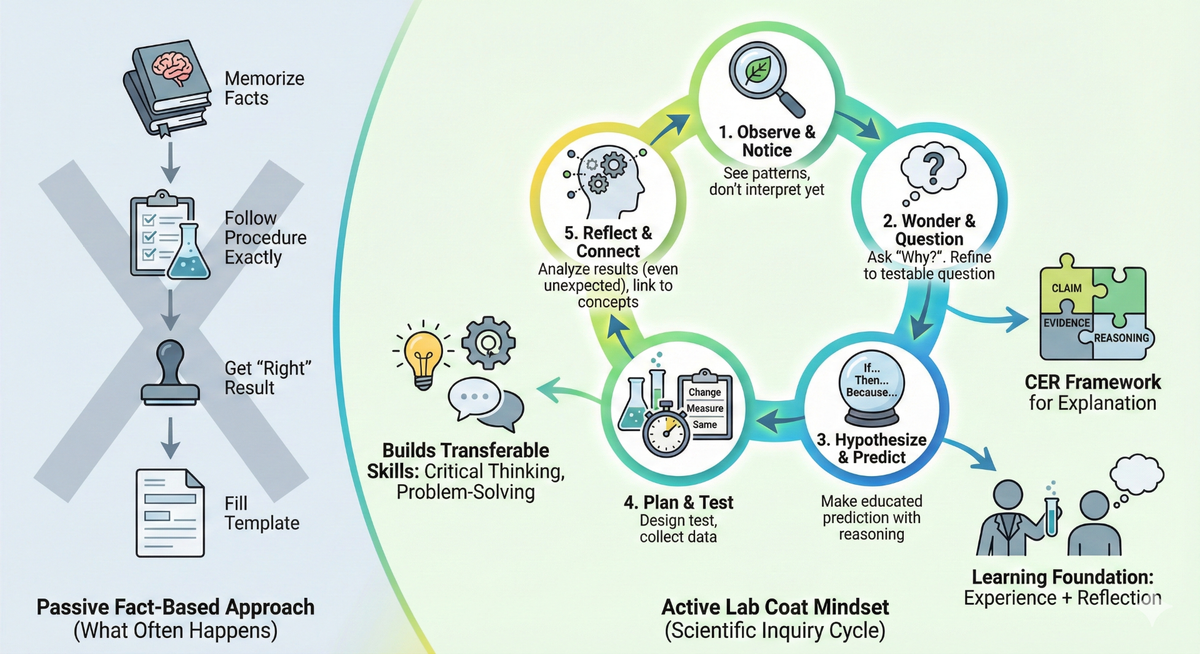
You memorized the periodic table. You can recite the steps of photosynthesis. So why does the lab report feel like a foreign language?
Science class has a secret that nobody tells students: knowing science facts and thinking scientifically are two completely different skills. You can ace a vocabulary quiz on cell organelles and still feel lost when asked to design an experiment or explain unexpected results.
The good news? Scientific thinking isn't a mysterious talent that some people have and others don't. It's a learnable approach to the world. Scientists don't have special brains. They have special habits of mind.
This post will give you those habits. Not more facts to memorize, but a system for approaching any science problem, lab report, or experiment with confidence.
The named pattern: The Lab Coat Mindset
The Lab Coat Mindset: The mental shift from passive learner ("tell me what to know") to active investigator ("let me figure out why"). Scientists don't just accept information. They observe, question, predict, test, and revise. This mindset is more important than any fact you'll memorize.
When you put on the Lab Coat Mindset, you stop waiting for the "right answer" and start asking:
- "What do I notice?"
- "What do I wonder?"
- "What would happen if...?"
- "How could I find out?"
The difference between students who struggle in science and students who excel isn't intelligence. It's this mindset shift from answer-seeker to question-asker.
Quick diagnosis: why science class feels different
Common symptoms:
- Does fine on vocabulary quizzes but struggles with lab reports
- Can recite steps of the scientific method but doesn't know how to apply them
- Feels lost during open-ended investigations
- Writes lab conclusions that just restate what happened without explaining why
- Gets confused when experiments don't work "the way they should"
What's actually missing (infrastructure):
- Observation skills (noticing details without jumping to conclusions)
- Question generation (turning curiosity into testable questions)
- Hypothesis formation (making educated predictions based on prior knowledge)
- Evidence evaluation (distinguishing what data shows from what you expected)
- Reasoning transparency (explaining your thinking, not just your answers)
Here's the uncomfortable truth: most science classes teach facts about science without teaching how to do science.
| What Science Class Often Teaches | What Scientific Thinking Requires |
|---|---|
| Memorize vocabulary and facts | Notice patterns and ask "why?" |
| Follow lab procedures exactly | Understand why procedures work |
| Get the "right" result | Learn from unexpected results |
| Fill in the lab report template | Explain your reasoning process |
| Study for the test | Build mental models you can apply |
The Lab Coat Mindset bridges this gap.
The science: why inquiry-based learning works
John Dewey's insight: learning is doing, not receiving
Over a century ago, educational philosopher John Dewey argued that real learning happens through experience and reflection, not through passive absorption of facts. His idea: students learn best when they actively investigate problems that matter to them.
Dewey's core principle: "We do not learn from experience. We learn from reflecting on experience."
This is why just doing a lab isn't enough. The learning happens when you stop to ask:
- "What did I observe?"
- "Was it what I expected?"
- "Why or why not?"
- "What does this tell me?"
Without reflection, experience is just activity. With reflection, experience becomes understanding.
Jerome Bruner's discovery learning: building your own knowledge
Psychologist Jerome Bruner showed that students who discover concepts remember them better than students who are simply told the concepts. His research on discovery learning found that:
- Active inquiry leads to deeper encoding than passive reception
- Students remember what they figure out better than what they're told
- The struggle of discovery builds transferable problem-solving skills
- Learning how to find answers is more valuable than learning answers
But here's the nuance: discovery learning works best with scaffolding. Students need just enough structure to guide inquiry without taking over the thinking. That's what this post provides.
The power of deductive and inductive reasoning
Scientific thinking uses two complementary reasoning styles:
| Reasoning Type | Direction | Science Example |
|---|---|---|
| Deductive | General rule -> Specific prediction | "All metals conduct heat" -> "This copper rod should conduct heat" |
| Inductive | Specific observations -> General pattern | "This copper rod, this iron pot, and this aluminum can all conduct heat" -> "Maybe all metals conduct heat" |
Scientists constantly move between these two modes:
- Observe specific cases (inductive starting point)
- Hypothesize a general pattern (inductive conclusion)
- Predict what should happen if hypothesis is true (deductive)
- Test the prediction (generates new observations)
- Revise the hypothesis if needed (back to inductive)
Students often get stuck because they've never been explicitly taught to move between these modes. The 10-Minute Hypothesis Habit (below) makes this movement automatic.
What we know about learning science specifically
Research on science education reveals several key findings:
- Prior knowledge matters enormously: Students come to science class with pre-existing ideas (sometimes misconceptions) that new information must connect with or challenge
- Hands-on doesn't mean minds-on: Activity without reflection produces no learning. The thinking during and after the activity is what matters
- Explaining is better than remembering: Students who explain why something happens understand it better than students who just remember what happens
- Productive failure helps: Students who struggle with a problem before being taught the solution outperform students who are taught first
The Study OS approach: building scientific thinking infrastructure
A Study OS for science doesn't just track what you've memorized. It builds the thinking habits that make science make sense.
1) Separate observation from interpretation
Before you can explain something, you need to observe it clearly. Most students jump straight to interpretation ("The plant died because it didn't get water") without first recording pure observations ("The plant's leaves turned brown and crispy; the stem became soft; the soil was dry and cracked").
Practice this habit:
- When you look at any science phenomenon (lab result, diagram, data), first write what you see
- Then write what you think it means
- Keep these separate. Good scientists know the difference between data and conclusions.
2) Turn curiosity into testable questions
Not all questions are testable. Scientific thinking means refining your curiosity into questions you can actually investigate.
| Untestable Question | Testable Version |
|---|---|
| "Why do plants need sunlight?" | "How does the amount of sunlight affect plant growth rate?" |
| "Is salt bad for plants?" | "What concentration of salt water causes visible damage to bean plants?" |
| "Which fertilizer is best?" | "Do tomato plants grow taller with organic or synthetic fertilizer over 4 weeks?" |
Notice the pattern: testable questions have:
- A variable you can change (independent variable)
- A variable you can measure (dependent variable)
- Something you keep the same (controlled variables)
3) Make predictions before looking at results
The brain learns more from surprising results than from expected ones. But you can only be surprised if you predicted something first.
Before any experiment, demonstration, or even reading a science text, write:
- "I think _____ will happen because _____."
This does two things:
- Forces you to activate prior knowledge (connects new learning to existing mental models)
- Creates a "prediction error" when wrong, which strengthens memory and corrects misconceptions
4) Use the "Claim-Evidence-Reasoning" framework
Scientists don't just state conclusions. They justify them. The CER framework trains you to think and write like a scientist:
- Claim: What do you conclude? (One clear statement)
- Evidence: What data supports this? (Specific observations or measurements)
- Reasoning: Why does this evidence support your claim? (Scientific principle that connects them)
Example:
- Claim: The mold grew faster in warm conditions than cold conditions.
- Evidence: After 5 days, the warm petri dish had 15mm of mold growth while the cold dish had only 3mm.
- Reasoning: Mold is a living organism that requires energy for growth. Warmer temperatures increase the rate of chemical reactions (including metabolism), allowing the mold to grow faster.
Notice how the reasoning explains why the evidence supports the claim. That's where scientific understanding lives.
5) Embrace "wrong" results
In most classes, wrong answers are bad. In science, unexpected results are interesting.
If your experiment doesn't go as expected, don't hide it. Ask:
- "What might have caused this result?"
- "Was my hypothesis wrong, or was my procedure flawed?"
- "What would I do differently next time?"
- "What new question does this result raise?"
Professional scientists spend most of their time with unexpected results. Learning to analyze them is a core scientific skill.
A concrete Tuesday example (what this looks like in real life)
Grade 7 Science (Ecosystems Unit), Tuesday 5:00-5:12 pm (12 minutes)
Goal: Build inquiry thinking skills, not just memorize ecosystem vocabulary.
- 3 minutes - Observe and wonder
- Open your science textbook or notes to today's topic (food webs)
- Look at the diagram for 60 seconds without reading any text
- Write 3 observations: "I notice..."
- Write 2 questions: "I wonder..."
- Output: 3 observations + 2 curiosity questions
- 4 minutes - Predict and read
- Pick one of your "I wonder" questions
- Write a prediction: "I think... because..."
- Now read the section looking for an answer
- Output: 1 prediction + notes on whether it was right
- 3 minutes - Explain with CER
- Pick one concept from the reading (e.g., "Removing a species affects the whole food web")
- Write a mini-CER:
- Claim: (One sentence stating the concept)
- Evidence: (One example from the reading)
- Reasoning: (Why this example proves the concept)
- Output: 1 complete CER explanation
- 2 minutes - Generate a testable question
- Based on what you learned, write one question that could be tested
- Example: "What would happen to the mouse population if we removed the owl from this food web?"
- Output: 1 testable question for review
Total output: 3 observations, 2 wonder questions, 1 prediction, 1 CER explanation, 1 testable question.
This 12 minutes builds more scientific thinking than an hour of passive reading.
Try this today (10 minutes): The Hypothesis Habit
Use this routine before, during, or after any science activity. It trains your brain to think scientifically without waiting for a lab assignment.
Total time: 10 minutes
Output: 1 science topic with complete inquiry cycle documented
Step 1: Observe and Notice (2 minutes)
Pick any science topic, phenomenon, or even something in your everyday life (weather, plant growth, cooking, sports physics).
Write three "I notice..." statements. Be specific. Focus on what you see, not what you think it means.
Examples:
- "I notice that my ice cream melts faster at the edges than in the middle."
- "I notice that the shadows are longer in the morning than at noon."
- "I notice that the fizz in soda disappears faster when the drink is warm."
Output: 3 specific observations
Step 2: Wonder and Question (2 minutes)
Turn your observations into "I wonder..." questions. Then refine at least one into a testable question.
For each observation, ask: "Why does this happen?" or "What affects this?"
Then make it testable: Include a variable you could change and a variable you could measure.
Example progression:
- Observation: "The fizz disappears faster in warm soda."
- Wonder: "I wonder why temperature affects fizz?"
- Testable: "Does soda lose carbonation faster at room temperature (20C) vs refrigerator temperature (4C) over 30 minutes?"
Output: 2-3 wonder questions + 1 testable question
Step 3: Hypothesize and Predict (2 minutes)
For your testable question, write a hypothesis using the "If... then... because..." format:
- If [I change the independent variable]
- Then [this will happen to the dependent variable]
- Because [scientific reasoning]
Example: "If I leave soda at room temperature instead of in the refrigerator, then it will lose fizz faster, because gas molecules move faster at higher temperatures and escape the liquid more easily."
This forces you to connect your prediction to a scientific principle.
Output: 1 complete hypothesis with reasoning
Step 4: Plan the Test (2 minutes)
Even if you won't actually do the experiment, planning it builds scientific thinking.
Answer:
- What would you change? (independent variable)
- What would you measure? (dependent variable)
- What would you keep the same? (controlled variables)
- How would you know if your hypothesis was right or wrong?
Output: Basic experimental design outline
Step 5: Reflect and Connect (2 minutes)
Write brief answers to:
- "What scientific concept does this connect to?" (Link to what you're learning in class)
- "What's one thing I'm still curious about?"
- "Where else might I see this principle at work?"
Output: 1 concept connection + 1 new curiosity + 1 real-world application
De-shaming reframe
If science has felt like memorizing foreign vocabulary, that's not your fault. Most science education emphasizes facts over thinking. The Lab Coat Mindset isn't something you should already have. It's something you're now building.
Every working scientist had to learn this too. The only difference is that you're learning it explicitly, which gives you an advantage.
For different types of science work
The Hypothesis Habit adapts to whatever you're doing:
For lab reports
Use the CER framework throughout:
| Lab Report Section | What to Include | Inquiry Skill |
|---|---|---|
| Introduction | Background + testable question + hypothesis | Question generation, hypothesis formation |
| Methods | What you did + why each step matters | Understanding procedure purpose |
| Results | What you observed (data, no interpretation yet) | Observation vs interpretation |
| Discussion | CER: Claim about results + evidence + reasoning | Evidence-based reasoning |
| Conclusion | Answer to original question + new questions raised | Reflection, curiosity |
The discussion section is where most students struggle. Use this formula:
- State your claim (what you concluded)
- Point to specific evidence (actual data/observations)
- Explain the scientific reasoning (why the evidence supports the claim)
- Address unexpected results honestly
- Suggest improvements or next questions
For science fair projects
The inquiry cycle IS the project:
- Observe the world around you for something you want to understand
- Question what you notice and refine into a testable question
- Hypothesize using "If... then... because..."
- Experiment with controlled variables and careful measurement
- Analyze data for patterns, not just "right" answers
- Conclude with CER + limitations + future questions
Science fair judges don't expect groundbreaking discoveries. They look for evidence of scientific thinking: Did you follow a logical process? Did you control variables? Did you draw conclusions supported by evidence? Did you learn from problems?
For reading science textbooks
Apply the Hypothesis Habit to reading:
- Before reading: Look at the section headings. Write predictions about what you'll learn.
- During reading: Mark observations ("I notice...") and questions ("I wonder...").
- After reading: Write one CER that explains a key concept from the section.
This transforms passive reading into active scientific thinking.
For studying for science tests
Don't just memorize facts. Practice explaining them:
- "Why does _____ happen?"
- "What evidence supports _____?"
- "What would change if _____?"
- "How does _____ connect to _____?"
Create your own questions, then answer them using CER format. If you can explain why, you understand it.
For parents: how to support scientific thinking at home
Do:
- Ask "What do you notice?" before asking "What does it mean?"
- Celebrate curiosity: "That's a great question. How could we find out?"
- Model wondering out loud: "I wonder why the sky looks red tonight?"
- When experiments fail, ask: "What did we learn from that?"
- Let them be wrong before correcting (prediction error helps learning)
Avoid:
- Jumping straight to explaining before they've observed
- Showing them the "right" way to do something before they've tried
- Treating unexpected results as failures
- Answering their questions before they've tried to figure it out
- Making science feel like there's always a "right answer" to find
Better reframe:
"Scientists don't know all the answers. They know how to ask good questions and find out. That's what you're learning to do."
The skills scientific thinking builds
Scientific thinking isn't just for science class. The Lab Coat Mindset transfers everywhere:
| Scientific Skill | Transfers To |
|---|---|
| Separating observation from interpretation | Critical thinking, media literacy |
| Generating testable questions | Problem-solving, research skills |
| Making and checking predictions | Decision-making, planning |
| Using evidence to support claims | Writing arguments, debates |
| Learning from unexpected results | Growth mindset, resilience |
| Explaining reasoning transparently | Communication, collaboration |
When you learn to think like a scientist, you're learning to think clearly in any domain.
Calm next step: make scientific thinking a habit
The Lab Coat Mindset doesn't develop from memorizing more facts. It develops from practicing the inquiry cycle until it becomes automatic.
EaseFactor's Study OS supports scientific thinking by:
- Tracking not just what you've studied but how you've thought about it
- Generating questions that push beyond recall to reasoning
- Building the habit of prediction, observation, and reflection
- Making the inquiry cycle visible so you can see your progress
The result? Science that feels less like foreign vocabulary and more like detective work, because now you have the mindset that makes discovery possible.
Citations
- Inquiry-Based Learning - John Dewey (1910, 1933): Experience and reflection as foundations of learning; "learning by doing"
- Discovery Learning - Jerome Bruner (1961): "The Act of Discovery"; students learn better when they figure things out; scaffolded inquiry
- Scientific Reasoning Development - Deanna Kuhn: Development of scientific thinking skills; argument and evidence evaluation
- Claim-Evidence-Reasoning Framework - Katherine McNeill & Joseph Krajcik: CER as tool for science writing and thinking
- 5E Instructional Model - Bybee et al. (BSCS): Engage, Explore, Explain, Elaborate, Evaluate cycle for science instruction
- Productive Failure - Manu Kapur: Learning benefits of struggle before instruction
- Misconceptions in Science - Rosalind Driver: Students' pre-existing ideas affect new learning
- Process Skills in Science - AAAS Science for All Americans: Observation, inference, hypothesis formation as core skills
- Inductive and Deductive Reasoning in Science - Lawson: Reasoning cycles in scientific inquiry
- Scaffolded Inquiry - Hmelo-Silver, Duncan & Chinn: Balancing guidance and discovery
Research notes
- Inquiry-based science instruction consistently shows positive effects on student learning when properly scaffolded (Furtak et al., 2012 meta-analysis)
- The key is not "pure discovery" but structured inquiry that gradually releases responsibility to students
- Explicit instruction in reasoning skills (not just content) produces transfer to new problems
- Writing-to-learn interventions in science (like CER) improve both understanding and writing quality
TL;DR
- Science class has two skills: knowing facts and thinking scientifically. Most students only practice the first.
- The Lab Coat Mindset shifts you from answer-seeker to question-asker: observe before explaining, question before concluding, test before believing.
- The 10-Minute Hypothesis Habit trains this mindset: Observe -> Wonder -> Hypothesize -> Plan -> Reflect.
- CER (Claim-Evidence-Reasoning) is how scientists explain their thinking. Practice it for lab reports and studying.
- Scientific thinking transfers everywhere. When you learn to think like a scientist, you're learning to think clearly about anything.

Manoj Ganapathi
Founder and Builder of EaseFactor. Passionate about evidence-based learning and helping students build effective study habits through cognitive science principles.
Ready to Study Smarter?
EaseFactor uses these learning science principles to help you build lasting knowledge.