The Science of Sequential Learning
 Manoj Ganapathi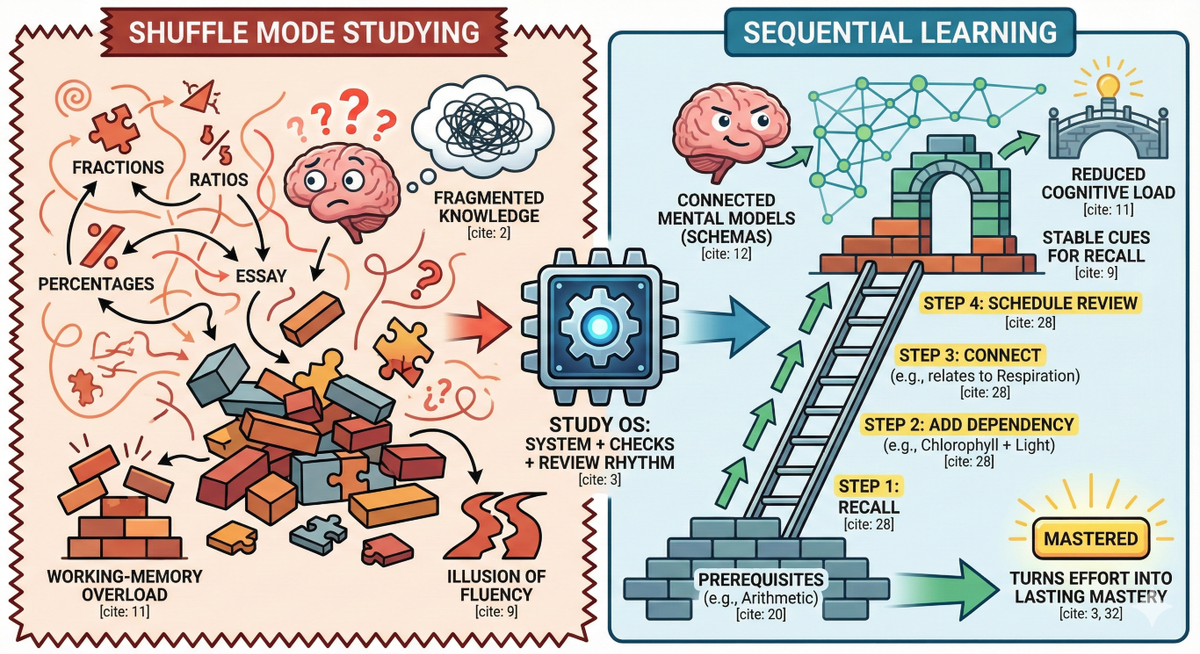
Most students don't fail because they're lazy. They fail because their learning is built like a house with missing bricks.
They watch a video on fractions, jump to percentages, skim a worksheet on ratios, then "revise" by rereading notes. It feels productive — but when a test question combines ideas, the brain can't find a stable path.
A named pattern: Shuffle Mode Studying
Shuffle Mode is when learning happens in the right topic area but in the wrong order — like listening to a story with chapters played randomly. You might catch lines, but you miss the plot.
Diagnosis: what's actually breaking
Here are the common learning gaps hiding underneath "I don't get it":
"I understand in class but forget later" — This usually means illusion of fluency (recognition ≠ retrieval). Sequenced steps create stable cues for recall.
"I can do easy questions, not mixed ones" — This usually means fragmented knowledge. Sequence builds schemas (connected mental models).
"I get overwhelmed fast" — This usually means working-memory overload. Sequence reduces cognitive load by chunking.
The science: your brain prefers paths, not piles
Sequential learning works because it matches how cognition is built:
1) Working memory is small
When too many "new" elements show up at once, the brain can't hold them all. Sequenced instruction reduces overload by introducing concepts in manageable chunks and stacking them.
2) Schemas are the real goal
A schema is a mental structure that makes thinking easier: you stop solving from scratch and start recognizing patterns. Sequencing helps students build schemas because each new idea connects to an existing one.
3) Transfer requires relationships, not memorization
When students learn in a logical progression, they're more likely to understand why something works, not just what to do — so they can apply it in new contexts.
The core idea: sequential learning doesn't just organize content. It organizes thinking.
Symptom relief vs infrastructure
Extra tutoring, more worksheets, and longer hours can help — especially short-term. But they often treat the symptom (today's confusion), not the infrastructure (how learning is built over time).
Nuance: Tutoring works best when paired with a Study OS — so every session follows prerequisites, checks understanding, and schedules review instead of adding more disconnected practice.
The Study OS view: learning has dependencies
Think of a curriculum like software:
- You can't run advanced apps without installing the right libraries.
- You can't build algebra fluency without stable arithmetic patterns.
- You can't write great essays without sentence control, paragraph logic, and argument structure.
Sequential learning is the "dependency map" that prevents fragile understanding.
What a good sequence looks like (example)
Math: Instead of mixing ratios, percentages, and fractions randomly, use a strong sequential progression: Fractions → equivalence → ratios → rates → percentages.
Science: Instead of memorizing terms before meaning, follow: Observe → explain → test → model → apply.
Writing: Instead of "write an essay" from day one, build up: Sentences → paragraphs → claims + evidence → essays.
What this looks like on a Tuesday
Grade 7 Science (12 minutes after school): Photosynthesis
Goal: Build the concept in sequence (not as isolated facts).
1) 2 min — Recall checkpoint (no notes)
Write answers to: "What do plants take in?" and "What do plants produce?"
Output: 2 short bullets.
2) 6 min — One-step build
Read a short section (or class notes) on chlorophyll + light energy, then write: "Because ___, therefore ___." (one causal sentence)
Output: 1 causal sentence.
3) 2 min — Connect to yesterday
Complete: "This relates to respiration because ___."
Output: 1 link.
4) 2 min — Schedule the next review
Put a reminder: "Photosynthesis recall (3 questions)" for 2 days later.
Output: a scheduled review.
This is sequential learning in practice: recall → add one dependency → connect → schedule.
A de-shaming reframe that matters
If your child (or you) "gets it wrong," that's not a character flaw.
Errors are data, not identity.
Next action (the next 5–10 minutes): identify which dependency is missing.
Use this quick prompt: "What did I need to know right before this step?"
That single question turns frustration into a fix.
How EaseFactor fits (gently)
EaseFactor's promise is simple: effort becomes advantage when it runs through a system.
Sequential learning is one of the pillars of that system:
- clear progressions (so students don't skip prerequisites)
- short mastery checks (so understanding is verified before moving on)
- built-in review rhythm (so today's learning survives next week)
Not to replace effort — but to make effort count.
Try this today (10 minutes): The Sequence Sprint
Purpose: Convert a messy topic into a dependency chain you can actually learn.
- 2 min — Pick one topic (Example: "Fractions to percentages.")
- 3 min — Build a 4-step ladder (Write: Step 1 → Step 2 → Step 3 → Step 4. If you're stuck, ask: "What must be true first?")
- 3 min — Make 4 retrieval questions (one per step) (Example: "What does equivalent fraction mean?" Output: 4 questions.)
- 2 min — Self-test immediately (Answer without notes. Mark weak steps with a star. Output: starred weak step(s) + next review scheduled.)
This is small, repeatable infrastructure — exactly what a Study OS is meant to provide.
TL;DR
- Learning sticks better when ideas arrive in a logical dependency order (each step supports the next).
- "Random" study often creates fragmented knowledge—you can recognize facts, but can't use them.
- A simple system (sequence + checks + review rhythm) turns effort into compounding progress.
Citations
- Cognitive Load Theory — John Sweller
- Working memory limits / capacity constraints — George A. Miller (and later working-memory research)
- Zone of Proximal Development & scaffolding — Lev Vygotsky
- Bloom's Taxonomy (hierarchy of cognitive skills) — Benjamin Bloom
- Instructional sequencing / First Principles of Instruction — M. David Merrill
- Schema theory (how knowledge structures form and support transfer)

Manoj Ganapathi
Founder and Builder of EaseFactor. Passionate about evidence-based learning and helping students build effective study habits through cognitive science principles.
Ready to Study Smarter?
EaseFactor uses these learning science principles to help you build lasting knowledge.