Test Day Tactics: Strategies for When You're Actually Taking the Test
 Manoj Ganapathi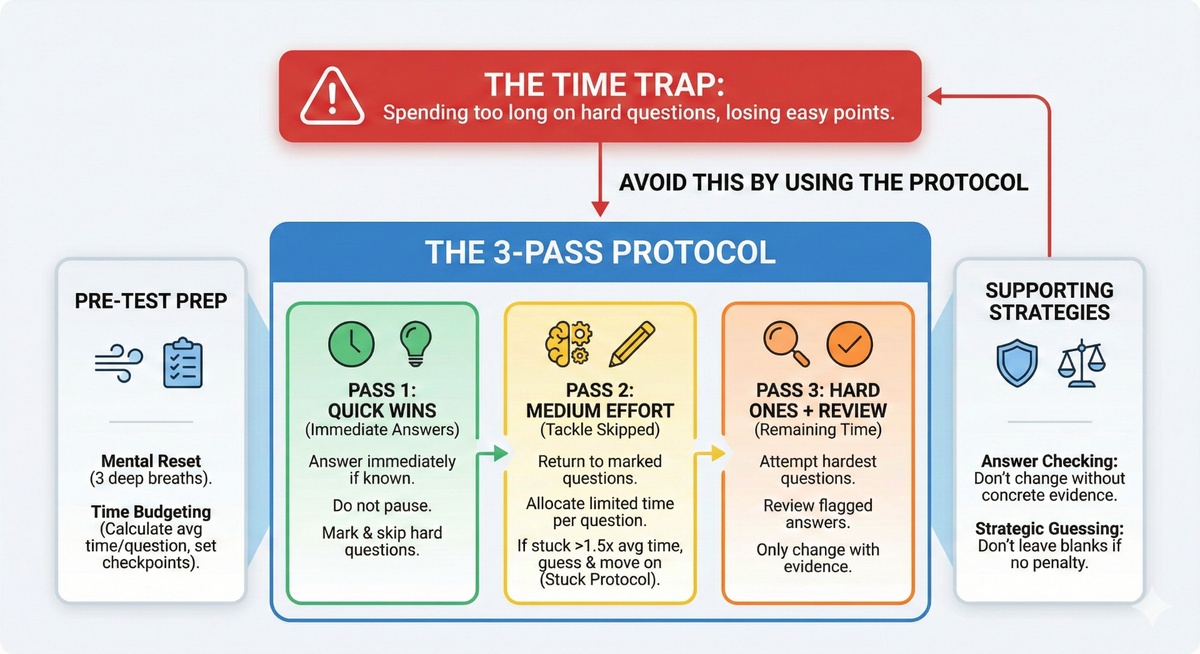
You studied for hours. You know the material. But somehow the test paper feels like a different subject entirely.
Here's a truth most students never hear: studying and test-taking are two separate skills. You can know everything and still lose points because of how you navigate the test itself.
Think about it. All those study strategies — active recall, spaced repetition, practice problems — they're for before the test. But what happens during the test? When the clock is ticking, when question 7 won't click, when you realize you've spent 15 minutes on one problem and there are 20 more to go?
That's where most students lose marks they've already earned through studying.
Test wiseness — the ability to use test format and time strategically — is a real, measurable skill. Research shows that two students with identical knowledge can score very differently based purely on how they take the test. The good news? Test-taking is trainable, just like any other skill.
The named pattern: The Time Trap
The Time Trap: When you spend so much time on difficult questions that you run out of time for questions you could easily answer — losing points you've already earned through studying.
Here's how it unfolds: You hit a hard question. You think, "I've spent 5 minutes on this already — I can't waste that time, I'll just figure it out." That's the sunk cost fallacy at work. Your brain treats the time already spent as an investment that you need to "protect," even when the mathematically correct move is to skip and return later.
Meanwhile, question 23 — which you could solve in 30 seconds — never gets answered because time runs out.
The Time Trap isn't about not knowing the material. It's about not knowing when to move.
Quick diagnosis: test-taking skills vs knowledge
When a student scores lower than expected, the instinct is usually: "They didn't study enough."
But often, the real issue is test-taking strategy:
Symptoms of weak test-taking skills:
- Runs out of time frequently
- Knows answers after the test ("I knew that!") but couldn't access them during
- Spends uneven time on questions (20 minutes on one, 30 seconds on another)
- Makes careless errors on easy questions
- Leaves questions blank that they could have answered
- Second-guesses correct answers and changes them to wrong ones
What's actually missing (infrastructure):
- A pre-test routine to manage nerves and focus
- A systematic approach to reading and triaging questions
- Time allocation rules (not just "don't run out of time")
- An answer-checking protocol that catches common errors
Tutoring and more study hours help with knowledge. A Study OS approach helps with applying that knowledge under pressure.
The science: what test wiseness research tells us
Researchers have studied "test wiseness" for decades, and the findings are clear: strategic test-taking is a measurable skill that can be taught.
1. Test wiseness is independent of content knowledge
Test wiseness describes the ability to use test characteristics and format strategically — regardless of content. A test-wise student can achieve a better result than a test-naive student, even with identical actual knowledge. This means some of your test score reflects how you took the test, not just what you knew.
2. Time allocation is a trainable skill
Studies show that effective test-takers allocate time per section, answer easy questions first (to secure quick points and build confidence), and use strategic guessing when there's no penalty for wrong answers.
Research also shows that the relationship between test-taking effort and performance depends heavily on whether students use appropriate time-based strategies. Simply spending more time doesn't help if that time is poorly allocated.
3. The anxiety-time connection matters
It's not just about whether there's a time limit — it's about the fit between a student's natural pacing style and the test structure. Some students ("clock timers") work better with clear time constraints that help them move forward. Others ("event timers") need to feel ready before moving on. Understanding your style helps you build better strategies.
| Research Finding | What It Means for Students |
|---|---|
| Test wiseness is a separate skill | You can know content AND still lose points on strategy |
| Easy-first strategies improve scores | Answer what you know quickly, then tackle hard questions |
| Time monitoring predicts performance | Students who check the clock strategically do better |
| Guessing helps when there's no penalty | Don't leave blanks; make educated guesses |
| Answer-changing is often harmful | First instincts are usually right; only change with new evidence |
The Study OS approach: treating test-taking as a trainable system
EaseFactor treats test-taking like any other skill: something you build through deliberate practice, not luck or natural ability.
1. Question Triage: The 3-Pass System
Most test errors come from answering questions in the order they appear. Instead, use three passes:
- Pass 1 (Quick wins): Answer everything you know immediately. Don't pause on anything hard. Mark questions you skip.
- Pass 2 (Medium effort): Return to questions that need a bit of thought. You now have context from the full test.
- Pass 3 (Hard ones + review): Tackle the hardest questions with remaining time. Then review flagged answers.
This system ensures you never lose easy points to time pressure.
2. Time Budgeting: Know Your Numbers
Before starting any test, calculate:
- Total time available
- Number of questions
- Average time per question
- "Checkpoint" times (at 25%, 50%, 75% completion)
Example: 60 minutes, 30 questions = 2 minutes per question average. At 15 minutes in, you should have completed roughly 7-8 questions.
3. The Stuck Protocol: When to Move On
If you've spent 1.5x the average time on any question and aren't making progress, apply the protocol:
- Mark your best guess
- Circle the question number
- Move on immediately
- Return only if time allows
The goal isn't to give up — it's to prevent the Time Trap from stealing points you've earned elsewhere.
4. Answer-Checking Strategy: Don't Change Without Evidence
Research consistently shows that first instincts are usually correct. Only change an answer if:
- You find specific evidence elsewhere in the test
- You catch a clear misreading of the question
- You remember a concrete fact (not a vague feeling)
"It feels wrong" is not a reason to change. "I see in question 15 that the answer must be X" is a valid reason.
5. Pre-Test Reset: Manage Your Mental State
The 2 minutes before a test sets your entire performance tone:
- Take 3 deep breaths (4-7-8 pattern: inhale 4, hold 7, exhale 8)
- Read question 1 with full attention (don't skim)
- Remind yourself: "I'll do my best pass first, then return."
A concrete Tuesday example (what this looks like in real life)
Grade 7 Science (Unit Test on Ecosystems), Tuesday 9:15 AM (45-minute test)
Before the test (2 minutes):
- Quick time calculation: 45 min / 25 questions = ~1.8 min each
- Set checkpoints: Q7 at 10 min, Q12 at 20 min, Q19 at 30 min
- Three breaths. "Quick wins first, then return."
Pass 1 — Quick Wins (12 minutes):
- Read each question, answer immediately if you know it
- Skip anything requiring thought — circle it and move on
- Output: 15 questions answered, 10 circled for return
Pass 2 — Medium Effort (18 minutes):
- Return to circled questions
- For each, read carefully, eliminate wrong answers, choose best option
- If stuck for more than 2 minutes, mark best guess and star for Pass 3
- Output: 8 more questions answered, 2 starred for Pass 3
Pass 3 — Hard Ones + Review (15 minutes):
- Tackle the 2 starred questions with remaining knowledge
- Review all answers — check for skipped questions, obvious errors
- Output: All 25 questions answered, flagged answers reviewed
Total: Complete test with time-appropriate effort on each question, no Time Trap casualties.
Try this today (10 minutes): The 3-Pass Practice Protocol
Practice test-taking strategy with any practice test, quiz, or even homework problems.
Total time: 10 minutes
Output: Completed practice using 3-pass system + time tracking data
Step 1: Setup (1 minute)
- Choose 10 practice problems (any subject)
- Set timer for 8 minutes total
- Calculate: ~45 seconds per problem average
Step 2: Pass 1 — Quick Wins (3 minutes)
- Scan all 10 problems
- Answer any you know immediately
- Circle numbers you skipped
- Target: 5-6 completed
Step 3: Pass 2 — Medium Effort (3 minutes)
- Return to circled problems
- Give each 30-45 seconds of focused thought
- Mark best guess if still stuck
- Target: 3-4 more completed
Step 4: Pass 3 — Finish + Review (2 minutes)
- Complete remaining problems
- Quick scan: any obvious errors? Skipped questions?
- Target: All 10 answered
Step 5: Debrief (1 minute)
Write down:
- "I completed __/10 problems"
- "I got stuck on: ______"
- "Next time I'll: ______"
Repeat this protocol 2-3 times before any real test. You're training your brain to triage automatically.
For parents: how to support test-taking skills without adding pressure
- Ask about strategy, not just content: "Did you use your 3-pass system?" is better than "Did you know the answers?"
- Praise recovery, not perfection: "You noticed you were stuck and moved on — that's the skill."
- Practice the protocol together: Run through a practice test using the 3-pass method so it feels familiar
- Don't emphasize time pressure: "You have plenty of time if you use it wisely" beats "Don't run out of time!"
- Normalize strategic guessing: "Leaving it blank is worse than a smart guess" removes shame from uncertainty
Calm Next Steps: make test-taking easier to practice
Knowing your material is step one. Knowing how to demonstrate that knowledge under test conditions is step two — and it's often the missing piece.
EaseFactor's Study OS approach means practice tests come with:
- Built-in time tracking so you learn your natural pace
- AI-generated quizzes that simulate test conditions
- Review sessions that reveal patterns (Do you always run out of time? Miss the same error types?)
Your effort deserves to show up on test day. A Study OS makes sure it does.
Citations
- Test wiseness research: General test-taking strategy literature, including work on strategic test behaviors independent of content knowledge
- Sunk cost fallacy in decision-making: Research on how time investment affects willingness to move on from unproductive tasks
- Time allocation strategies: Studies showing that answering easy questions first and monitoring time predicts better performance
- Answer-changing research: Meta-analyses showing first instincts are usually correct; changes should be evidence-based
- Test anxiety and time pressure: Research on the relationship between pacing style (clock-timers vs event-timers) and test performance
- Dunlosky et al. (2013): Review of effective learning and test-taking strategies
- Test preparation impact: Research distinguishing content learning from test-wiseness training
TL;DR
- Test-taking is a skill separate from knowledge — and most students never practice it directly.
- The Time Trap is spending too long on hard questions, losing easy points you've already earned through studying.
- The 3-Pass Protocol (quick wins → medium effort → hard + review) prevents the Time Trap and matches effort to difficulty.
- Practice the protocol before real tests so triage becomes automatic, not stressful.

Manoj Ganapathi
Founder and Builder of EaseFactor. Passionate about evidence-based learning and helping students build effective study habits through cognitive science principles.
Ready to Study Smarter?
EaseFactor uses these learning science principles to help you build lasting knowledge.