The One-Page Summary: How Shrinking Your Notes Grows Your Understanding
 Manoj Ganapathi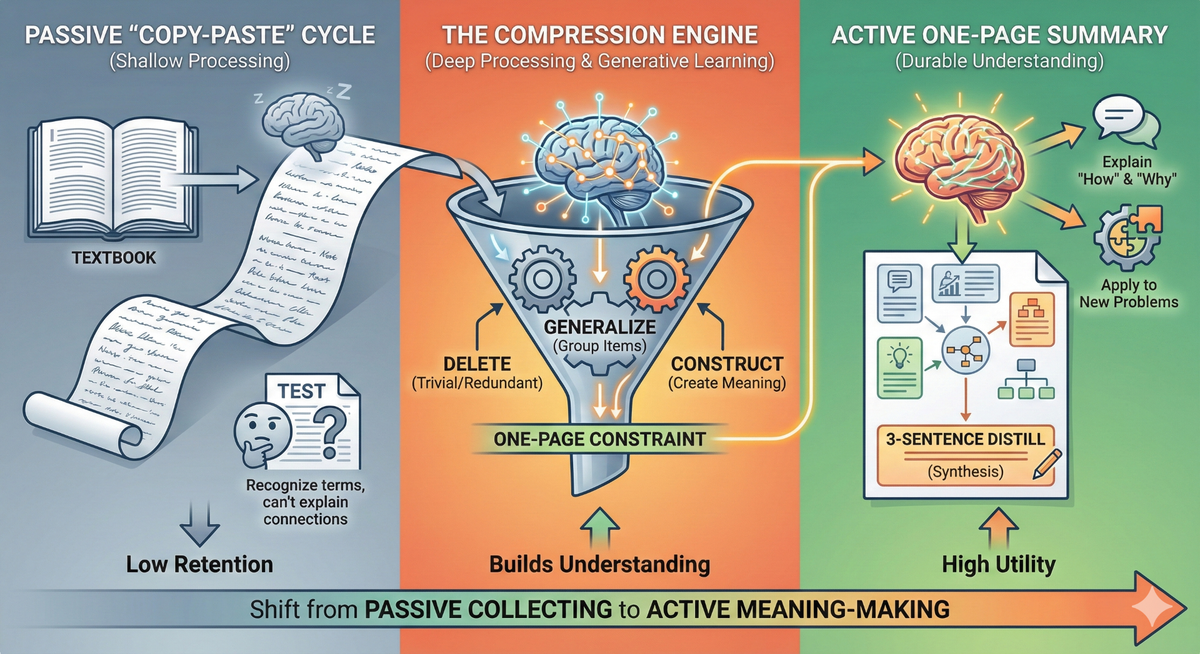
Why your notes keep getting longer — but your understanding doesn't.
You finished the chapter. You've got two full pages of notes. Every key term is there, every definition, every example the teacher mentioned. It looks thorough. It feels productive.
Then the test asks you to explain how photosynthesis connects to cellular respiration, and you freeze — because your notes told you what each process is, but never forced you to figure out how they fit together.
The problem isn't that you didn't write enough. It's that you wrote too much —and your brain never had to do the hard work of deciding what actually matters.
The named pattern: The Copy-Paste Notes
The Copy-Paste Notes: You write down everything the teacher says or the textbook contains — definitions, examples, bullet points — creating a near-duplicate of the source material that looks like studying but keeps your brain in copy mode instead of thinking mode.
Here's the cycle:
- You read a section and write down anything that seems important
- "Important" starts meaning everything because you're afraid to miss something
- Your notes grow to match the original text in length
- When you review, you're re-reading your notes — which is just re-reading the textbook with extra steps
- Test day arrives and asks you to use the information, not recite it
- You can recognize terms but can't explain relationships or solve new problems
The Copy-Paste Notes feel safe because they capture everything. But capturing everything means deciding nothing — and deciding is exactly where learning happens.
Quick diagnosis: symptoms vs infrastructure
Symptoms you may notice:
- "I have great notes but I still don't do well on tests"
- "I don't know what's important — everything seems important"
- "I can find it in my notes but I can't explain it without looking"
- "My notes are really long but I never go back and read them"
What's actually missing:
Not more notes — better compression. The skill of summarizing forces your brain to:
- Select: What's the core idea versus supporting detail?
- Organize: How do these ideas connect to each other?
- Integrate: How does this fit with what I already know?
These three operations are exactly what tests measure. A Study OS that trains summarization builds the processing muscles that passive note-taking never exercises.
The science: why shrinking builds understanding
Generative learning: your brain as meaning-maker (Wittrock)
Merlin Wittrock's generative learning theory explains why summarization works: learning isn't about receiving information — it's about generating meaning from it.
When you summarize, you're not copying. You're doing four things simultaneously:
- Selecting the most relevant information
- Organizing it into a coherent structure
- Integrating it with what you already know
- Generating new connections the original text didn't explicitly state
This is fundamentally different from note-taking. Notes record what someone else organized. Summaries reflect your organization — and that personal construction is what creates durable understanding.
The macrorules: how expert summarizers think (Kintsch & van Dijk)
Walter Kintsch and Teun van Dijk identified three mental operations — called macrorules — that skilled summarizers use:
Ann Brown and Jeanne Day tested these rules with students from elementary school through college and found something striking: even college students struggled with the two hardest rules — generalization and construction. Most students could delete obvious filler, but far fewer could compress multiple ideas into a single, accurate statement.
The good news? These rules are trainable. Students who were explicitly taught the macrorules produced dramatically better summaries — and, more importantly, better comprehension — than those who just practiced without guidance.
The summarization paradox (Dunlosky et al.)
In their landmark 2013 review of ten learning techniques, John Dunlosky and colleagues rated summarization as "low utility" — but with an important caveat. Summarization only underperformed when students didn't know how to do it effectively. Students who received training in summarization strategies showed significant improvements in both summary quality and comprehension.
The issue isn't that summarization doesn't work. It's that most students have never been taught how to summarize — so they default to copying with fewer words instead of compressing with deeper thinking.
Self-questioning beats passive summarizing (King)
Alison King's 1992 study compared three strategies: self-questioning, summarizing, and reviewing notes. Summarizers recalled more content on an immediate test, but self-questioners performed better on a retention test one week later.
The insight? The best summaries are the ones that answer questions. When you summarize by asking "What's the main claim here?" and "How does this connect to what came before?" — you're combining summarization with self-questioning, getting the benefits of both.
Levels of processing: depth beats volume (Craik & Lockhart)
Fergus Craik and Robert Lockhart's levels of processing framework explains why a one-page summary outperforms five pages of notes. What determines how well you remember isn't how much you write — it's how deeply you process while writing.
The one-page constraint works because it forces deep processing. You literally cannot fit everything, so you must make choices — and every choice is a thinking act.
The Study OS approach: why a Study OS beats more note-taking
A Study OS turns summarization from a vague instruction ("summarize the chapter") into a structured, repeatable process:
- Constraint-driven processing: The one-page limit isn't arbitrary — it forces the deletion, generalization, and construction that build understanding
- Question-first summaries: Start with "What are the 3 most important ideas?" instead of "What should I write down?" — this activates self-questioning alongside summarization
- Visible compression ratio: Tracking how many pages of source material you compressed into one page gives you a concrete metric for processing depth
- Iterative refinement: Revisit your one-page summary after a day and try to shrink it further — each compression pass deepens understanding
- Connection mapping: Your summary should show how ideas relate, not just what they are — arrows, groupings, and hierarchies make relationships visible
A concrete Tuesday example (what this looks like in real life)
Grade 7 Science (Ecosystems and Food Webs), Tuesday 4:15 PM (12 minutes)
Maya just finished a chapter on ecosystems that covered producers, consumers, decomposers, food chains, food webs, and energy transfer. Her textbook notes are two pages long.
- Close the textbook, grab a blank page (1 min): Maya puts away her notes and the textbook. She writes "Ecosystems & Food Webs" at the top of a single blank page.
- Brain dump the big ideas (3 min): Without looking at anything, Maya writes down everything she remembers about the chapter. She gets: "producers make energy from sun, consumers eat other things, decomposers break down dead stuff, energy flows one way, food webs are connected food chains."
- Open notes and fill gaps using the macrorules (5 min): Now Maya opens her textbook and compares. She notices she forgot about trophic levels and the 10% energy rule. She adds these, but instead of copying definitions, she writes: "Only 10% of energy moves up each level → that's why there are more producers than top predators." She groups related concepts together and draws arrows showing energy flow direction.
- Write a 3-sentence summary at the bottom (3 min): Maya writes: "Ecosystems run on energy that flows from sun → producers → consumers → decomposers, losing 90% at each step. Food webs show how organisms are connected through multiple overlapping food chains. If one species disappears, the web doesn't collapse—it reroutes, but with less efficiency."
Output: One page with grouped concepts, arrows showing relationships, and a 3-sentence summary that demonstrates understanding — not just recognition. Maya can now explain why there are more rabbits than wolves without looking at her notes.
Try this today (10 minutes): The One-Page Distill
Total time: 10 minutes
Output: One summary page + 3-sentence compression
Step 1: Close everything (1 min)
Put away notes, textbook, and devices. Take one blank sheet of paper. Write the topic at the top.
Step 2: Brain dump from memory (3 min)
Write everything you remember about the topic. Don't worry about order or completeness. This is retrieval practice—pulling from memory strengthens the connections.
Step 3: Open and compress (4 min)
Now open your source material. Use the three macrorules:
- Delete: Cross out anything trivial or repeated in your dump
- Generalize: Replace lists of specific items with category names
- Construct: Write a connecting statement for each major idea group
Fit everything on the one page. If you're running out of room, that means you need to compress more — which is exactly the point.
Step 4: The 3-sentence test (2 min)
At the bottom of your page, write a 3-sentence summary of the entire topic. If you can do this without looking at your notes above, you've processed deeply. If you can't, circle what you're missing — that's your study target for tomorrow.
For parents: how to support summarization without doing it for them
- Ask "What's the one-page version?" instead of "Did you study?" — this gives your child a concrete task rather than an open-ended obligation
- Resist the urge to correct their summary — the value is in their compression process, not in having a perfect document. If something important is missing, ask "Is there anything about [topic] you're not sure about?" instead of pointing it out
- Celebrate the ratio, not the length — "You turned 8 pages into 1? That's serious thinking" is more motivating than "Did you get everything?"
- Model it yourself — summarize a news article, a recipe, or a meeting into three sentences at dinner. When kids see adults compressing information, it normalizes the skill
Calm next step: make summarization a Study OS habit
EaseFactor helps you build the one-page summary into your regular study rhythm — not as extra work, but as the replacement for passive re-reading.
Instead of reviewing notes before a test (shallow processing), you create a fresh one-page summary from memory (deep processing). Instead of wondering whether you understand a chapter, you have a concrete artifact that proves it — or reveals exactly where you're stuck.
The one-page constraint isn't about limitations. It's about forcing your brain to do the work that makes learning stick: selecting what matters, organizing how it connects, and generating meaning that's truly yours.
Small wins. Visible progress. Repeatable system.
TL;DR
- Summarization is compression, not copying — shrinking information forces your brain to select, organize, and connect ideas, which is where real understanding happens.
- A Study OS uses the one-page constraint to turn passive note-collectors into active meaning-makers who can explain what they've learned, not just recognize it.
- Your next step: the 10-minute "One-Page Distill" routine that turns any chapter into a one-page understanding check.
Citations
- Dunlosky, Rawson, Marsh, Nathan & Willingham (2013): Comprehensive review of ten learning techniques; rated summarization as "low utility" for untrained students but noted significant benefits when summarization strategies are explicitly taught. Psychological Science in the Public Interest, 14(1), 4–58.
- Wittrock, Merlin (1989, 1992): Generative learning theory—learning requires actively generating meaning through selection, organization, and integration, not passively receiving information. Educational Psychologist.
- Kintsch & van Dijk (1978): Proposed macrorules for text comprehension and summarization—deletion, generalization, and construction—as the cognitive operations that transform text into understanding. Psychological Review, 85(5), 363–394.
- Brown & Day (1983): Demonstrated that summarization rules are trainable and that students at all levels struggle with generalization and construction without explicit instruction. Journal of Verbal Learning & Verbal Behavior, 22.
- King, Alison (1992): Compared self-questioning, summarizing, and note-taking review; found summarizers recalled more immediately but self-questioners retained more after one week—suggesting the best approach combines both. American Educational Research Journal.
- Craik & Lockhart (1972): Levels of processing framework—deeper semantic processing produces stronger, more durable memories than shallow surface-level encoding. Journal of Verbal Learning & Verbal Behavior, 11, 671–684.

Manoj Ganapathi
Founder and Builder of EaseFactor. Passionate about evidence-based learning and helping students build effective study habits through cognitive science principles.
Ready to Study Smarter?
EaseFactor uses these learning science principles to help you build lasting knowledge.