The Missing "Operating System": Why More Tutoring Won't Solve Student Burnout
 Manoj Ganapathi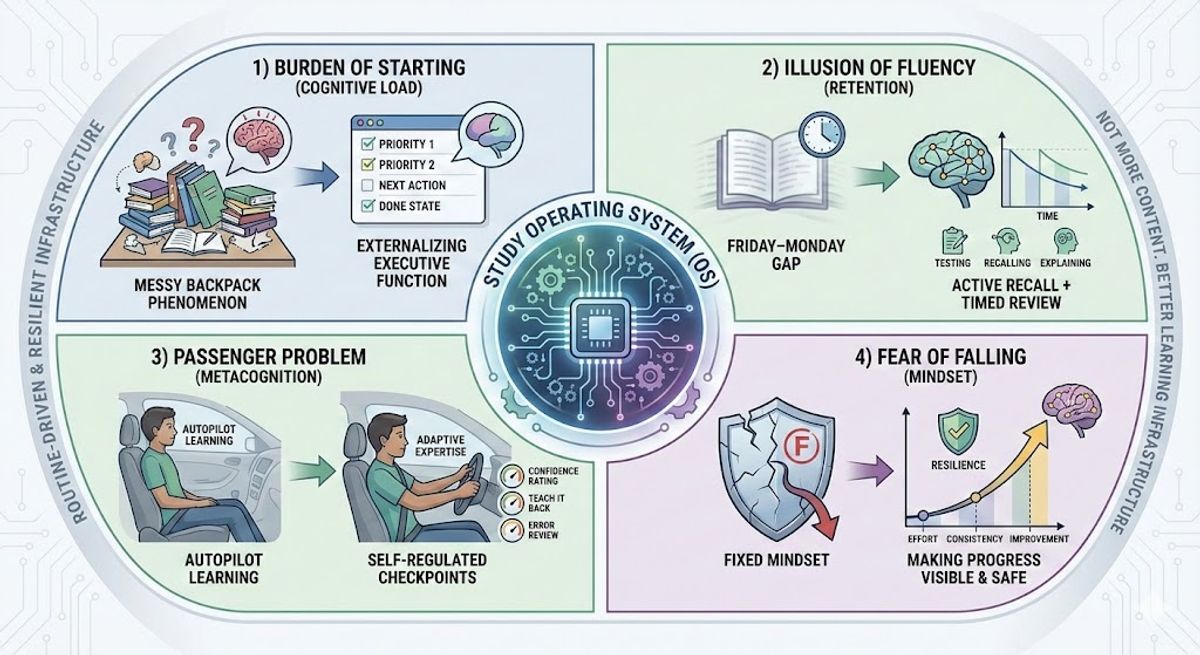
Parents are living through a paradox.
We have more educational resources than any generation in history—high-definition video lessons, practice tests on demand, tutoring apps, worksheets, and textbooks refined over decades.
Yet if you ask most parents of a middle-schooler how studying is going, you rarely hear "smooth," "organized," or "calm."
You hear about Thursday-night tears at the kitchen table.
You hear about the student who "knew it perfectly" at home but went blank in the exam.
You hear about the smart, capable child who is slowly losing confidence because, despite working harder, the results aren't changing.
The uncomfortable truth is this:
The problem isn't the content. The problem is the system.
In our rush to perfect what children should learn, we've neglected how they should learn. We expect students to manage complex information streams, regulate their emotions, and schedule their own review—skills that even adults struggle with—without giving them the infrastructure to do so.
We don't need to pile more data onto their hard drives.
We need to upgrade their "operating system."
What a "Study OS" actually means
When we say Study Operating System (Study OS), we're not talking about software code.
We're talking about the underlying set of habits, routines, and cognitive strategies that governs how a student:
- starts work without friction,
- retains what they learn,
- notices what they don't understand,
- and stays resilient when it gets hard.
Without a system, studying becomes chaotic and willpower-driven. And willpower is a finite resource.
With a system, studying becomes routine-driven. And routines are renewable.
A simple analogy helps.
Imagine a laptop without an operating system. The files might exist. The apps might exist. But nothing is coordinated.
There's no scheduler to decide what runs next. No memory management to prevent overload. No consistent structure to keep things from becoming a mess.
That's what studying feels like for many students today.
And it's why more tutoring—while sometimes helpful—often fails to fix the underlying problem. We're installing more "apps" on top of a fragile OS.
To see why, let's look at four predictable gaps in the default study approach.
1) The burden of starting (cognitive load)
The problem: the "messy backpack" phenomenon
Every parent knows the struggle of getting a student to simply start.
We often mistake this for laziness. But cognitive science points to something more practical: cognitive load.
Picture walking into a kitchen to cook dinner, but:
- the sink is full of dishes,
- the groceries are still in bags on the floor,
- and you can't find a knife.
You feel exhausted before you've even chopped an onion.
For a student, sitting down to study often feels like that kitchen.
They're forced to make a dozen decisions before learning even begins:
- Which subject first?
- Which chapter is highest priority?
- Notes or textbook?
- Do I revise or do problems?
- Where did I keep that handout?
Twenty minutes disappear into planning, searching, and worrying.
By the time they start, their mental energy—what you could call their "decision battery"—is already drained.
The solution: externalizing executive function
A Study OS reduces start-up friction by acting like a skilled executive assistant.
It clarifies:
- what matters most today,
- what the next action is,
- and what "done" looks like.
When a student sits down, the question shouldn't be "What do I do?"
The answer should already be waiting.
2) The illusion of fluency (retention)
The problem: the "Friday–Monday" gap
This is one of the most common heartbreaks in education.
A student studies for four hours on Friday. They reread the chapter three times. They highlight the important lines. They feel great.
Then Monday comes, and they score a C.
Why?
Because rereading creates a warm familiarity that masquerades as mastery. It feels like competence, but it's often just recognition.
They were looking at the map.
They never practiced driving.
The solution: active recall + timed review
A Study OS shifts students from passive review (reading, highlighting) to active retrieval (testing, recalling, explaining).
And it manages timing.
We forget in a predictable pattern. A good system knows when a memory is about to fade and prompts review at the moment it matters.
This is how "cramming" becomes "maintenance."
Retention becomes a natural by-product of the system—not a desperate last-minute effort.
3) The passenger problem (metacognition → adaptive expertise)
The problem: learning on autopilot
Have you ever read a page and realized you have no idea what you just read?
Students do this for hours.
They complete the worksheet. They watch the video. They copy the solution. But they are passengers in the journey.
They aren't asking:
- Do I actually understand this?
- Can I explain it simply?
- How does this connect to what I learned last week?
- Could I solve a new kind of question with this idea?
That skill—thinking about thinking—is metacognition.
It's what turns a student from a memorizer into an adaptive expert: someone who can apply knowledge to unfamiliar problems.
The solution: self-regulated checkpoints
A Study OS builds reflection into the workflow.
It creates checkpoints such as:
- confidence ratings before revealing answers,
- quick "teach it back" prompts (Feynman-style),
- error reviews that ask "why was this wrong?",
- and difficulty calibration to keep learning in the right challenge zone.
These aren't "extra."
They're how a student moves from passenger seat to driver seat.
4) The fear of falling (mindset, grit, self-efficacy)
The problem: the fragility of confidence
In a content-heavy world, grades become the only visible metric.
So when a student tries hard and gets a bad grade, it doesn't feel like they failed a test.
It feels like they are a failure.
That's how fixed mindset creeps in:
- "I'm just bad at math."
- "I can't do science."
- "I'm not smart like them."
Often, it's a defense mechanism. If you believe you can't learn, you stop trying—and you protect yourself from the pain of trying and failing again.
The solution: making progress visible and safe
A Study OS must provide psychological safety.
It should track the process:
- effort,
- consistency,
- improvements over time,
- and patterns in mistakes.
It should treat errors as data, not identity.
"You got this wrong? Good. Now we know what to practice on Tuesday."
When students see progress as a curve—not a verdict—they build grit.
They learn that difficulty isn't a sign of weakness.
It's the sensation of new neural pathways being built.
The tutoring trap: more help on top of a broken system
Tutoring can be valuable.
But here's the hard claim: tutoring often treats symptoms, not infrastructure.
If a child lacks:
- a reliable way to start,
- a method that produces durable memory,
- reflection loops that build understanding,
- and a framework that protects confidence,
…then adding more tutoring is like installing more applications on a computer that still can't manage memory or prioritize tasks.
It might run for a while.
Eventually, it slows down.
Then it crashes.
The shift worth making
If EaseFactor has a point of view, it's this:
Not more content. Better learning infrastructure.
When a system handles the logistics, students can spend their limited cognitive resources on what matters:
- understanding,
- connection-making,
- and growth.
Which leads to a better question than "How do we make children study more?"
What would change if effort isn't the problem at all—if the missing piece is the operating system?
Where EaseFactor fits
EaseFactor is being built as a Study Operating System for Grades 3–10—an integrated ecosystem that helps students:
- start with clarity,
- retain through active recall and spaced repetition,
- build metacognition through structured checkpoints,
- and grow resilience through progress visibility.
The goal is not to replace teachers or tutors.
It's to give students the infrastructure they were never taught—so learning becomes calmer, more predictable, and more personal.
Because in the long run, the students who win aren't the ones who have the most content.
They're the ones who have the best system.

Manoj Ganapathi
Founder and Builder of EaseFactor. Passionate about evidence-based learning and helping students build effective study habits through cognitive science principles.
Ready to Study Smarter?
EaseFactor uses these learning science principles to help you build lasting knowledge.