The Study OS Habit Loop
 Manoj Ganapathi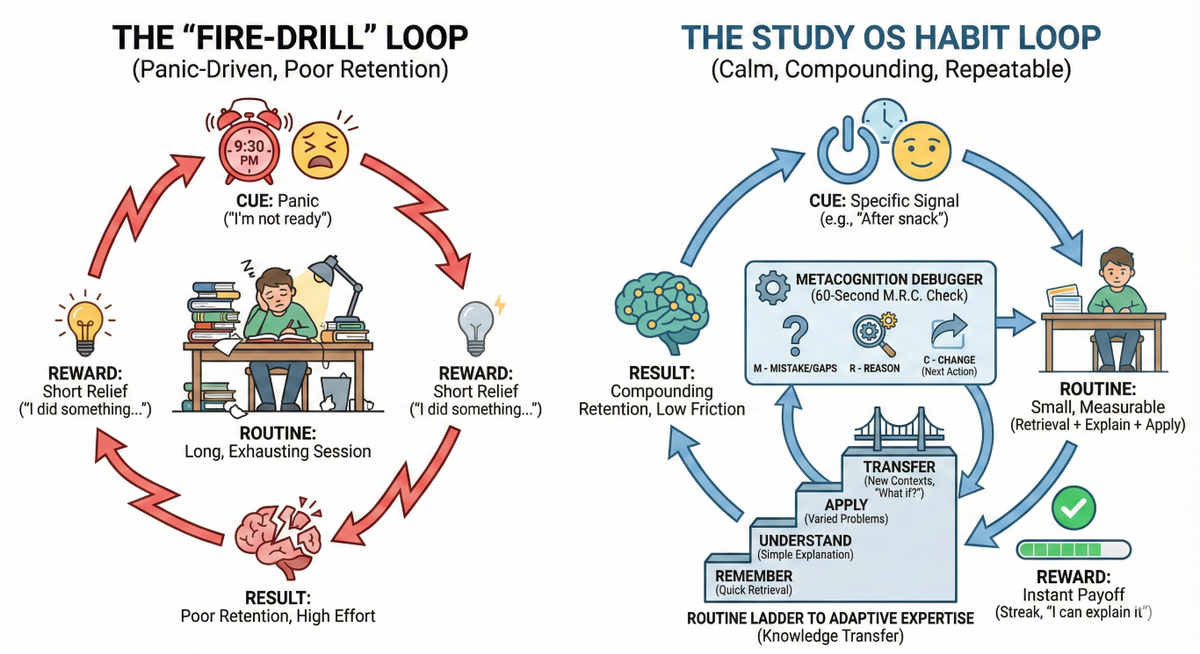
It's 9:30 PM. Tomorrow is the test. The book is open, the highlighter is working overtime, and the brain is… mostly panicking.
This is the Fire-Drill Loop:
- Cue: panic ("I'm not ready")
- Routine: long, exhausting study session
- Reward: short relief ("I did something… I think")
Fire drills create effort. They don't reliably create retention. And they're hard to repeat calmly.
A habit isn't what you do when you're scared. A habit is what you do when you're calm — because your environment and routine make starting almost automatic.
Diagnosis: Symptoms vs Infrastructure
Symptoms (what families try first):
- more hours
- more notes
- more tutoring
- more "be serious now"
These can help in the short term. But they're often symptom relief, not infrastructure.
Infrastructure (what actually compounds):
- a predictable start signal
- a small repeatable routine
- a fast reward
- a tiny debug step (reflection) that makes tomorrow smarter than today
A tutor can be helpful — especially for misconceptions — but tutoring works best when it plugs into a Study OS: a system that keeps practice consistent between sessions.
Insight: Your brain needs a "boot sequence," not a pep talk
Motivation is like Wi-Fi: sometimes strong, sometimes gone.
A Study OS approach is different. You don't wait to "feel ready." You build a boot sequence:
- Cue = the power button
- Routine = the startup program
- Reward = the "it's working" signal
- Reflection = the system monitor that prevents repeated errors
Once the boot sequence is stable, learning stops being a daily debate.
The science, simply: Cue → Routine → Reward
A practical way to talk about habits is the habit loop: Cue → Routine → Reward.
Two important truths for Grades 3–10:
- The cue must be specific. "Later" is not a cue.
- The routine must be small. If it's too big, your brain resists starting.
Also: habit formation takes time. It varies widely, and often takes weeks to months to feel automatic.
Build the Study Habit Loop (with low start-up friction)
| Loop Element | What it means in a Study OS | Grade 3–10 examples | Common failure mode |
|---|---|---|---|
| Cue | The power button | "After snack," "After bag is kept," "After dinner" | Cue is vague ("sometime later") |
| Routine | The startup program (small + measurable) | 5 recall Qs, 8 flashcards, 3 mixed problems, 10-min closed-book summary | Routine is too big ("finish chapter") |
| Reward | The green light (instant payoff) | streak tick ✅, quick progress bar, "I can explain it" moment | Reward depends only on exam marks |
| Craving | The "I want that feeling again" glue | "I like seeing fewer mistakes," "I like finishing my set" | No immediate payoff → drop-off |
Design rule: Make the routine smaller than your excuses.
The missing layer: Metacognition (your habit debugger)
Here's the quiet trap: students can repeat an ineffective routine (re-reading, highlighting) because it feels productive.
A more reliable approach is retrieval practice — trying to remember without looking — so your brain learns to pull information out, not just see it again.
So, we add a Study OS component: a 60-second debugger.
The 60-second M.R.C. check (after every session)
- M — Mistake/Gaps: What did I not recall correctly?
- R — Reason: Why did I miss it? (confusion / skipped step / mixed concepts)
- C — Change: What will I do differently tomorrow? (smaller set, new cue, different practice)
Upgrade from habits to adaptive expertise (knowledge that transfers)
There are two kinds of "being good" at schoolwork:
- Routine expertise: "I can do the same type of question again and again."
- Adaptive expertise: "I can use what I know in a new question I've never seen."
Your habit design decides which one you build.
The Routine Ladder (5–12 minutes can still do this)
- Remember: quick retrieval (closed-book, short quiz)
- Understand: explain in simple words (teach-back)
- Apply: 2–3 varied problems (not all identical)
- Transfer: one "what if?" question
A concrete Tuesday example
Grade 7 Science, Tuesday after school (12 minutes), topic: Photosynthesis
Cue (power button): "After snack, desk cleared."
Routine (startup program):
- 6 minutes — Closed-book: answer 6 questions
- "What are the raw materials of photosynthesis?"
- "Why is sunlight needed?"
- "Where does it happen in the cell?"
- 4 minutes — Fix 2 misses (look once, then re-answer without looking)
- 1 minute — Teach-back: explain photosynthesis like you're talking to a Grade 4 student
- 1 minute — M.R.C. check: write 1 mistake, 1 reason, 1 change
Reward (green light): streak ✅ + "I can explain it" line in the notebook.
That's a Study OS session: short, structured, repeatable, and improving.
Grade-band recipes
Grades 3–5: "Tiny loops, big wins"
- Cue: After snack
- Routine (10 min):
- 3 flashcards or 3 questions
- Teach one idea to a toy/parent (30–60 seconds)
- Reward: sticker/streak ✅
- Debugger prompt: "What was tricky today?"
Grades 6–8: "Own your routine"
- Cue: same time daily (after school or after dinner)
- Routine (15–20 min):
- 5 min retrieval quiz
- 10 min mixed practice
- 1 min M.R.C.
- Reward: progress tracker + weekly milestone
Grades 9–10: "Strategic advantage"
- Cue: calendar + exam timeline
- Routine (25–35 min):
- closed-book retrieval
- error log (what/why)
- one transfer prompt ("new type" question)
- Reward: trend line: fewer repeated errors, faster recall
A ready-to-use 7-day starter plan (15 minutes/day)
| Day | Cue | Routine (15 min) | Metacognition (1 min) | Reward |
|---|---|---|---|---|
| 1 | After snack | 5 retrieval questions | What surprised me? | streak=1 ✅ |
| 2 | Same cue | Fix yesterday's 2 misses | Why did I miss? | progress tick |
| 3 | Same cue | Mix old + new | What's still weak? | mini-badge |
| 4 | Same cue | Teach-back (simple explanation) | Could I explain it? | confidence note |
| 5 | Same cue | 3 varied problems | Which step fails? | streak=5 ✅ |
| 6 | Same cue | Quick self-test | What changed in my method? | trend line |
| 7 | Same cue | Review + plan next week | What worked best? | weekly win |
Try this today (10 minutes, strict, measurable)
Goal: one complete loop + one debugger pass.
- 1 min — Set the cue: clear desk, open notebook, timer on.
- 6 min — Retrieval: answer 6 closed-book questions (or 6 flashcards).
- 2 min — Fix: pick 2 misses → check → re-answer without looking.
- 1 min — M.R.C.: write
- M: ___
- R: ___
- C: ___ (tomorrow's change)
Output (non-negotiable): 6 answers + 2 corrected misses + 1 M.R.C. line.
How EaseFactor fits (without replacing effort)
EaseFactor is designed to run the Study OS for you:
- it helps you define clear cues (anchors),
- generates retrieval-first routines (not just notes),
- tracks streaks and error patterns (rewards + signal),
- and prompts quick M.R.C. reflection so the habit gets smarter over time.
The student still does the work. EaseFactor keeps the work repeatable.
A Calm Next Step
If studying keeps turning into fire drills, don't aim for perfect motivation. Aim for a better loop. Choose one cue ("after snack"), one 10-minute routine, and one tiny reward — and run it for 7 days. Calm consistency beats panic intensity.
TL;DR
- Habits aren't motivation. They're a repeatable loop: Cue → Routine → Reward.
- Add a 60-second "habit debugger" (reflection) so practice improves — not just repeats.
- When your routine includes retrieval + explanation + application, you build adaptive expertise (knowledge that transfers).
Citations
- Habit loop model and cue–routine–reward framing (Duhigg; habit research summaries)
- Habit automaticity and real-world formation timelines (Lally et al.)
- Retrieval practice / testing effect (Roediger & Karpicke)
- Desirable difficulties (Bjork & Bjork)
- Metacognition monitoring/control (Flavell)

Manoj Ganapathi
Founder and Builder of EaseFactor. Passionate about evidence-based learning and helping students build effective study habits through cognitive science principles.
Ready to Study Smarter?
EaseFactor uses these learning science principles to help you build lasting knowledge.