The Science of Learning Preferences (Without the Learning Styles Myth)
 Manoj Ganapathi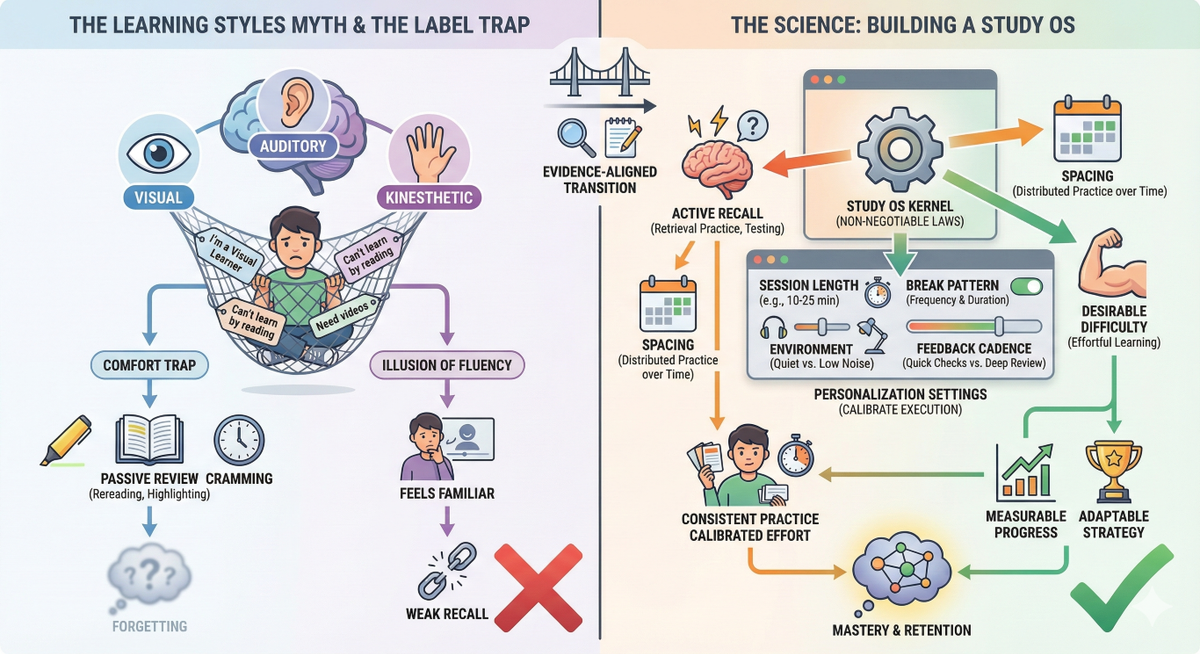
Emotional truth: Most students aren't lazy. They're trying to learn — then watching information evaporate a week later. When that happens, it's tempting to reach for an identity label ("I'm a visual learner") because it offers a simple explanation.
The problem is: the label is usually not the lever.
What is the lever is building a Study OS — simple routines that turn effort into retained knowledge — then calibrating it to genuine individual differences (attention, pacing, prior knowledge, motivation). That's personalization that compounds.
Diagnosis: what's actually going wrong?
Students typically struggle with one (or more) of these predictable learning gaps:
- The Illusion of Fluency: "It feels familiar, so I must know it." (Familiarity isn't recall.)
- The Comfort Trap: Students pick methods that feel easier (highlighting, rereading) over methods that work better (retrieval, spacing).
- The Passenger Problem: Studying happens to the student (notes, videos, tutoring), instead of being driven by the student (questions, recall, feedback).
A learning-style label often treats symptoms. A Study OS builds infrastructure.
The named pattern: "The Label Trap"
The Label Trap is when a student uses a learning-style identity to explain difficulty ("I can't learn from reading"), and then avoids the exact practice that would create growth (e.g., retrieval from text).
This is not a character flaw. It's a strategy problem. And strategies are trainable.
What research says about "learning styles"
The popular idea that instruction should be matched to a preferred sensory "style" (visual/auditory/kinesthetic) is known as the meshing hypothesis. Large reviews and experimental work have found little to no evidence that matching teaching to a student's reported learning style reliably improves learning outcomes.
Even Daniel Willingham — who has spent years translating cognitive science for educators — argues that the learning-styles approach doesn't deliver the benefits people expect, and that the belief persists partly because it feels intuitive.
Important nuance: This does not mean "everyone learns the same way." It means the VAK labels are too crude to guide instruction.
Learning preferences are real — just not the way TikTok posters explain them
Here are evidence-aligned differences that often matter in real classrooms and real homes:
1) Pacing and cognitive load
Some students need information chunked more tightly; others can handle bigger conceptual jumps. In practice, this shows up as:
- how long they can study before accuracy drops
- how many steps they can hold in mind while solving problems
Working memory capacity is a real, studied individual difference that affects attention control and susceptibility to distraction.
2) Prior knowledge (the hidden multiplier)
Prior knowledge changes what's easy, what's confusing, and what sticks. Two students can hear the same explanation and take away very different understanding — because one has more "mental hooks" to attach it to.
3) Attention regulation and environment
Some students do best in quiet. Others can tolerate low-level background noise. The point isn't "preference as identity." It's "environment as a performance variable."
4) Motivation profile (autonomy, competence, relatedness)
Self-Determination Theory highlights three psychological needs that shape motivation: autonomy, competence, and relatedness. Students vary in which need is most "hungry" right now — and that affects effort and persistence.
The Personalization Paradox (and how to resolve it)
Here's the paradox:
- The best learning methods work for everyone (retrieval practice, spacing, feedback).
- But personalization still matters — because it determines whether the student can stick with those methods and apply them well.
That means personalization should answer:
"How do we keep the science constant, while adapting the delivery so this student can execute consistently?"
This is exactly how a Study OS thinks: keep the core protocol stable; tune the settings.
The "OS" approach: personalize the settings, not the laws of learning
Think of learning science as the operating system's kernel — non-negotiable rules. Your preferences are configuration: what makes the kernel run smoothly on your hardware.
Kernel (don't personalize away)
- Active recall beats passive review (test yourself; don't just reread).
- Spacing beats cramming (review over days/weeks).
- Difficulty is not the enemy — desirable difficulty often improves long-term retention.
Settings (personalize thoughtfully)
- Session length (10 vs 25 minutes)
- Break pattern (2 minutes every 10; or 5 minutes every 25)
- Explanation format (example-first vs concept-first)
- Feedback cadence (quick checks vs deeper weekly review)
- Motivation scaffolds (choice, streaks, social study)
A concrete Tuesday example (what this looks like in real life)
Grade 7 Science | Topic: Photosynthesis | Tuesday 6:30 pm | 12 minutes
- 2 min — Setup
- Open notes/text.
- Write today's goal: "Explain photosynthesis in my own words + recall key equation."
- 6 min — Retrieval sprint (no notes)
- Answer 6 questions from memory:
- What is photosynthesis for?
- Where does it happen in the cell?
- Inputs?
- Outputs?
- Why is chlorophyll important?
- One common confusion (e.g., "plants get food from soil")
- Answer 6 questions from memory:
- 2 min — Check + fix
- Compare with notes.
- Correct with one sentence per error (errors are data, not identity).
- 2 min — Schedule
- Put a 5-minute review on Thursday (same 6 questions).
- Add 2 new questions after Thursday.
Personalization layer:
- If attention drops at minute 7, shorten next time to 9 minutes.
- If the student is motivated by autonomy, let them choose 2 of the 6 questions.
- If they need competence feedback, track accuracy (e.g., 4/6 → 5/6 next time).
"Try this today" (10–12 minutes): Preference Calibration Sprint
Output: 6 answered retrieval questions + 1 calibration note + next review scheduled
- Pick one small chunk (1 concept or 1 page). (1 min)
- Write 6 retrieval questions. If stuck, use: definition, steps, example, "why," "common mistake," and "connect to…" (2 min)
- Answer from memory. No notes. (4 min)
- Grade yourself quickly: correct / partially correct / wrong. (1 min)
- Calibration note (one line):
- "I lost focus at minute __; next session I'll do __ minutes + __ break."
- OR "Errors were mostly __; next time I'll add 2 questions on __." (2 min)
- Schedule the next review in 2 days (same questions). (1–2 min)
This is how personalization becomes scientific: you change one setting, measure the result, and keep what works.
Where EaseFactor fits
EaseFactor is designed as a Personal Study OS: it keeps the science stable (retrieval, spacing, feedback) while helping students personalize the execution — pacing, difficulty, reminders, and reflection — so effort turns into retained mastery over time.
If you want the calm version of "personalization," start here:
Keep the method constant. Calibrate the settings. Track what improves recall.
TL;DR
- "Learning styles" labels don't reliably improve outcomes when matched to instruction.
- Individual differences are real — attention, working memory, prior knowledge, and motivation change how a student should run a Study OS.
- Personalize the settings, not the laws: use retrieval + spacing, then tune session length, feedback cadence, and environment.
Citations
- Pashler, McDaniel, Rohrer, & Bjork (2008) — review of the meshing hypothesis / learning styles.
- Rogowsky, Calhoun, & Tallal (2015) — experimental test of matching modality preference to instruction.
- Willingham (American Educator, 2018) — "Does tailoring instruction to learning styles help?"
- Bjork & Bjork (2011) — desirable difficulties and long-term learning.
- Deci & Ryan (2000) — Self-Determination Theory (autonomy, competence, relatedness).
- Kozhevnikov (2007) — cognitive styles framework (nuanced individual differences).

Manoj Ganapathi
Founder and Builder of EaseFactor. Passionate about evidence-based learning and helping students build effective study habits through cognitive science principles.
Ready to Study Smarter?
EaseFactor uses these learning science principles to help you build lasting knowledge.