It's Not Laziness: The Real Reason You Procrastinate (and How to Beat It)
 Manoj Ganapathi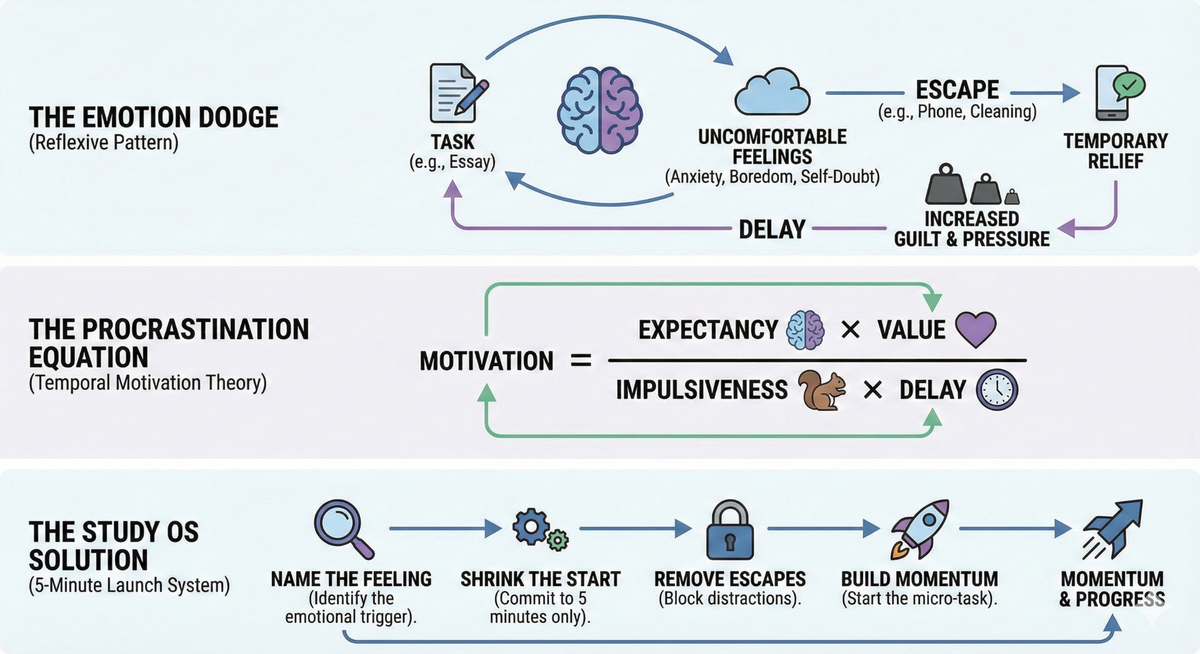
Why you can binge a three-hour documentary about ancient Rome but can't make yourself open a 20-minute math worksheet.
You're not lazy. Read that again.
The student who spent all weekend "meaning to start" the essay isn't lazy. The kid who reorganized their entire desk instead of studying for tomorrow's quiz isn't lazy. The teenager who scrolled for 45 minutes while the textbook sat open to page one isn't lazy.
They're all doing something very specific: avoiding a feeling.
Procrastination isn't a time management problem. It isn't a discipline problem. It isn't a character flaw. According to decades of research, procrastination is an emotion regulation problem — your brain choosing short-term mood repair over long-term goals.
The task isn't the enemy. The feeling the task triggers is.
And once you understand that, everything changes — because feelings are something you can learn to work with.
EaseFactor treats procrastination as a solvable system problem: identify the emotion, shrink the start, and let momentum do the rest.
The named pattern: The Emotion Dodge
The Emotion Dodge: When your brain quietly substitutes a comfortable activity for an uncomfortable one — not because you don't care about the task, but because the task triggers a feeling your brain wants to escape. You're not avoiding the homework. You're avoiding the anxiety, boredom, confusion, or self-doubt that the homework activates.
Here's how it plays out:
- Assignment appears → Brain scans for emotional threat
- Negative feeling detected (boredom, confusion, self-doubt, overwhelm)
- Brain offers an escape → "Just check your phone for a sec" / "You'll do it later when you feel ready"
- Escape feels good → Relief floods in immediately
- Time passes → Deadline closes in, guilt accumulates
- Now the task is harder → Original emotion PLUS guilt PLUS time pressure
- Brain dodges again → Or student panic-sprints at the last minute
The Emotion Dodge isn't a decision you make. It's a reflex your brain runs automatically — prioritizing "feel better now" over "do better later." The good news? Reflexes can be retrained.
Quick diagnosis: symptoms vs infrastructure
When a student procrastinates, the usual responses are:
- "Just sit down and do it" — Assumes the problem is willpower
- "You need better time management" — Assumes the problem is scheduling
- "You're being lazy" — Assumes the problem is character
All three miss the actual cause. They treat the visible symptom (not starting) while ignoring the invisible driver (the emotion).
Common symptoms of The Emotion Dodge:
- Knows exactly what to do but can't make themselves start
- "Productive procrastination" — cleans room, organizes notes, does everything except the real task
- Waits for motivation that never arrives
- Starts only when panic from the deadline exceeds the discomfort of the task
- Says "I'll do it later" with genuine intention, then doesn't
- Feels guilt and shame after procrastinating, which makes starting even harder next time
What's actually missing:
- A way to identify which emotion is triggering the dodge
- A strategy to shrink the start so the emotional barrier drops
- A momentum system that doesn't depend on feeling ready
- Self-compassion skills that break the guilt-avoidance cycle
The science: why you dodge (and what actually helps)
Three researchers have fundamentally changed how we understand procrastination — and none of their findings involve "trying harder."
1. Procrastination is emotion regulation, not time management (Pychyl)
Timothy Pychyl, professor of psychology at Carleton University and director of the Procrastination Research Group, has spent over 25 years studying why people delay. His core finding:
"Procrastination is an emotion-regulation problem, not a time-management problem."
Pychyl's research shows that when we face a task that triggers negative emotions — anxiety, boredom, frustration, resentment, self-doubt — our brain's immediate priority isn't "complete the task." It's "make the bad feeling stop." Avoiding the task accomplishes that. Instantly.
The problem: the relief is temporary, but the consequences compound.
| What you feel | What your brain does | What actually happens |
|---|---|---|
| Anxiety about the task | Avoids to reduce anxiety | Anxiety grows as deadline approaches |
| Boredom with the subject | Switches to something stimulating | Work piles up, creating more boredom later |
| Confusion about how to start | Delays until it "makes sense" | Never starts because clarity comes from doing, not waiting |
| Self-doubt about ability | Protects ego by not trying | Lack of practice confirms the doubt |
The key insight: You don't procrastinate because you're lazy. You procrastinate because your brain is prioritizing short-term mood repair over long-term outcomes. It's not a character flaw — it's a wiring pattern.
2. The Procrastination Equation (Steel)
Piers Steel, organizational psychologist at the University of Calgary, developed Temporal Motivation Theory, which explains procrastination with a formula:
Motivation = (Expectancy × Value) / (Impulsiveness × Delay)
| Factor | What it means | Procrastination risk |
|---|---|---|
| Expectancy | "Do I believe I can do this?" | Low expectancy → more procrastination |
| Value | "Do I find this meaningful or rewarding?" | Low value → more procrastination |
| Impulsiveness | "How sensitive am I to immediate rewards?" | High impulsiveness → more procrastination |
| Delay | "How far away is the deadline?" | Long delay → more procrastination |
This explains why students procrastinate on some tasks but not others. A fun art project (high value) due tomorrow (short delay) gets done. A confusing math assignment (low expectancy) due next week (long delay) gets dodged.
The practical implication: You can reduce procrastination by adjusting any variable — boost expectancy ("I can do the first problem"), increase value ("this connects to something I care about"), reduce impulsiveness ("phone in another room"), or shrink delay ("I'll do just 5 minutes right now").
3. Self-compassion beats self-criticism (Sirois)
Fuschia Sirois, professor of psychology at Durham University, discovered something that contradicts most people's intuition: being kinder to yourself after procrastinating reduces future procrastination.
Across multiple studies, Sirois found:
- Procrastination is strongly associated with low self-compassion
- The guilt and self-blame that follow procrastination create more negative emotion
- More negative emotion triggers more avoidance — the cycle continues
- Self-compassion breaks the cycle by reducing the emotional charge around the task
This means the voice that says "You're so lazy, what's wrong with you?" after a bout of procrastination isn't helping. It's making the next round of procrastination more likely — because now the task carries the original negative emotion PLUS shame about having delayed.
De-shaming reframe:
Procrastinating doesn't make you lazy, broken, or weak. It makes you human. Every brain on the planet runs the Emotion Dodge. The difference between chronic procrastinators and people who get things done isn't willpower — it's whether they have a system for starting anyway.
The Study OS approach: beating The Emotion Dodge
A Study OS doesn't wait for motivation. It builds a system that works before motivation shows up.
1. Name the feeling, not the failure
Before you can beat the dodge, you have to catch it happening. The moment you notice yourself reaching for your phone, opening YouTube, or reorganizing your pencil case — pause and ask: "What feeling am I dodging right now?"
Common answers:
- "I'm confused about where to start" (ambiguity)
- "This topic is boring" (low value)
- "I'm afraid I'll get it wrong" (self-doubt)
- "There's too much to do" (overwhelm)
Naming the emotion takes away its stealth power. Once you see the dodge, it's much harder for your brain to run it automatically.
2. Shrink the start (the 5-minute rule)
The biggest emotional barrier is the start. Not the middle, not the end — the moment of transitioning from "not doing" to "doing."
The fix: commit to only 5 minutes. Not 5 minutes of perfect work. Five minutes of anything — even staring at the assignment and writing down what's confusing.
Why this works: Starting shrinks the delay variable in Steel's equation to near-zero, and the actual experience of doing the task is almost always less painful than the anticipated experience. Five minutes in, the emotion has usually dropped enough for momentum to take over.
3. Remove the escape routes
Your brain can't dodge what it can't reach. Before starting:
- Phone in another room (not just face-down — proximity still drains focus)
- Close all browser tabs except the one you need
- Tell someone: "I'm working on math for the next 15 minutes"
This adjusts the impulsiveness variable — when the easy escape is harder to reach, the task wins by default.
4. Build a momentum bridge
The hardest rep is the first one. Make the first action absurdly small:
| Task | First action (momentum bridge) |
|---|---|
| Write an essay | Open the doc and type one sentence — any sentence |
| Study for a test | Write down 3 things you remember about the topic |
| Read a chapter | Read the first paragraph and write one question |
| Complete a worksheet | Do problem #1, even if you're not sure |
Once you're moving, the emotion that was blocking you typically fades within minutes.
5. Replace guilt with a reset
When you catch yourself procrastinating (and you will), skip the self-blame and go straight to:
- "That happened. Now what's the smallest thing I can do in the next 5 minutes?"
Sirois's research is clear: self-compassion after procrastinating leads to less procrastination next time. Self-criticism leads to more.
A concrete Tuesday example (what this looks like in real life)
Grade 8 English (Essay Draft — Compare/Contrast), Tuesday 4:15–4:27 PM (12 minutes)
The situation: The essay is due Friday. The student has been "meaning to start" since Saturday. Every time they think about it, they feel overwhelmed and do something else.
- 1 min — Catch the dodge (name the feeling)
Write: "I've been avoiding this essay. The feeling I'm dodging is: overwhelm — I don't know how to organize my ideas."
Output: 1 named emotion + 1 specific trigger - 1 min — Shrink the start
Cross out "Write the essay" from the to-do list. Replace with: "Write 3 bullet points about how the two books are similar."
Output: 1 micro-task defined - 7 min — 5-minute launch (plus momentum)
Set a timer for 5 minutes. Write the 3 bullet points. Still going? Keep writing. List 3 differences. Still going? Pick the strongest similarity and write 2 sentences about it.
Output: 3 similarities + 3 differences + 2 draft sentences - 3 min — Schedule the next session + self-compassion reset
Write: "Tomorrow I'll turn these bullets into an outline. Wednesday I'll draft."
Write: "I started. That was the hard part. The essay is moving now."
Output: Next 2 sessions scheduled + 1 self-compassion statement
Total output: Named emotion + micro-task + 6 bullet points + 2 sentences + 2 scheduled sessions
The essay isn't done. But The Emotion Dodge is broken. The student went from "frozen since Saturday" to "outline in progress" in 12 minutes.
Try this today (10 minutes): The 5-Minute Launch
Use this whenever you notice yourself avoiding a task. The goal isn't to finish — it's to break the dodge and build momentum.
Total time: 10 minutes
Output: Named emotion + micro-task completed + momentum gained + next session scheduled
Step 1: Catch the dodge (1 min)
Write down:
- "The task I'm avoiding: ________"
- "The feeling I'm dodging: ________" (boredom? confusion? overwhelm? self-doubt? frustration?)
Don't judge the feeling. Just name it. Naming is the first crack in the dodge.
Step 2: Shrink the task (1 min)
Ask: "What's the absolute smallest version of this task I could do in 5 minutes?"
Not "finish the assignment" — maybe:
- "Read the first paragraph and write one question"
- "Do problem #1 only"
- "Open the document and write a bad first sentence"
- "List 3 things I already know about this topic"
Write your micro-task down. This is your only job for the next 5 minutes.
Step 3: Launch for 5 minutes (5 min)
Set a timer for exactly 5 minutes. Start the micro-task.
Rules:
- It doesn't have to be good
- You can't check your phone
- If you finish the micro-task early, keep going — momentum is real
- If 5 minutes pass and you want to stop, you can. But most people don't.
Step 4: Reset and schedule (3 min)
Whether you stopped at 5 minutes or kept going:
Write:
- "What I actually did: ________"
- "Next session: [day, time, micro-task]"
- "Note to self: Starting was harder than doing. Remember that next time."
For parents: how to help without triggering more avoidance
When your child procrastinates, your instinct might be to:
- Lecture about consequences ("If you don't start now...")
- Add pressure ("This is due tomorrow!")
- Label the behavior ("You're being lazy")
All three increase the negative emotion around the task — which is exactly what caused the procrastination in the first place.
- Name the pattern, not the character. Instead of "You're procrastinating again," try "Looks like your brain is running The Emotion Dodge. What feeling is it trying to avoid?" This externalizes the problem and makes it solvable.
- Help shrink the start. "What if you just did the first problem? You don't have to finish tonight — just start." Lower the bar until starting feels possible.
- Skip the guilt trip. Sirois's research is clear: guilt after procrastinating increases future procrastination. If your child delayed all weekend and started Sunday night, say "You started — that's the hard part" instead of "Why did you wait so long?"
- Model your own dodges. "I've been putting off that email all day because I'm dreading the reply. I'm going to do my own 5-minute launch right now." When kids see adults using the same system, it normalizes the struggle.
Calm next step: make starting easier than dodging
Procrastination isn't something you defeat once. It's a reflex that shows up every time a task triggers an uncomfortable emotion. The question isn't "How do I stop procrastinating forever?" It's "Do I have a system for starting anyway?"
A Study OS makes starting easier:
- Emotion check-ins that catch the dodge before it runs
- Micro-tasks that shrink the emotional barrier to near-zero
- Session timers that make 5-minute launches automatic
- Progress tracking that proves momentum is real — even when motivation is absent
EaseFactor builds this starting system into every study session. Not willpower. Not guilt. Just a smaller start, a visible output, and proof that the feeling passes.
Less avoidance. Less guilt. A Study OS that starts before motivation does.
TL;DR
- Procrastination is an emotion regulation problem, not laziness — your brain avoids tasks to escape uncomfortable feelings like boredom, confusion, or self-doubt.
- The Emotion Dodge is a reflex, not a choice — but you can retrain it by naming the feeling, shrinking the start, and building momentum.
- Your next step: the 5-Minute Launch — commit to just 5 minutes of the task you're avoiding. Starting is almost always harder than doing.
Citations
- Pychyl, T. A. & Sirois, F. M. (2016): "Procrastination, Emotion Regulation, and Well-Being" — foundational chapter establishing procrastination as an emotion regulation failure, not a time management problem
- Pychyl, T. A. (2013): Solving the Procrastination Puzzle — accessible summary of research showing procrastination as short-term mood repair at the expense of long-term goals
- Steel, P. (2007): "The Nature of Procrastination: A Meta-Analytic and Theoretical Review of Quintessential Self-Regulatory Failure" — meta-analysis of 691 correlations establishing Temporal Motivation Theory and the procrastination equation
- Steel, P. (2011): The Procrastination Equation — integrative account of Temporal Motivation Theory: Motivation = (Expectancy × Value) / (Impulsiveness × Delay)
- Sirois, F. M. (2014): "Procrastination and Stress: Exploring the Role of Self-compassion" — across four samples, low self-compassion explained the stress associated with procrastination; self-criticism increases future procrastination
- Sirois, F. M. (2023): Procrastination: What It Is, Why It's a Problem, and What You Can Do About It — comprehensive APA guide connecting procrastination to emotion regulation and self-compassion
- Tice, D. M. & Bratslavsky, E. (2000): "Giving in to Feel Good: The Place of Emotion Regulation in the Context of General Self-Control" — emotional distress overrides self-control, leading to immediate mood repair through avoidance
- Wohl, M. J. A., Pychyl, T. A., & Bennett, S. H. (2010): "I Forgive Myself, Now I Can Study: How Self-Forgiveness for Procrastinating Can Reduce Future Procrastination" — self-forgiveness after procrastination led to less procrastination on the next exam

Manoj Ganapathi
Founder and Builder of EaseFactor. Passionate about evidence-based learning and helping students build effective study habits through cognitive science principles.
Ready to Study Smarter?
EaseFactor uses these learning science principles to help you build lasting knowledge.