Olympiads Aren't About "Being Smart." They're About Building a Thinking Engine.
 Manoj Ganapathi
The Diagnosis: When "studying" doesn't produce understanding
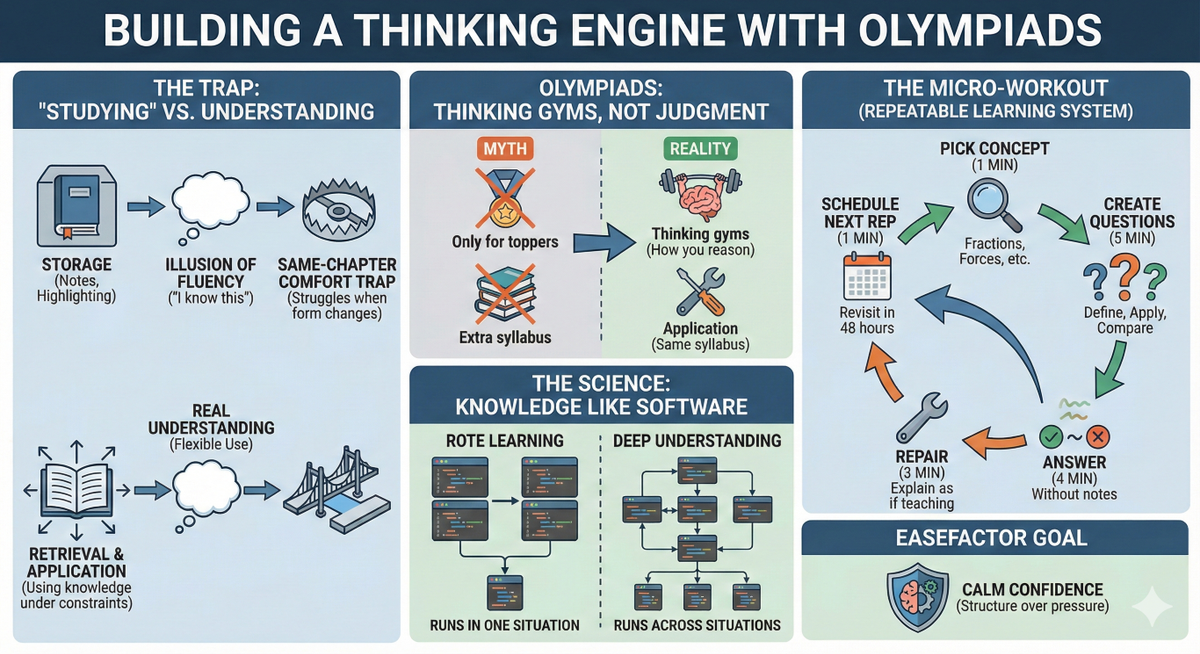
Most students don't struggle because they're lazy. They struggle because school often trains storage (notes, highlighting, rereading) more than retrieval and application (using knowledge under constraints).
This creates two predictable learning gaps:
- Illusion of fluency — "I understand this" (because it looks familiar), until the question changes shape.
- Low transfer readiness — knowledge stays stuck in one chapter, worksheet, or format.
Competitive exams — when handled well — can expose both gaps early and give students a safe way to repair them.
A Named Pattern: The "Same-Chapter Comfort Trap"
Definition: A student performs well when questions look exactly like the examples, but struggles when the same concept appears in a new form.
This is not a talent issue. It is a training environment issue.
Olympiad-style questions are designed to break this trap by asking:
- Which concept applies here?
- What changes if a condition is altered?
- Can two ideas be combined?
That is why these exams often feel harder — even when the syllabus content is familiar.
Myth vs Reality: What Olympiads Actually Measure
| Myth | Reality |
|---|---|
| Olympiads are only for toppers | They are thinking gyms that reveal how a student reasons |
| Olympiads mean extra syllabus | Often the same syllabus, tested through application |
| More papers = better results | Better results come from targeted retrieval and repair |
Symptoms vs Infrastructure
- Symptom relief: more worksheets, more hours, more coaching.
- Infrastructure: a Study OS that repeatedly trains retrieval, feedback, and transfer.
Coaching can help — but it works best when paired with a system that makes learning visible and repeatable.
The Science Beneath the Benefit (In Plain Language)
Think of knowledge like software.
- Rote learning copies code until it runs in one exact situation.
- Deep understanding builds the logic so it runs across situations.
Effective Olympiad preparation strengthens three capabilities:
- Active Recall (Retrieval Strength): Can the student bring the idea back without cues?
- Transfer (Flexible Use): Can the idea be applied in a new context?
- Error-Driven Learning: Do mistakes guide the next practice instead of ending the attempt?
This is why Olympiads — used correctly — align naturally with the spirit of NEP 2020's focus on critical thinking and application.
What This Looks Like on a Tuesday
Grade 6 Science | 12 minutes after school | Topic: Separation of substances
Goal: Train application, not chapter completion.
- 2 minutes — Recall Sprint
Without notes, answer:
- What is the difference between filtration and evaporation?
- Give one real-life example of each.
- 6 minutes — One Concept, Three Skins
- Direct question
- Story problem (kitchen / playground / rainwater)
- Twist: What if the mixture contains both sand and salt?
- 2 minutes — Confusion List
Write two bullets: what felt unclear or mixed up.
- 2 minutes — Schedule the Next Rep
Plan a short review in 48 hours: three recall questions + one twist.
Output: answers, a confusion list, and a scheduled review — evidence of understanding.
Keeping Competition Healthy
Competitive exams help only when students experience them as challenge, not judgment.
Two rules matter:
- Process over outcome: praise strategy, effort, and repair.
- Errors are data, not identity: a wrong answer is a signal, not a label.
A parent reframe that works:
"We're not testing if you're good. We're training your brain to handle unfamiliar questions calmly."
Try This Today: The Olympiad Micro-Workout (10–15 minutes)
- Pick one concept (1 min)
Fractions, forces, photosynthesis, nouns vs verbs.
- Create six retrieval questions (5 min)
- Two define/explain
- Two apply in a scenario
- Two compare, combine, or 'what if'
- Answer without notes (4 min)
Mark each: ✓ confident / ~ shaky / ✗ wrong.
- Repair one weak spot (3 min)
Explain it in 3–4 lines as if teaching a younger student.
- Schedule the next rep (1 min)
Revisit the same questions in 48 hours.
Output: six answers, one explanation, one scheduled review.
Where EaseFactor Fits
EaseFactor exists to turn Olympiad intent into a repeatable learning system:
- Higher-order question generation
- Visibility into gaps and confusion lists
- Spaced retrieval loops that compound over time
- Calm, age-appropriate challenge without pressure
The goal is not acceleration at any cost. It is calm confidence built through structure.
A Calm Next Step
If your child is curious about Olympiads, don't start with pressure or timetables.
Start with one micro-workout, twice a week.
Build the thinking engine first. Results can follow.
TL;DR
- Olympiads reward how you think, not just what you remember — making them a practical bridge from rote learning to real understanding.
- Used well, they build pattern recognition, flexible application, and calm performance under time constraints.
- The win is not the medal; it's a repeatable thinking practice that can be run weekly — without pressure.
Suggested Reading & Research Anchors
- National Education Policy (NEP) 2020 – Ministry of Education, India
- Roediger & Karpicke – Retrieval Practice and Learning
- Carol Dweck – Growth Mindset and Challenge Framing
- Murayama & Elliot – Competition and Performance Motivation
- Zohar & Dori – Higher-Order Thinking in Science Education

Manoj Ganapathi
Founder and Builder of EaseFactor. Passionate about evidence-based learning and helping students build effective study habits through cognitive science principles.
Ready to Study Smarter?
EaseFactor uses these learning science principles to help you build lasting knowledge.