The Neuroscience of Curiosity: How Wonder Turns Studying Into Real Learning
 Manoj Ganapathi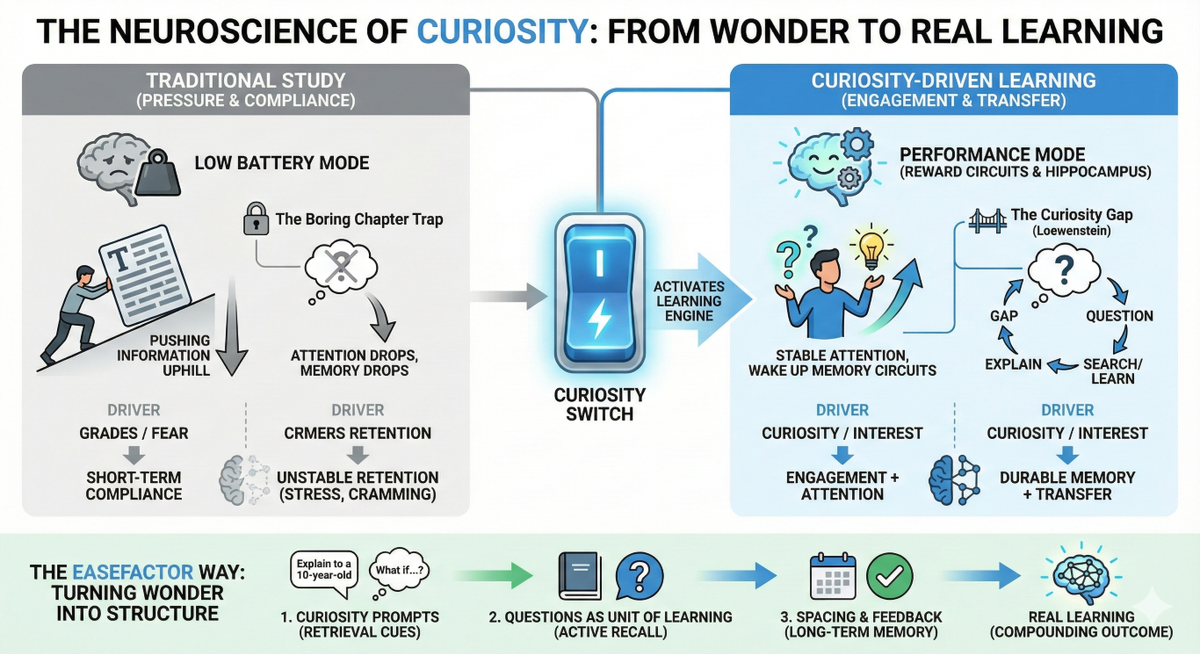
Most students don't struggle because they're "lazy." They struggle because studying often feels like pushing information uphill: read, underline, re-read… and still forget it two days later.
That's not a character flaw. It's a brain-state problem.
When you're curious, your brain behaves differently: attention stabilizes, memory circuits "wake up," and learning stops being purely effortful. Curiosity is not just a nice-to-have mood. It's a biological setup that makes the same 20 minutes of study produce a different outcome.
Diagnosis: what's actually breaking down (and why "more hours" doesn't fix it)
Here are the most common learning gaps hiding underneath "I can't focus":
- Starting friction (cognitive load): the first 5 minutes feel heavy, so you delay.
- Illusion of fluency: reading feels like learning, but retrieval is weak, so recall fails later.
- External-pressure override: grades and fear can force compliance, but they don't reliably create deep encoding.
A tutor can relieve symptoms today. A Study OS builds infrastructure so learning works repeatedly, across subjects, weeks, and exams.
A named pattern to recognize: The Boring Chapter Trap
The Boring Chapter Trap is when a student labels a topic "boring," so they stop asking questions - then attention drops, memory drops, and the label gets "proven" by the outcome.
The fix isn't "try harder." The fix is to restore the brain's question engine - because questions create the conditions for better learning.
The brain's "learning mode" switch: curiosity as an OS-level setting
Think of your brain like a computer running a Study OS.
- External pressure is like forcing an app to run on low battery: it works, but it throttles performance.
- Curiosity is like plugging in power + enabling performance mode: attention stays online and memory processes run more effectively.
Neuroscience work has shown that curiosity engages reward-related circuits (often discussed in relation to dopamine) and interacts with the hippocampus -the core memory system - supporting better encoding and later recall.
Curiosity doesn't replace discipline. It changes what discipline produces.
The "curiosity gap" is a feature, not a bug
Psychologist George Loewenstein's "curiosity gap" idea is simple and powerful: curiosity appears when you feel the gap between what you know and what you want to know.
That gap feels like mild tension. Your brain wants to close it. And that "closure drive" can be harnessed as a repeatable study mechanism:
Gap → Question → Search/learn → Explain → New gap
That cycle is what a Study OS formalizes.
Curiosity vs external pressure (why one compounds and the other burns out)
Understanding the difference between curiosity-driven and pressure-driven learning helps explain why some study sessions feel productive while others feel draining:
Grades and fear produce short-term compliance quickly, but over time lead to unstable retention. The common downside: stress, avoidance, and cramming loops.
Curiosity and interest produce engagement and attention quickly, and over time build durable memory plus transfer to new contexts. The challenge: curiosity needs prompting when topics feel "assigned."
What this looks like on a Tuesday
Grade 7 Science (Photosynthesis), 12 minutes after school
1. 2 minutes — Curiosity primer (create the gap):
Write 3 "why/how" questions:
- Why do plants need sunlight and CO₂?
- How does light become "food"?
- What happens if a plant gets light but no CO₂?
2. 6 minutes — Active recall (close the gap):
Close the book. Answer your questions from memory in short bullets.
3. 2 minutes — Check + correct (tight feedback loop):
Open notes/textbook, correct only what's wrong or missing.
4. 2 minutes — Schedule the next rep (make it compound):
Add one review slot: "Friday: 6-question recall (photosynthesis)."
Output: 3 questions answered + 1 scheduled review. That's a Study OS session: small, structured, repeatable.
The EaseFactor way: turning wonder into structure
Curiosity is powerful, but it's unreliable if you treat it like inspiration. EaseFactor's philosophy is: effort → system → outcome.
Here's how curiosity becomes infrastructure:
1) Curiosity prompts become retrieval prompts
Instead of "study photosynthesis," you run:
- "Explain photosynthesis to a 10-year-old."
- "What would break if sunlight disappeared?"
Those are retrieval cues, not just motivation.
2) Questions become your unit of learning
A chapter is too big. A question is the right size.
When your Study OS is built around questions, you naturally reduce passive reading and increase active recall.
3) Spacing turns interest into long-term memory
Curiosity helps encode today. Spacing protects you from forgetting next week.
Curiosity gets you into learning mode; spaced repetition keeps learning alive.
Try this today: The Wonder → Recall → Schedule routine
Goal: turn one "boring" topic into a curiosity-driven retrieval set.
Time box: 10 minutes.
- 2 min — Write 4 curiosity questions using stems: Why…? How…? What if…? So what…?
- 5 min — Answer from memory (no notes) — short answers only. If stuck, write "I'm not sure" and keep moving.
- 2 min — Check notes, correct, add one missing detail — only fix what matters.
- 1 min — Schedule the next review — put a 6-minute follow-up in 2 days: "Answer the same 4 questions again."
Output: 4 Qs + 4 answers + 1 scheduled review.
Citations
The research behind curiosity and learning:
- Gruber, Gelman & Ranganath (2014): curiosity states and hippocampus-dependent learning
- Kidd & Hayden (2015): psychology/neuroscience of curiosity
- Gottlieb & Oudeyer (2018): active sampling and curiosity frameworks
- Loewenstein (1994): curiosity gap theory
- Marvin & Shohamy (2016): curiosity, reward, and learning effects
- Roediger & Karpicke: the testing effect; Cepeda et al.: the spacing effect

Manoj Ganapathi
Founder and Builder of EaseFactor. Passionate about evidence-based learning and helping students build effective study habits through cognitive science principles.
Ready to Study Smarter?
EaseFactor uses these learning science principles to help you build lasting knowledge.