The Motivation Engine: How Curiosity, Streaks, and Self-Efficacy Fuel Each Other
 Manoj Ganapathi
Why do some students stay fired up about learning while others, equally capable, quietly give up after a few hard weeks?
The answer isn't willpower. It isn't "caring more." And it isn't being naturally gifted.
The difference is infrastructure: students who sustain motivation have stumbled into (or built) a system where three psychological forces feed each other:
- Curiosity creates engagement
- Streaks build momentum
- Self-efficacy creates confidence
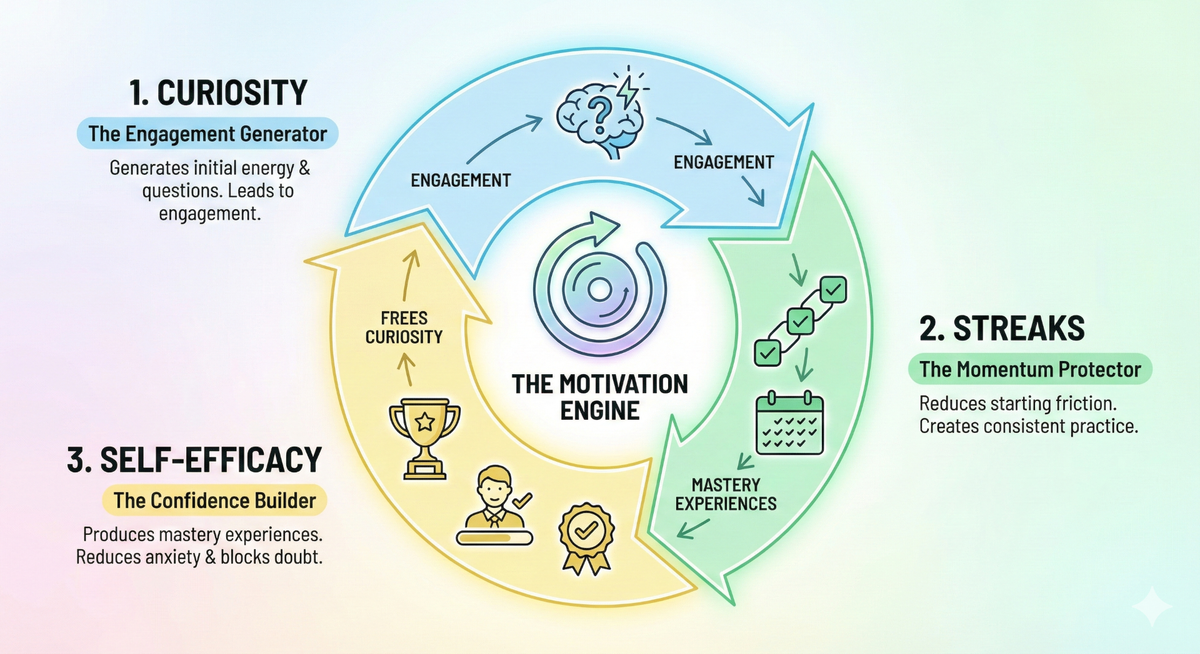
When these three connect, they form a self-reinforcing cycle - what we call The Motivation Engine. Each element powers the next, and learning becomes easier to sustain.
But here's the hidden danger: this engine can also stall. And when it does, the same cycle runs in reverse - creating a downward spiral that's hard to escape.
This post explains how the engine works, why it breaks down, and how to restart it when momentum disappears.
The named pattern: The Motivation Engine
The Motivation Engine: A self-reinforcing cycle where curiosity drives engagement, engagement enables consistency (streaks), consistency creates mastery experiences, mastery builds self-efficacy (belief in ability), and self-efficacy reduces the anxiety that blocks curiosity - completing the loop.
Think of it like a flywheel: heavy to start, but once spinning, each element adds energy to the next. The problem is that flywheels can also slow down - and when they do, the reverse happens: doubt kills curiosity, broken streaks kill momentum, and the whole system grinds to a halt.
Quick diagnosis: why motivation "suddenly" disappears
When a student's motivation crashes, parents and teachers often look for a single cause: "The material got harder," "They're distracted by friends," "They don't care anymore."
But motivation collapse is rarely one thing. It's usually a broken link in the engine:
| Symptom | What it looks like | What's actually broken |
|---|---|---|
| "I'm bored" | Disengagement, minimal effort | Curiosity circuit - no questions driving the work |
| "I forgot to study" | Inconsistent practice, restart friction | Streak system - no momentum protecting the habit |
| "I'm just not good at this" | Avoidance, giving up quickly | Self-efficacy - no receipts proving ability |
| "Why bother?" | Nihilism about school | Multiple breaks - the engine has fully stalled |
The hidden truth: These problems feed each other. A student who doesn't believe they can succeed (low self-efficacy) stops being curious about the material. Without curiosity, they disengage. Without engagement, their streak breaks. Without streaks, they lose the mastery experiences that build self-efficacy. Spiral complete.
The science: three psychological forces that compound
Let's look at each component of the engine and why they matter.
1. Curiosity: The Engagement Generator
Curiosity isn't a personality trait. It's a brain state.
When you're curious about something, your brain behaves differently: attention stabilizes, reward-related circuits activate, and memory encoding improves. Neuroscience research has shown that curiosity engages the hippocampus (the memory center) and interacts with dopamine-related reward systems, supporting better encoding and later recall.
George Loewenstein's "curiosity gap" theory explains the mechanism: curiosity appears when you feel the gap between what you know and what you want to know. That gap creates a mild tension your brain wants to resolve. That's why questions are more powerful than statements for learning.
What curiosity does for the engine: It generates the initial energy. Without it, studying feels like pushing a boulder uphill.
2. Streaks: The Momentum Protector
Streaks work because they reduce starting friction.
Research on habit formation shows that when a behavior repeats in a stable context, it becomes easier to initiate. Over time, your brain treats it less like a decision and more like a routine. The streak isn't about perfect studying - it's about making "learning mode" the default state.
Streaks also leverage loss aversion: people dislike losing something they already have. A well-designed streak creates a gentle "don't break it" nudge without creating pressure.
But the real power of streaks is what they enable: consistent practice creates the spaced repetition that builds durable memory. Short daily sessions often beat long weekly sessions because memory needs repeated contact over time.
What streaks do for the engine: They convert interest into consistent action, which produces the mastery experiences that build confidence.
3. Self-Efficacy: The Confidence Builder
Self-efficacy isn't general self-esteem. It's task-specific belief: "I can solve this type of problem."
Psychologist Albert Bandura identified four sources of self-efficacy:
| Source | What builds belief | Example in learning |
|---|---|---|
| Mastery experiences | You succeed yourself | Completing quizzes, solving problems, visible progress |
| Vicarious learning | You see someone like you succeed | Peer examples, worked solutions |
| Verbal persuasion | Credible feedback and encouragement | Specific praise tied to effort and strategy |
| Emotional states | You feel calmer during challenge | Lower anxiety, clearer steps |
The most powerful source is mastery experiences: personal proof that "my effort leads to results."
What self-efficacy does for the engine: It reduces the anxiety and doubt that block curiosity. When you believe you can succeed, you're willing to wonder about harder questions.
The engine in action: how the cycle reinforces itself
Here's how the three components connect:
    CURIOSITY
        |
        | (generates questions)
        v
    ENGAGEMENT
        |
        | (enables consistent practice)
        v
    STREAKS
        |
        | (produce mastery experiences)
        v
    SELF-EFFICACY
        |
        | (reduces anxiety, frees curiosity)
        v
    CURIOSITY (cycle continues)
Upward spiral (healthy engine):
- Student asks "Why does photosynthesis need both sunlight and CO2?" (curiosity)
- They engage with the material to find out (engagement)
- They practice daily and track progress (streaks)
- They answer correctly on a quiz (mastery experience)
- "I can learn this" (self-efficacy grows)
- "I wonder what happens in plants at night?" (new curiosity)
Downward spiral (stalled engine):
- Student fails a test (self-efficacy drops)
- "I'm just not good at science" (doubt increases)
- Material feels boring (curiosity dies)
- They skip study sessions (streak breaks)
- Next test goes worse (fewer mastery experiences)
- "See, I told you I'm bad at this" (self-efficacy drops further)
This is why some students seem to "suddenly" lose motivation. The spiral was building before anyone noticed.
The System: Why a Study OS keeps all three running
A Study OS doesn't just organize studying. It protects each component of the Motivation Engine.
1. Protecting Curiosity: Question-Based Learning
Instead of "study Chapter 4," a Study OS generates questions:
- "What would happen if plants got no CO2?"
- "Explain photosynthesis to a 7-year-old"
- "What's the difference between inputs and outputs?"
Questions create the curiosity gap that drives engagement. The learning unit becomes a question, not a chapter.
2. Protecting Streaks: Low-Friction Consistency
A Study OS makes it easy to maintain momentum:
- Minimum viable sessions (5-10 minutes counts)
- Multiple streak types (review, practice, reflection)
- Recovery rules (grace days, streak freezes)
- Automatic scheduling (you don't decide what to study; the system surfaces it)
The goal isn't perfect attendance. It's reducing restart friction to near-zero.
3. Protecting Self-Efficacy: Visible Progress
A Study OS creates receipts:
- Progress tracking that shows growth over time
- Immediate feedback after each session
- Mastery metrics beyond just streak length
- Small wins that accumulate into confidence
When effort connects to visible results, students believe their work matters.
Warning: How to break the engine (and how to restart it)
Three common ways parents/teachers accidentally stall the engine
1. Pressure without support
"You need to study more" increases anxiety, which crowds out curiosity. If the student doesn't have a system that produces wins, more pressure just accelerates the downward spiral.
Fix: Pair expectations with infrastructure. Don't just demand effort - help build a system that converts effort into visible results.
2. Perfectionism about streaks
"Don't break your streak!" can turn a momentum tool into a stress source. When streaks become about never failing, one missed day feels catastrophic.
Fix: Build in grace. Streaks should protect momentum, not punish humanity. Recovery is part of the system.
3. Outcome-only feedback
"You got a B" tells students nothing about how to improve. Outcome-focused feedback weakens the connection between effort and results.
Fix: Praise process: "You did 5 retrieval sessions this week and your accuracy went up 15%." Connect effort to specific gains.
The Emergency Restart Protocol
If a student's motivation has fully stalled, trying to "re-motivate" them rarely works. Instead, restart the engine at its easiest component: curiosity.
Step 1: Create one question (2 minutes)
Find one thing they're even mildly curious about. Not "What do you need to study?" but "What's one thing you don't understand but wish you did?"
Step 2: Answer it together (5 minutes)
Don't lecture. Explore together. Model curiosity.
Step 3: One micro-win (3 minutes)
End with something they can do successfully. A quiz they can pass. A problem they can solve. One receipt.
Step 4: Schedule the next touch (1 minute)
Not tomorrow's homework. One tiny follow-up: "In 2 days, we'll see if you still remember this."
This won't fix everything in one session. But it primes the engine for restart.
A concrete Tuesday example (what this looks like in real life)
Grade 7 Science (Plant Biology), Tuesday 6:10-6:22 pm (12 minutes)
Goal: Keep the Motivation Engine running.
1. Curiosity primer (2 min)
Write 2 questions you actually wonder about:
- "Why can't we just breathe out the oxygen plants make?"
- "What happens to a plant at night if photosynthesis needs light?"
2. Engagement sprint (6 min)
Answer from memory:
- Write the photosynthesis equation
- Name 3 inputs and 3 outputs
- Answer your 2 curiosity questions in 2-3 sentences each
3. Self-efficacy receipt (2 min)
Check your answers. Write:
- "I got right: ____"
- "I'm still confused about: ____"
Circle your win. That's the receipt.
4. Streak protection (2 min)
Schedule Thursday's 10-minute review.
Mark today as complete.
Streak: protected.
Output: 2 curiosity questions + 5 retrieval answers + 1 receipt + next session scheduled.
Try this today (10 minutes): The Engine Check-Up
Use this routine weekly to keep all three components healthy.
Total time: 10 minutes
Output: 3 diagnostic answers + 1 action item
1. Curiosity check (2 min)
Write one question you're genuinely curious about in any subject.
If you can't think of anything: That's diagnostic. The curiosity circuit needs attention.
2. Streak check (3 min)
How many days this week did you do at least 5 minutes of retrieval practice?
If less than 3: That's diagnostic. Restart friction needs reduction.
3. Self-efficacy check (3 min)
Write one thing you can do now that you couldn't do last month.
If you can't think of anything: That's diagnostic. You need more visible wins.
4. One action item (2 min)
Based on what you found:
- Curiosity low? → Ask 3 "why" questions before your next study session
- Streaks broken? → Set a 5-minute minimum for the next 3 days
- Self-efficacy weak? → Do 5 easy retrieval reps and note your accuracy
De-shaming reframe:
If all three checks came back low, that's not a character flaw. It's information. The engine is stalled, not broken. Restart it one component at a time.
For parents: how to support without taking over
Your child's Motivation Engine is theirs to run. Your job is to protect the conditions that let it spin.
Do:
- Ask curiosity questions: "What's something confusing that you wish you understood?"
- Celebrate process: "You did 4 review sessions this week. That's how learning compounds."
- Reduce restart friction: "Let's set up your study space so starting is easy."
- Model curiosity yourself: Let them see you wondering about things.
Don't:
- Add pressure without adding support ("Study more" without "Here's how")
- Make streaks feel punishing ("You broke your streak again?")
- Focus only on grades ("What did you get?" vs "What did you learn?")
- Take over the process (doing their practice for them kills self-efficacy)
The best question to ask weekly:
"What's one thing you learned this week that you didn't know before?"
This prompts reflection, creates a receipt, and models that learning - not performing - is the goal.
Keep your engine running
The Motivation Engine isn't magic. It's mechanics.
Curiosity generates interest. Streaks turn interest into rhythm. Rhythm produces mastery experiences. Mastery builds belief. Belief frees curiosity.
EaseFactor is designed to keep all three components running: generating questions, tracking consistency, and making progress visible - so students can build momentum that sustains itself.
A Personal Study OS turns effort into advantage: calm, visible, repeatable progress that compounds over time.
Because motivation isn't something you find. It's something you build - one curious question, one consistent day, one small win at a time.
TL;DR
- The Motivation Engine is a self-reinforcing cycle: Curiosity generates engagement, engagement builds streaks, streaks produce mastery experiences, mastery builds self-efficacy, and self-efficacy frees the mind to be curious again.
- When one component breaks, the whole engine can stall - explaining why "sudden" motivation collapses often have deeper causes.
- A Study OS keeps all three components running: it generates questions (curiosity), tracks consistency (streaks), and produces visible wins (self-efficacy).

Manoj Ganapathi
Founder and Builder of EaseFactor. Passionate about evidence-based learning and helping students build effective study habits through cognitive science principles.
Ready to Study Smarter?
EaseFactor uses these learning science principles to help you build lasting knowledge.