Metacognition: The "Study OS" Upgrade That Turns Effort Into Results
 Manoj Ganapathi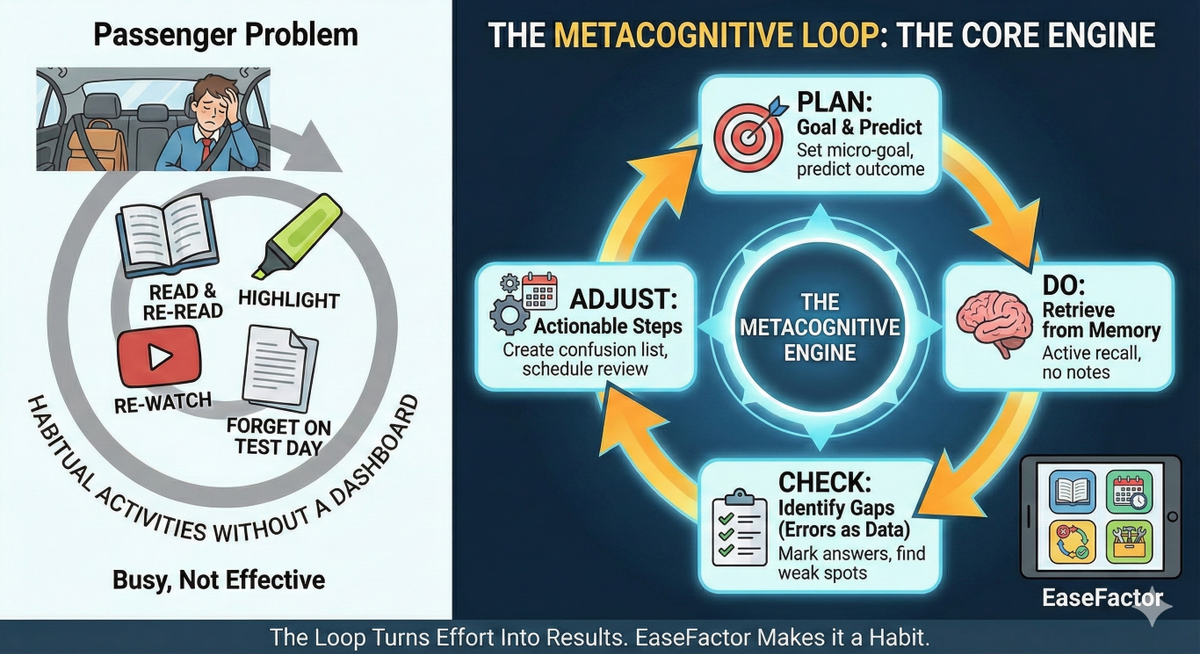
Most students don't struggle because they're lazy. They struggle because they're running learning without a dashboard.
They read, highlight, re-watch, rewrite notes… and still forget on test day. That's not a character flaw. It's a systems problem.
Metacognition (thinking about your thinking) is the skill of noticing what's actually happening in your learning. Meta-learning goes one step further: learning how you learn best, so you can choose strategies with intent—not habit.
Together, they are the "Study OS" layer that helps effort compound instead of evaporate.
A quick diagnosis: symptoms vs infrastructure
When a student is stuck, we usually treat symptoms:
- More tuition
- Longer hours
- More notes
- More tests
These can help in the short term (symptom relief). But the deeper issue often remains:
The student doesn't know what's working, why it's working, or what to do next.
A Study OS builds infrastructure:
- feedback loops
- planning rhythms
- strategy selection
- reflection rituals
Nuance: tutoring works best when paired with a Study OS—because then every session feeds a repeatable system rather than becoming a one-off rescue.
The named pattern: The "Passenger Problem"
Here's a common, very fixable pattern:
The Passenger Problem: a student is "in the car" (doing study time) but not "in the driver's seat" (making decisions based on evidence).
Symptoms look like:
- "I studied a lot… I don't know why it didn't work."
- "I understand it when I read it, but I blank in exams."
- "I'll start fresh from Monday." (again)
Metacognition is how students move from passenger to driver.
The science in plain language: why this works
A simple way to think about learning:
- Your brain forgets quickly unless you retrieve.
- Retrieval shows you what you actually know.
- That evidence lets you adjust your strategy.
Metacognition is the loop that makes this reliable:
Plan → Do → Check → Adjust
This is closely aligned with what researchers call self-regulated learning: setting goals, monitoring progress, and adapting tactics based on feedback (not vibes).
Metacognition, as a Study OS
If studying is an operating system, most students are missing four "core apps":
1) A dashboard (self-monitoring)
Without visibility, students mistake familiarity for mastery.
A dashboard answers: What did I do? What improved? What's still weak?
2) A scheduler (planning + spacing)
Good learners don't rely on motivation. They rely on rhythm: small sessions, repeated over time, with planned reviews.
3) A strategy engine (choosing the right tactic)
Reading is not "bad," but it's often the wrong default. Students need a way to choose:
- recall vs review
- practice problems vs notes
- explain-it-back vs re-watch
4) A feedback loop (adjustment)
Errors aren't identity. Errors are data.
The only question is: What's the next action?
What this looks like on a Tuesday
Grade 7 Science | 12 minutes after school | Topic: "Types of heat transfer"
Minute 0–2: Plan
- Goal: "Answer 6 recall questions without notes."
- Confidence prediction: "I think I'll get 5/6."
Minute 2–8: Retrieve
- Close the book.
- Write answers to 6 prompts (example):
- Define conduction.
- Give a conduction example.
- Define convection.
- Give a convection example.
- Define radiation.
- Give a radiation example.
Minute 8–10: Check
- Mark with notes.
- Circle any shaky answer.
Minute 10–12: Adjust
- Make a "confusion list" of 2 items:
- "Conduction vs convection examples"
- "Radiation definition in one line"
- Schedule a 5-minute review for Thursday.
That's metacognition: not more time—better steering.
How EaseFactor turns metacognition into a habit
The hardest part of metacognition isn't knowing it exists. It's doing it consistently.
EaseFactor is designed as a Study OS so reflection and regulation happen with less friction—more like checking your phone's battery than writing an essay about your feelings.
Here's the mapping from principle → system behavior:
Self-monitoring → Dashboard + activity tracking → "I can see what I actually did."
Planning → Study planner + tasks → "My reviews are scheduled, not hoped for."
Strategy evaluation → Stats + patterns over time → "I know what methods pay off for me."
Feedback loops → Practice → feedback → next step → "Mistakes turn into actions."
Adaptive review → Spaced repetition + notifications → "I review before I forget."
Reflection → Prompts + journaling support → "I'm learning how I learn."
The goal is not perfection. The goal is progress you can observe—so motivation stops being the fuel and becomes the reward.
Try this today (10 minutes): The "Driver's Seat" Routine
Output by the end:
- 6 answers written from memory
- 2-item confusion list
- 1 next review scheduled
Step-by-step
- (1 min) Pick one micro-topic you studied recently.
- (1 min) Predict: "Out of 6 questions, I'll get __ correct."
- (5 min) Retrieve: write 6 Q&As from memory (no notes).
- (2 min) Check: mark, circle weak spots.
- (1 min) Adjust: write a 2-item confusion list + schedule the next review.
If a student resists because it feels uncomfortable, that's normal. Retrieval feels harder because it's honest. But it's also the fastest route to stable learning.
A Calm Next Step
If your child (or your students) already puts in effort, metacognition is how that effort starts compounding.
EaseFactor's role is simple: make the Plan–Do–Check–Adjust loop easy enough to repeat until it becomes automatic—your family's calm, consistent Study OS.
TL;DR
- Metacognition turns "study time" into evidence-based learning decisions.
- The goal is a loop: Plan → Retrieve → Check → Adjust (small, repeatable, compounding).
- EaseFactor acts like a Study OS that reduces friction and makes progress visible.
Citations
- Flavell, J. H. (1979): Metacognition and cognitive monitoring
- Zimmerman, B. J. (2002): Self-regulated learning overview
- Dunlosky & Metcalfe (2009): Metacognition (book)
- Bjork & Bjork: Desirable difficulties; retrieval and forgetting dynamics
- Roediger & Karpicke (2006): Testing effect / retrieval practice
- Cepeda et al. (2006): Spacing effect / distributed practice
- Schön (1983): Reflective practice (why reflection improves expertise)

Manoj Ganapathi
Founder and Builder of EaseFactor. Passionate about evidence-based learning and helping students build effective study habits through cognitive science principles.
Ready to Study Smarter?
EaseFactor uses these learning science principles to help you build lasting knowledge.