Maximizing Study Efficiency with EaseFactor
 Manoj Ganapathi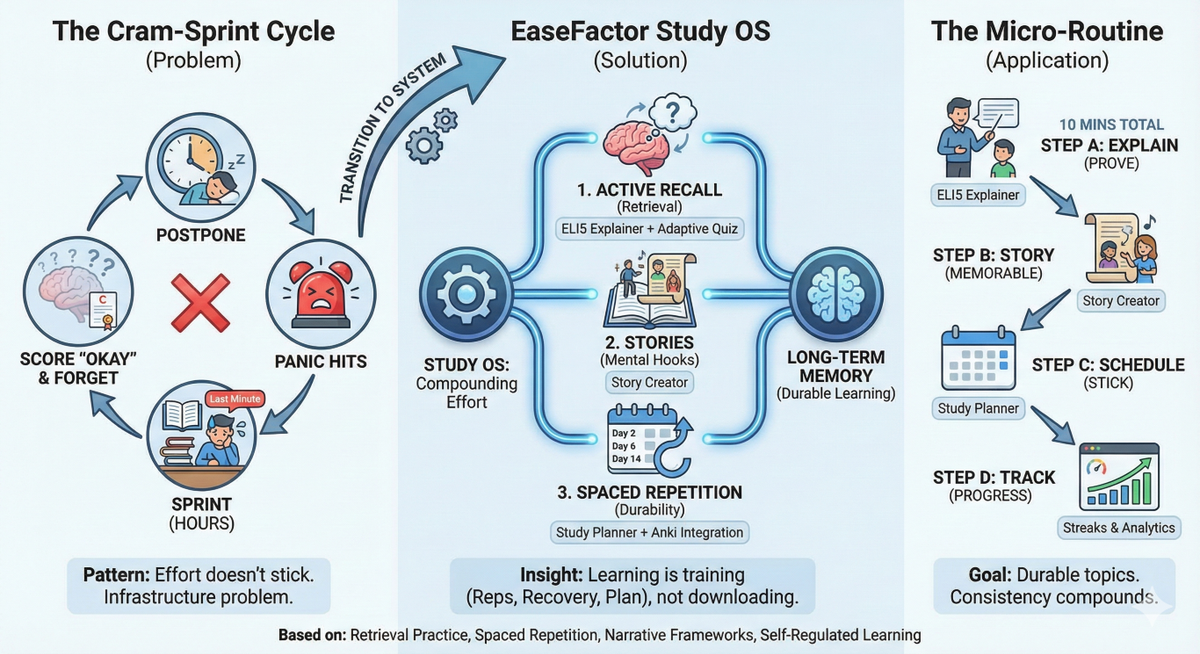
Many students aren't lazy — they're stuck in a pattern where effort doesn't "stick."
A named pattern you can recognize: The Cram–Sprint Cycle
You postpone → panic hits → you sprint (hours of reading/highlighting) → you score "okay" → and then… you forget most of it within days.
This feels like an effort problem, but it's usually an infrastructure problem: your brain didn't get the right repetitions, in the right form, at the right times.
Quick diagnosis: symptoms vs. infrastructure
"I studied but blanked out in the exam." — What's missing: Retrieval practice (active recall). EaseFactor builds: ELI5 Explainer + Adaptive Quiz + Cornell Notes + Flashcards.
"It made sense yesterday; today it's gone." — What's missing: Spacing + planned reviews. EaseFactor builds: Study Planner + smart scheduling.
"I don't know where to start." — What's missing: Lower cognitive load + clear next action. EaseFactor builds: Study OS workflow + Kanban board.
"I keep rereading notes." — What's missing: Avoiding desirable difficulty. EaseFactor builds: Prompts, quizzes, and explanation loops.
The key insight: your brain learns like training, not like downloading
Think of learning like physical training:
- You don't get fit by reading about workouts.
- You get fit by reps, recovery, and a plan.
A Study OS is that plan: it turns your intention ("I'll study later") into a reliable sequence of actions ("I'll retrieve, explain, schedule, and revisit").
The science (in plain language): what actually builds long-term memory
1) Active recall beats passive review
Rereading feels fluent, but it often creates an illusion: "I recognize it" is not the same as "I can produce it."
What works: forcing your brain to pull the answer out (retrieval practice).
EaseFactor support: ELI5 Explainer, Adaptive Quiz System, Comprehension Testing, etc.
2) Stories create stronger mental hooks
When facts sit alone, they're slippery. Stories give facts a structure — characters, cause-and-effect, and meaning — so your brain has more "handles" to grab later.
What works: turning abstract content into a narrative you can replay.
EaseFactor support: Story Creator.
3) Spaced repetition fights the forgetting curve
Cramming can boost short-term performance, but spacing builds durability. The trick is not "study more," it's study again later — on purpose.
What works: revisiting material at increasing intervals.
EaseFactor support: Study Planner, Flash Card Integration, Smart Notifications.
The EaseFactor Study OS: Effort → System → Outcome
Here's a simple way to see EaseFactor as an operating system.
Step A: Explain (prove you understand)
ELI5 Explainer prompts you to explain a topic simply — like teaching a younger student.
- If you can explain it clearly, you understand it.
- If you can't, you've found a specific gap (which is valuable data).
Next action (always): write one sentence:
"The part I can't explain yet is ______."
Step B: Story (make it memorable)
Use Story Creator to convert the concept into a narrative.
- A story becomes a mental "container" for the facts.
- Later, recalling the story helps recall the details.
Step C: Schedule (make it stick)
Use the Study Planner to schedule spaced reviews automatically.
- Not "when I have time," but when your brain needs it.
- The system reduces decision fatigue and protects consistency.
Step D: Track (make progress visible)
Use streaks + analytics to see what's working and adjust without drama.
- Consistency becomes measurable.
- Motivation becomes less fragile because the system carries you.
A concrete Tuesday example (what this looks like in real life)
Grade 7 Science (Photosynthesis), Tuesday 6:15–6:27 PM (12 minutes)
- 2 minutes — AI Chat Assistant (diagnose): Ask: "Quiz me on photosynthesis at Grade 7 level. Start easy, then increase difficulty."
- 5 minutes — ELI5 Explainer (retrieve + explain): Write a simple explanation of photosynthesis in your own words. Output: 6–8 sentences, no textbook phrasing.
- 3 minutes — Story Creator (encode with meaning): Turn it into a story: "A leaf is a kitchen; sunlight is the stove…" Output: one short paragraph story.
- 2 minutes — Study Planner (space it): Schedule reviews: 2 days, 6 days, 14 days. Output: 3 review slots created (auto reminders on).
This is small, but it compounds. That's the point of a Study OS.
Try this today (10 minutes): The "Explain–Story–Schedule" micro-routine
Goal: one topic becomes durable, not just "covered."
10-minute routine
- (2 min) Pick one micro-topic: Example: "Types of triangles" or "Parts of a cell."
- (4 min) ELI5 Explainer: Write a simple explanation from memory. Output: 5 sentences + 1 confusion line ("I'm unsure about…")
- (2 min) Story Creator: Make a tiny story/metaphor that includes the key facts. Output: 3–5 lines
- (2 min) Study Planner: Schedule 3 reviews (2 days / 1 week / 2 weeks). Output: 3 spaced review events
If a student does this 4–5 times a week, they aren't just studying—they're training memory.
TL;DR
- Efficiency is time. Effectiveness is memory. You need both — and they require different behaviors.
- Most students repeat the Cram–Sprint Cycle: last-minute effort that "works today" but leaks tomorrow.
- EaseFactor acts like a Study OS: it turns active recall + stories + spaced repetition into a repeatable rhythm that compounds.
Citations
- Retrieval practice / "testing effect" (Roediger & Karpicke)
- Spaced repetition & forgetting curve (Ebbinghaus; modern spacing research)
- Make It Stick principles (Brown, Roediger, McDaniel)
- Self-regulated learning (Zimmerman)
- Narrative and memory frameworks (Schank & Abelson)
- Explanation-based learning / learning-by-teaching research (e.g., "protégé effect" literature)

Manoj Ganapathi
Founder and Builder of EaseFactor. Passionate about evidence-based learning and helping students build effective study habits through cognitive science principles.
Ready to Study Smarter?
EaseFactor uses these learning science principles to help you build lasting knowledge.