Mastering Time Management for Students
 Manoj Ganapathi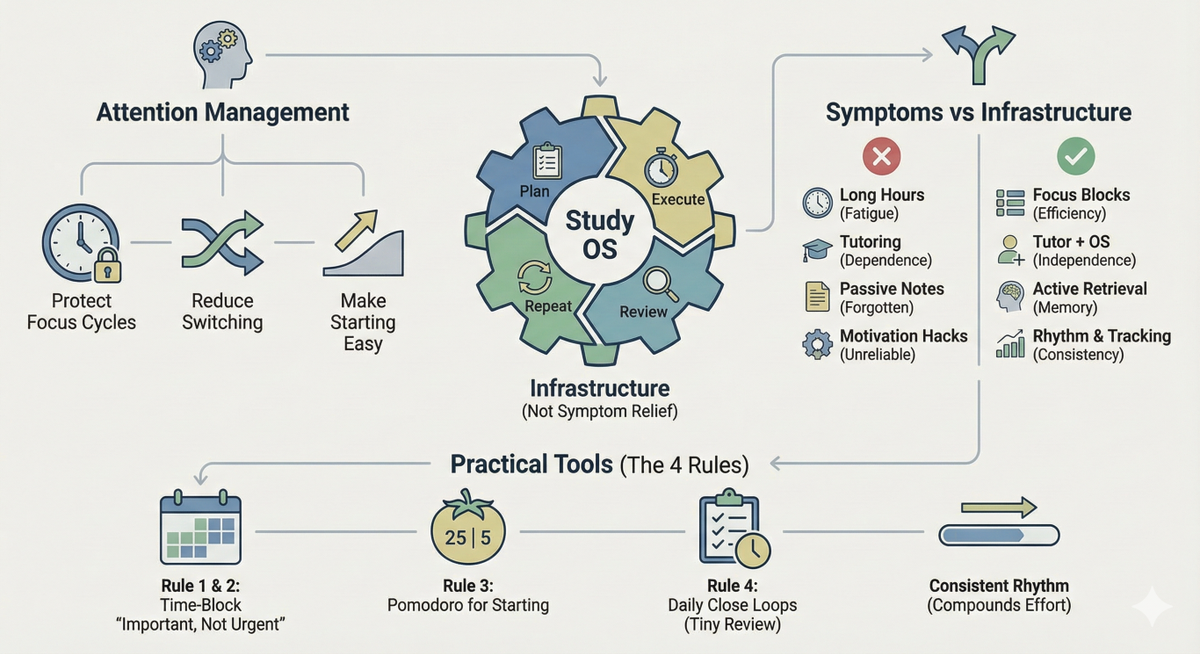
The emotional truth
Most students don't "waste time" because they're lazy. They waste time because their day is fragmented: homework in bits, notifications in between, and panic near deadlines. The result is a familiar feeling: busy… but not improving.
If you've ever thought, "I studied for hours — why can't I remember it?" that's not a character flaw. It's usually a system problem.
Diagnosis: what's actually breaking
Here are the learning gaps that quietly turn effort into overwhelm:
- Starting friction (cognitive load): "Where do I begin?" burns energy before learning starts.
- Illusion of productivity: long hours feel productive even when focus is scattered.
- Present bias: the brain prefers immediate comfort (scrolling) over delayed reward (studying).
- Planning fallacy: tasks take longer than students predict — then the schedule collapses.
A pattern to recognize: The Friday–Monday Gap
The Friday–Monday Gap is when small delays on Friday become stress on Monday: "I'll start later" turns into "I'm behind," and the week begins in recovery mode instead of control.
We'll fix it with a weekly rhythm that makes progress predictable.
The core idea: Time is the "operating system" of learning
Think of learning like training in a gym. You don't get stronger by doing one heroic workout. You get stronger by showing up with a plan, repeating the right moves, and increasing challenge gradually.
A Study OS does the same:
- Plan (what matters)
- Execute (focus blocks)
- Review (close loops + adjust)
- Repeat (compounding progress)
That's how effort turns into advantage — consistently.
The science (in plain English): why time feels hard
1) Your brain discounts the future
A test next week is abstract. A notification right now is vivid. That bias is normal.
What helps: make studying feel near-term by breaking it into small, winnable units (micro-goals, timers, visible progress).
2) Attention works in cycles, not straight lines
Focus rises and falls. Planning around cycles (short sprints + breaks) beats "sit for 3 hours" almost every time.
3) Habits beat willpower
Willpower fatigues. Systems don't. The goal is to build a routine that runs even on low-motivation days.
Symptoms vs Infrastructure
A lot of popular advice reduces stress today—but doesn't reliably improve learning over time.
Nuance: tutoring, better notes, and motivation all help - best when paired with a Study OS.
The student-ready system: four rules that change everything
Rule 1: Protect "important, not urgent" time
This is where top students are made: regular review, practice problems, project progress before panic.
Student translation: "Do a little before it becomes a lot."
Rule 2: Time-block the day (not just a to-do list)
A to-do list is a wish. A time block is a commitment.
Minimum viable version:
- 1 block for "hard subject"
- 1 block for "assignment finishing"
- 1 small block for "review"
Add buffers between blocks (10–15 minutes) so reality doesn't break your plan.
Rule 3: Use Pomodoro to make starting easy
Start with 25 minutes work + 5 minutes break, then a longer break after four rounds.
Why it works: "One Pomodoro" feels doable even when "study for 2 hours" feels impossible.
Rule 4: Close loops daily (tiny review)
Unfinished tasks create mental noise. A 5–10 minute evening review reduces stress and prevents the Friday–Monday Gap.
What this looks like on a Tuesday
Grade 7 Science | Tuesday | 12 minutes after school
Goal: lock in today's "Photosynthesis" lesson with retrieval (not rereading).
- 2 min: Open notebook and write 6 quick recall prompts:
- What is the equation?
- What happens in chloroplasts?
- Why is sunlight needed?
- What are inputs/outputs?
- One misconception I had today?
- One diagram I can redraw?
- 8 min: Answer from memory (no notes). Then check notes and fix only what's wrong.
- 2 min: Schedule a 10-minute review for Thursday, and mark one confusion to ask in class.
Output: 6 answered questions + 1 confusion list + next review scheduled.
Try this today (10–15 minutes): The 12-Minute Launch
This routine works even on low-energy days.
- 2 min — Choose the target: pick one subject that matters most this week.
- 2 min — Define the win: write the smallest clear outcome (e.g., "solve 4 problems," "draft 6 lines," "answer 6 recall questions").
- 6 min — One focus sprint: timer on, phone away, single task only.
- 2–5 min — Close the loop: write:
- What did I finish?
- What's next?
- When will I do it? (schedule one next block)
Next action: do one 6-minute sprint now.
Where EaseFactor fits
EaseFactor works best as the "external executive function" students borrow while theirs is still developing:
- Weekly rhythm and planning (protect important-not-urgent time)
- Clear next actions (reduce starting friction)
- Focus timer and streaks (make consistency visible)
- Reviews and stats (feedback: "Where did my time go?")
- AI support for planning (break tasks into steps; generate retrieval questions)
Not as a shortcut — more like training wheels for consistency.
TL;DR
- Time management is mostly attention management: protect focus cycles, reduce switching, and make starting easy.
- Cramming is symptom relief; a Study OS is infrastructure (plan → execute → review → adapt).
- Calm consistency comes from time blocks + Pomodoro + weekly planning + tiny daily reviews.
References
- Distributed practice / spaced repetition (Cepeda et al.)
- Self-regulated learning (Zimmerman)
- Implementation intentions (Gollwitzer)
- Planning fallacy / task-duration underestimation (Pychyl and others)
- Attention and task switching / benefits of brief breaks (Ariga & Lleras)
- Self-control and decision fatigue (Baumeister; Vohs)
- Smartphone presence and cognitive capacity (Ward et al.)

Manoj Ganapathi
Founder and Builder of EaseFactor. Passionate about evidence-based learning and helping students build effective study habits through cognitive science principles.
Ready to Study Smarter?
EaseFactor uses these learning science principles to help you build lasting knowledge.