The Learning Loop Cycle: How Memory, Mindset, and Method Connect
 Manoj Ganapathi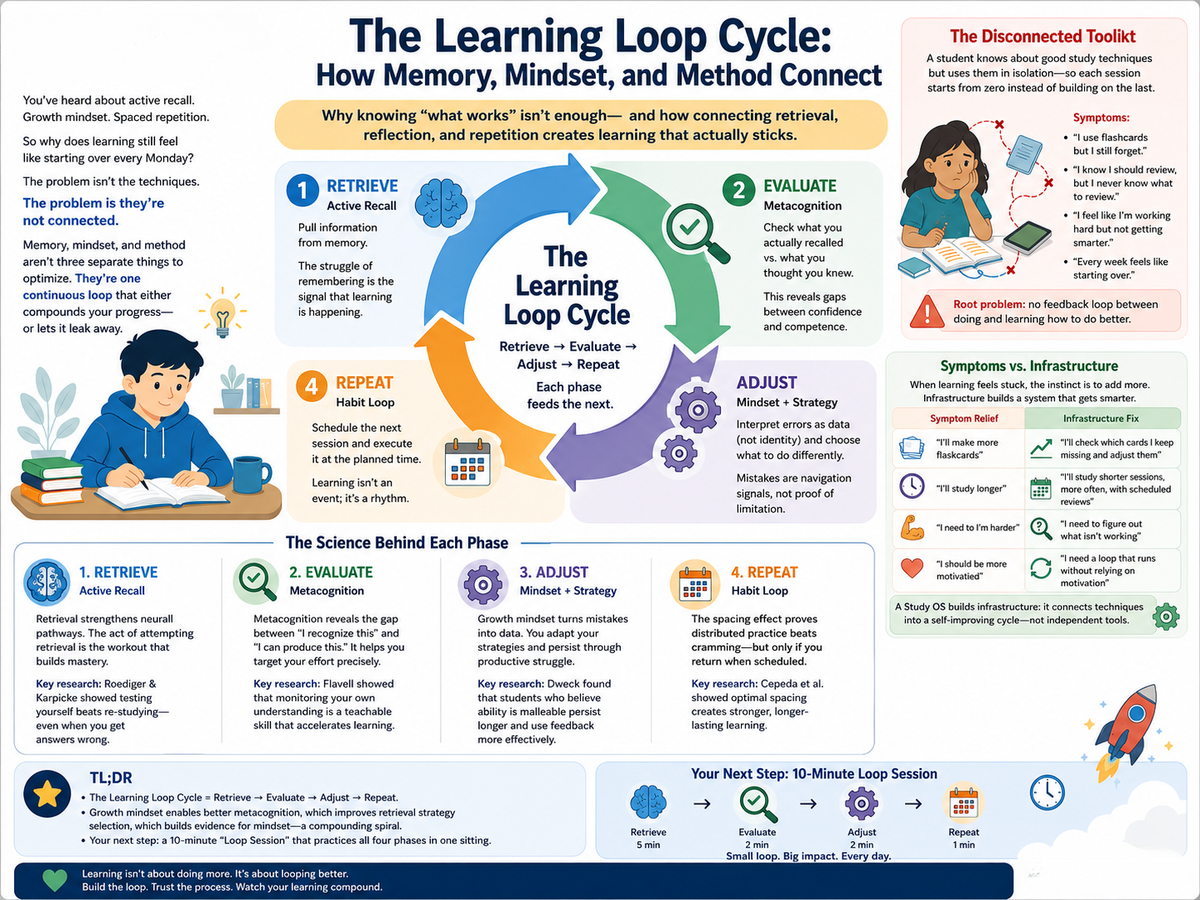
Why knowing "what works" isn't enough - and how connecting retrieval, reflection, and repetition creates learning that actually sticks.
You've probably heard about active recall. You've heard about growth mindset. You may have even tried spaced repetition apps.
So why does learning still feel like starting over every Monday?
The problem isn't the techniques. The problem is they're not connected. Most students treat study methods like separate apps that don't talk to each other - retrieval practice on one day, mindset pep talk on another, habit tracking somewhere else.
But learning doesn't work in silos. It works in cycles.
EaseFactor's approach is built on a simple insight: memory, mindset, and method aren't three separate things to optimize. They're one continuous loop that either compounds your progress - or lets it leak away.
The named pattern: The Disconnected Toolkit
The Disconnected Toolkit: A student knows about good study techniques (flashcards, spaced repetition, practice tests) but uses them in isolation - so each session starts from zero instead of building on the last.
Symptoms:
- "I use flashcards but I still forget."
- "I know I should review, but I never know what to review."
- "I feel like I'm working hard but not getting smarter."
- "Every week feels like starting over."
The root problem: no feedback loop between doing and learning how to do better.
A toolkit without a loop is like a gym membership without a training plan. You show up, you do random exercises, you don't track progress, and six months later you're not sure what changed.
Quick diagnosis: symptoms vs infrastructure
When learning feels stuck, the instinct is to add more:
- More flashcards
- More review time
- More tutoring sessions
- More "trying harder"
These are symptom relief. They help in the moment but don't change the underlying system.
Infrastructure looks different:
| Symptom Relief | Infrastructure Fix |
|---|---|
| "I'll make more flashcards" | "I'll check which cards I keep missing and adjust them" |
| "I'll study longer" | "I'll study shorter sessions, more often, with scheduled reviews" |
| "I need to try harder" | "I need to figure out what isn't working" |
| "I should be more motivated" | "I need a loop that runs without relying on motivation" |
A Study OS builds infrastructure: it connects techniques into a self-improving cycle rather than treating them as independent tools.
The science: four phases that compound each other
The Learning Loop Cycle isn't a new technique - it's a framework that shows how existing techniques connect.
Phase 1: Retrieve (Active Recall)
What happens: You pull information from memory without looking at notes.
Why it matters: Every retrieval attempt strengthens the neural pathway to that knowledge. The struggle of remembering is the signal that learning is happening. Re-reading creates familiarity; retrieval creates mastery.
Key researchers: Roediger & Karpicke showed that testing yourself beats re-studying, even when you get answers wrong. The act of attempting retrieval is the workout.
Phase 2: Evaluate (Metacognition)
What happens: You check what you actually recalled versus what you thought you knew.
Why it matters: Without evaluation, you can't tell the difference between "I recognize this" and "I can produce this." Metacognition - thinking about your thinking - reveals the gap between confidence and competence.
Key researchers: Flavell's work on metacognition shows that monitoring your own understanding is a teachable skill. Students who actively evaluate their performance learn faster because they target their effort more precisely.
Phase 3: Adjust (Mindset + Strategy)
What happens: You interpret errors as data (not identity) and choose what to do differently.
Why it matters: This is where growth mindset becomes operational, not just inspirational. A fixed mindset treats mistakes as proof of limitation ("I'm just not good at this"). A growth mindset treats mistakes as navigation signals ("This shows me what to practice next").
Key researchers: Dweck's work on implicit theories of intelligence shows that students who believe ability is malleable persist longer and use feedback more effectively. But the mechanism isn't "believing harder" - it's connecting beliefs to behaviors.
Phase 4: Repeat (Habit Loop)
What happens: You schedule the next session and execute it at the planned time.
Why it matters: Learning isn't an event; it's a rhythm. The spacing effect shows that distributed practice beats massed practice (cramming). But spacing only works if you actually return when scheduled.
Key researchers: Cepeda et al.'s meta-analysis of spacing effect; Lally et al. on habit formation showing that automatic behaviors develop through consistent repetition in stable contexts.
Why the cycle matters more than any single technique
Here's the insight most students miss: each phase enables the next.
The Compounding Spiral (when the loop works)
- Retrieve reveals what you actually know (not what you think you know)
- Evaluate turns that revelation into specific feedback
- Adjust converts feedback into better strategy choices (supported by growth mindset)
- Repeat turns better strategies into automatic habits
- Retrieve again shows evidence that your adjustments worked
- This evidence strengthens confidence and growth mindset
- Stronger mindset enables more honest evaluation
- The loop accelerates
The Leaking Bucket (when the loop is broken)
- Retrieve but skip Evaluate = you don't know what you missed
- Evaluate but skip Adjust = you see errors but don't change strategy
- Adjust but skip Repeat = you have a plan but don't execute it
- Repeat without Retrieve = you're just re-reading, creating familiarity not mastery
- Progress leaks out at every broken connection
The difference between students who "get better at learning" and those who "keep trying the same things" often comes down to whether their practices form a closed loop or a series of disconnected efforts.
The Study OS approach: making the loop automatic
A Study OS doesn't just teach the loop - it runs it for you with less friction.
1) Built-in Retrieval
Instead of hoping students quiz themselves, a Study OS generates retrieval prompts automatically. The default is active recall, not passive review.
2) Visible Evaluation
Instead of vague feelings about "how it went," a Study OS shows specific data: what you got right, what you missed, patterns over time.
3) Structured Adjustment
Instead of leaving error analysis to the student's willpower, a Study OS prompts reflection: "What was tricky? Why? What will you try next?"
4) Scheduled Repetition
Instead of relying on memory ("I should review that sometime"), a Study OS schedules the next session and reminds you when it's time.
The goal isn't to remove effort. It's to remove the meta-effort of figuring out what to do - so all your energy goes into actual learning.
A concrete Tuesday example (what this looks like in real life)
Grade 7 Math (Ratios and Proportions), Tuesday 5:30 pm, 12 minutes
Phase 1: Retrieve (4 minutes)
Close the book. No notes.
Answer 6 questions from memory:
- What is a ratio?
- Write 3:5 as a fraction.
- Are 2:3 and 4:6 equivalent? How do you know?
- If 3 pencils cost $6, what do 5 pencils cost?
- Convert the ratio 15:25 to simplest form.
- A recipe uses 2 cups flour for 3 cups sugar. How much flour for 9 cups sugar?
Output: 6 written answers.
Phase 2: Evaluate (3 minutes)
Open notes. Check each answer.
Mark:
- Correct
- Wrong
- "I guessed and got lucky"
Write: "My confidence was ___/6. My accuracy was ___/6."
Output: Marked answers + confidence vs accuracy comparison.
Phase 3: Adjust (3 minutes)
For each miss, write one sentence: "I missed this because ___."
Example: "I missed #6 because I forgot to check if my units made sense."
Choose one adjustment for tomorrow:
- Make 3 flashcards for the concepts I missed
- Do 2 more ratio word problems before tomorrow's session
- Ask someone to explain #6 using a different example
Output: 1-3 "because" sentences + 1 chosen next action.
Phase 4: Repeat (2 minutes)
Schedule the next session: Thursday 5:30 pm (same time, same place).
Write down exactly what you'll do: "6 retrieval questions including 2 word problems."
Output: Scheduled session + specific plan.
Total time: 12 minutes.
Total outputs: 6 answers, accuracy comparison, cause analysis, next action, scheduled session.
That's one complete Learning Loop Cycle. Do it three times per week and learning compounds.
For parents: how to support the loop without disrupting it
The Learning Loop Cycle works best when students own it. But parents can support without taking over.
Do:
- Ask "What did you discover you didn't know yet?" (normalizes evaluation)
- Ask "What's your plan for tomorrow's session?" (reinforces repetition)
- Celebrate the process: "You identified exactly what tripped you up" (supports adjustment)
- Respect the schedule: if they planned 5:30, help protect that time
Don't:
- Ask "Did you get them all right?" (shifts focus from learning to performance)
- Rescue them from the struggle of retrieval ("Let me just show you...")
- Add extra work on top of their planned session
- Make the loop feel like surveillance
The goal is for the loop to feel like their system, not something done to them.
Try this today (10 minutes): The Loop Session Routine
Total time: 10 minutes
Output: 6 retrieval answers + confidence check + cause analysis + scheduled next session
Step 1: Retrieve (4 minutes)
Pick one micro-topic you studied recently.
Write 6 questions and answer them from memory. No notes. No peeking.
If you blank on one, write "I don't know" and move on.
Step 2: Evaluate (2 minutes)
Check your answers against your notes/textbook.
Mark each one: correct, wrong, or lucky guess.
Write: "I predicted ___/6. I actually got ___/6."
Step 3: Adjust (2 minutes)
For each wrong answer, write: "I missed this because ___."
Choose ONE thing you'll do differently in your next session.
Step 4: Repeat (2 minutes)
Open your calendar/planner.
Write: "Next session: [date] [time] [topic] [what I'll do]."
Close the loop. Make it concrete.
Calm Next Steps
If the Learning Loop Cycle makes sense but feels like a lot to track, that's exactly why EaseFactor exists.
EaseFactor is designed as a Study OS that runs the loop with less friction:
- Retrieve: Auto-generated retrieval prompts (not just notes to re-read)
- Evaluate: Visible accuracy tracking and pattern analysis
- Adjust: Prompted reflection ("What was tricky? Why?")
- Repeat: Scheduled reviews with reminders
The promise isn't effortless learning. It's effort that connects - so every session makes the next one smarter.
Progress becomes calm, visible, and repeatable.
Citations
Active Recall / Retrieval Practice
- Roediger & Karpicke (2006): Testing effect - retrieval practice enhances long-term retention
- Karpicke & Roediger (2008): Critical role of retrieval in memory
Spacing Effect
- Cepeda et al. (2006): Meta-analysis of distributed practice
- Ebbinghaus (1885): Forgetting curve (historical foundation)
Metacognition
- Flavell (1979): Metacognition and cognitive monitoring
- Dunlosky & Metcalfe (2009): Metacognition - comprehensive review
- Nelson & Narens (1990): Metamemory framework
Growth Mindset
- Dweck (2006): Mindset - implicit theories of intelligence
- Blackwell, Trzesniewski & Dweck (2007): Mindset intervention effects
- Yeager & Dweck (2012): Mindsets and resilience
Habit Formation
- Lally et al. (2010): How habits form - real-world timeline data
- Duhigg (2012): Cue-routine-reward framework
- Wood & Runger (2016): Psychology of habit
Desirable Difficulties
- Bjork & Bjork (conceptual framework): Why difficulty enhances learning
TL;DR
- The Learning Loop Cycle is a four-phase model: Retrieve -> Evaluate -> Adjust -> Repeat.
- Each phase enables the next: retrieval reveals gaps, evaluation identifies patterns, adjustment improves strategy, repetition makes it automatic.
- When the phases connect, learning compounds. When they're disconnected, progress leaks.
- A Study OS like EaseFactor runs the loop with less friction, so students spend energy on learning - not on figuring out what to do.
- Growth mindset enables better metacognition, which improves retrieval strategy selection, which builds evidence for mindset - a compounding spiral.
- Your next step: a 10-minute "Loop Session" that practices all four phases in one sitting.

Manoj Ganapathi
Founder and Builder of EaseFactor. Passionate about evidence-based learning and helping students build effective study habits through cognitive science principles.
Ready to Study Smarter?
EaseFactor uses these learning science principles to help you build lasting knowledge.