Mix It Up: Why Jumbling Your Practice Makes Learning Stick
 Manoj Ganapathi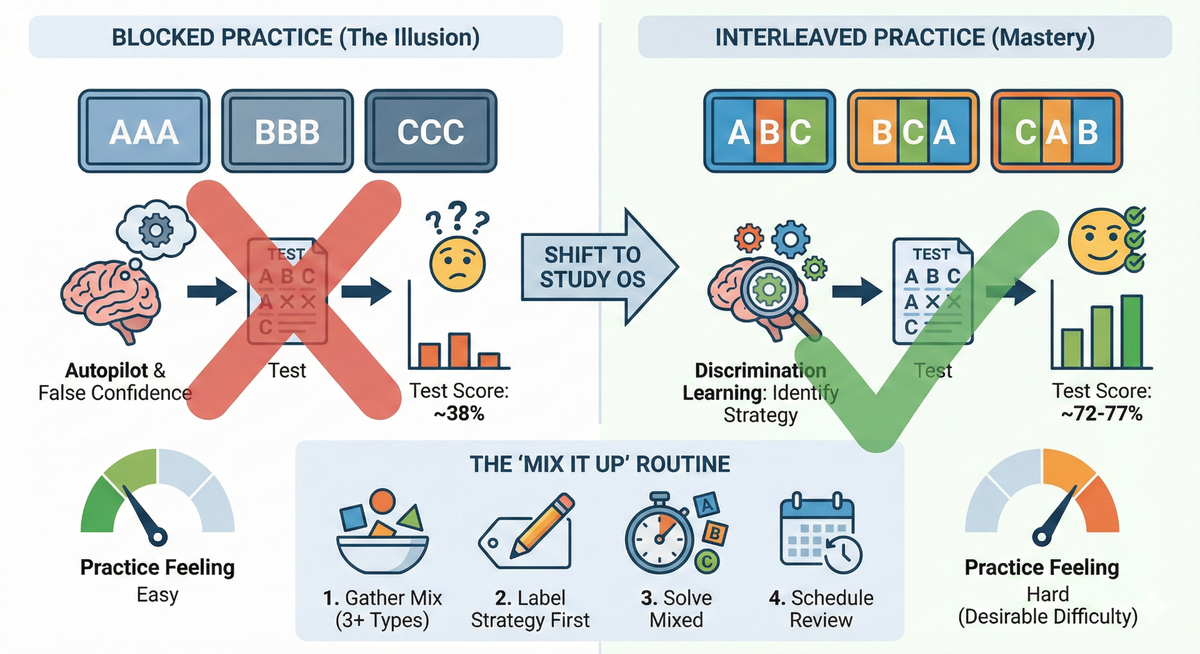
Why drilling the same problem type feels productive — but leaves you blank when the test mixes everything together.
You know that feeling: you practice 20 fraction problems, get most of them right, feel confident. Then the test shows up with fractions, decimals, and percentages all jumbled together — and suddenly you're not sure which method to use for which problem.
The issue isn't that you didn't practice enough. It's that you practiced in a way that never trained the most important skill: recognizing which strategy to use when no one tells you.
This is where interleaved practice comes in — a learning strategy that feels harder in the moment but produces dramatically better results when it counts.
The named pattern: The Blocked Practice Illusion
The Blocked Practice Illusion: You drill one problem type until it feels easy, building false confidence — because the test will mix problem types and require you to choose the right approach without hints.
Here's what happens:
- You practice 15 similar problems in a row
- By problem 5, you're on autopilot — you know the method before reading the question
- You feel confident: "I've got this!"
- Test day arrives with problems mixed together
- You stare at a problem, unsure which formula to use
- Your "mastery" evaporates
The illusion is strong because blocked practice feels more effective. But feeling and learning aren't the same thing.
Quick diagnosis: symptoms vs infrastructure
Symptoms you may notice:
- "I can do the homework, but tests are different"
- "When problems are mixed, I don't know where to start"
- "I knew how to do it when we practiced it, but I forgot which method to use"
What's actually missing:
Not more practice — the right kind of practice. A Study OS that mixes problem types trains your brain to:
- Identify the problem type before solving
- Select the appropriate strategy
- Transfer skills to new contexts
This is called discrimination learning — and it only happens when you practice with variety.
The science: why mixing beats drilling
The discrimination advantage (Kornell & Bjork)
Nate Kornell and Robert Bjork at UCLA discovered something surprising: when people learned to identify paintings by different artists, mixing the artists' works together led to better identification on a test than grouping all works by the same artist together.
Why? Interleaving forces your brain to notice what makes each category different. When you see a Monet followed by a Degas followed by a Renoir, you're constantly asking: "What's unique about this one?"
When everything is blocked (all Monets, then all Degas), your brain goes on autopilot: "More of the same." You stop noticing the distinguishing features.
The math classroom evidence (Rohrer)
Doug Rohrer, a psychologist at the University of South Florida who taught high school math before his research career, has conducted multiple classroom studies on interleaving.
In one study, 7th graders received either blocked or interleaved practice over nine weeks. Two weeks later, they took an unannounced test. Results:
| Practice Type | Test Score |
|---|---|
| Interleaved | 72% |
| Blocked | 38% |
That's nearly double the performance from interleaving.
In another study with 4th graders (Taylor & Rohrer, 2010), the pattern was even more striking: interleaved practice led to 77% retention after one day, compared to 38% for blocked practice — despite blocked practice feeling easier during the learning phase.
Why it feels wrong (the metacognitive trap)
Here's the uncomfortable truth: blocked practice feels more effective even when it's not.
When you drill one problem type, performance during practice is high. When you interleave, performance during practice drops — you make more errors, work slower, feel less confident.
But those feelings are misleading. The struggle of interleaving is a desirable difficulty — it makes your brain work harder in ways that build durable, transferable learning.
The system: a Study OS that mixes for mastery
A Study OS doesn't let you fall into the blocked practice trap. Here's how to build interleaving into your routine:
1. Mix problem types within each session
Instead of: 10 fraction addition, then 10 fraction subtraction
Do this: 2 addition, 2 subtraction, 2 multiplication, repeat (mixed throughout)
2. Include review from previous topics
Every practice session should include at least 20-30% problems from topics you learned in previous weeks. This creates both interleaving and spacing.
3. Practice choosing the strategy
Don't just solve — before each problem, write down: "This is a ____ problem, so I'll use ____." This builds the discrimination skill explicitly.
4. Embrace the difficulty
When mixed practice feels harder, remind yourself: that difficulty is the learning happening. Easy practice is often wasted practice.
A concrete Tuesday example (what this looks like in real life)
Grade 6 Math (Operations with Fractions), Tuesday 4:15 PM (12 minutes)
Goal: Build discrimination skill for fraction operations (add/subtract/multiply/divide).
- 2 minutes — Strategy sort (no solving)
Look at 6 problems. For each, write only: "Add," "Subtract," "Multiply," or "Divide."
Don't solve yet — just identify.
Output: 6 strategy labels. - 6 minutes — Mixed practice
Solve 6 problems — 2 from each operation, shuffled randomly.
For each problem, write the operation type before solving.
Output: 6 solved problems with strategy labels. - 2 minutes — Error analysis
Check answers. For any wrong ones, ask: "Did I use the wrong operation, or make a calculation error?"
Output: Error type identified for each mistake. - 2 minutes — Schedule next mix
Plan tomorrow's practice: mix these fraction operations with decimal operations from last week.
Output: 1 scheduled 10-minute session.
This 12-minute session trains the brain to do what tests require: identify, select, solve.
Try this today (10 minutes): The "Mix It Up" Routine
Total time: 10 minutes
Output: 8 solved problems (mixed types) + strategy labels + 1 scheduled review
Step 1: Gather your mix (1 minute)
Pull together 8-10 problems from at least 3 different types you've been learning. If you're studying math, mix operations. If you're studying science, mix concepts. If you're studying history, mix time periods.
Step 2: Label first (2 minutes)
Before solving anything, look at each problem and write down: "Type: ____"
This forces the discrimination step.
Step 3: Solve mixed (5 minutes)
Work through the problems in random order. Don't group by type — jump around.
Step 4: Check and tag (2 minutes)
Check your answers. For each error, ask:
- "Did I pick the wrong approach?" → Strategy error
- "Did I know the approach but mess up the execution?" → Calculation error
Strategy errors mean you need more interleaved practice. Calculation errors mean you need more practice with that specific technique.
De-shaming reframe:
Struggle during practice is learning in progress. If interleaving feels harder than drilling, you're doing it right.
For parents: how to support interleaved practice without micromanaging
- Don't reorganize their homework. If the teacher assigns blocked practice, your child can still mix in review problems from previous topics.
- Normalize the struggle. When they say, "this is harder," that's the point — validate that difficulty equals growth.
- Ask about strategy, not just answers. "How did you know which method to use?" builds metacognition.
- Help them see the test connection. "Tests mix everything up — practicing mixed prepares you for exactly that."
Calm Next Step: make mixing easier
Interleaved practice works, but organizing it yourself can be tedious. That's what a Study OS is for.
EaseFactor automatically mixes review with new material, surfaces problems from past topics alongside current ones, and builds the discrimination skill into every practice session — so your brain learns not just how to solve, but when to use which strategy.
Less guessing. More confidence. Knowledge that actually transfers to test day.
Citations
- Rohrer, D., Dedrick, R. F., Hartwig, M. K., & Cheung, C.-N. (2020): Randomized controlled trial showing interleaved practice nearly doubled test scores in 7th grade math
- Taylor, K. & Rohrer, D. (2010): 4th grade math study showing 77% vs 38% retention (interleaved vs blocked)
- Hartwig, M. K. & Rohrer, D. (2025): Recent study on students' perceptions of spaced and interleaved practice
- Kornell, N. & Bjork, R. A. (2008): Foundational "Learning Concepts and Categories" study on discriminative contrast
- Birnbaum, M. S., Kornell, N., Bjork, E. L., & Bjork, R. A. (2013): Why interleaving enhances inductive learning (discrimination and retrieval)
- Bjork, R. A. & Bjork, E. L. (2019): "The myth that blocking one's study or practice by topic or skill enhances learning"
- Dunlosky, J., et al. (2013): "Improving Students' Learning With Effective Learning Techniques" - comprehensive review including interleaving
TL;DR
- Interleaved practice = mixing different problem types together instead of drilling one type at a time.
- Blocked practice creates an illusion: high performance during practice, poor transfer to tests.
- Interleaved practice trains discrimination: the ability to recognize which strategy to use.
- The discomfort is the point: struggle during mixed practice means your brain is building durable skills.
- The benefit comes from discrimination learning: your brain learns to identify which strategy fits which problem.
- Start today: mix 3+ problem types in one session, label strategies before solving, schedule mixed reviews.

Manoj Ganapathi
Founder and Builder of EaseFactor. Passionate about evidence-based learning and helping students build effective study habits through cognitive science principles.
Ready to Study Smarter?
EaseFactor uses these learning science principles to help you build lasting knowledge.