Incidental Learning in Digital Spaces: Turn "Accidental" Knowledge into Real Progress
 Manoj Ganapathi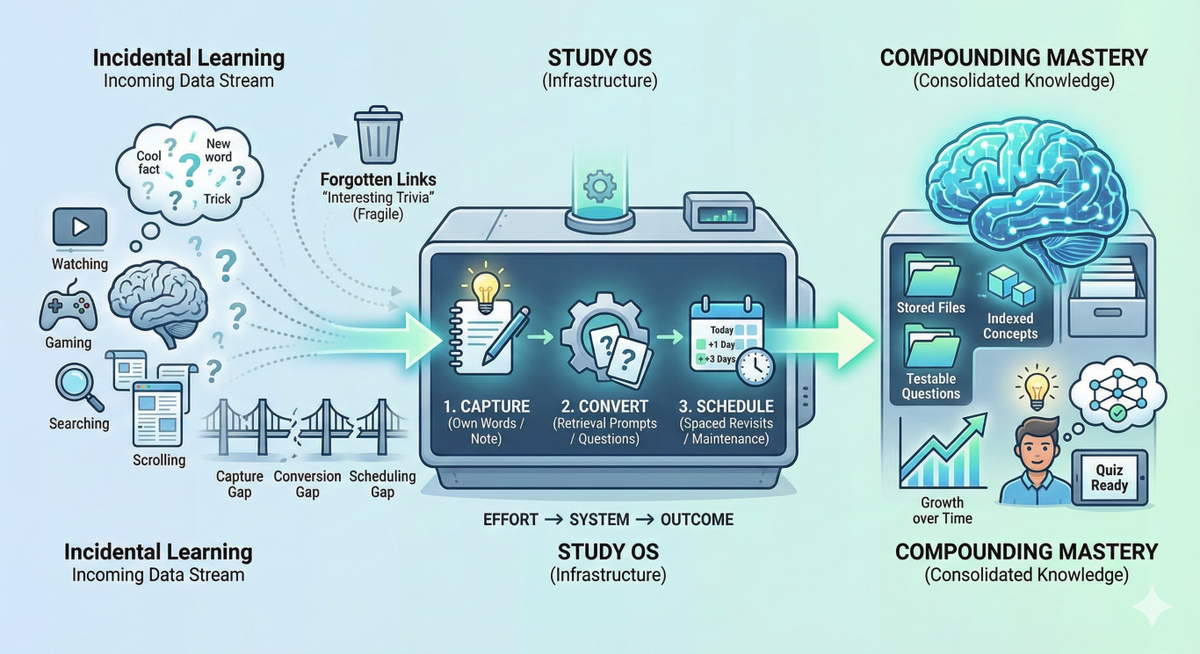
A student opens a Science video to prep for a quiz and ends up learning:
- a cool fact (black holes),
- a new word ("oxidation"),
- a shortcut-looking trick for remembering formulas.
It feels productive. It is learning.
But a week later, the quiz arrives - and the mind goes blank.
That isn't laziness. It's the difference between knowledge encountered and knowledge consolidated.
Digital life produces constant "learning moments." The real question is: do those moments compound - or just pass by?
Diagnosis: what's actually going wrong?
Most families describe the symptoms:
- "He gets distracted easily."
- "She goes down rabbit holes."
- "They watch a lot, but don't remember."
Underneath, what's missing is infrastructure:
- Capture gap — Good ideas vanish (or become a pile of links no one revisits).
- Conversion gap — Curiosity doesn't become testable questions, so it can't be strengthened.
- Scheduling gap — No spaced revisits, no retrieval practice - so memory fades on schedule.
A Study OS doesn't fight curiosity. It routes curiosity into a reliable pipeline.
A named pattern to recognize: Rabbit-Hole Drift
Rabbit-Hole Drift is when a useful curiosity detour turns into tab-switching that feels like learning, but produces no durable output.
The fix is not "be stricter." The fix is "install a better operating system."
The science (in plain language): why incidental learning helps —and why it often fails
Why it can help
Digital environments are rich: explanations, examples, visuals, communities, and quick access to definitions. That richness increases the chance of running into something that clicks.
Why it often fails
Incidental learning is usually unplanned and often untested:
- You recognize an idea when you see it (familiarity),
- but you can't produce it when you need it (recall).
If the brain never has to retrieve the idea, it treats it like "optional." And optional knowledge disappears first.
Symptom relief vs infrastructure
Tutoring, notes, and "more hours" can help - but mostly as symptom relief unless you add a system that turns exposure into retrieval.
"Just focus harder" improves short-term compliance today, but has low infrastructure value (willpower is variable).
Blocking everything "fun" reduces distraction but often lowers curiosity and motivation.
More tutoring / more notes provides better explanations but doesn't guarantee retention without retrieval and review.
The Study OS approach keeps curiosity while reducing chaos, building compounding mastery via capture → retrieval → spacing.
The Study OS approach: treat curiosity like incoming data
Think of learning like a computer:
- Incidental learning is your incoming data stream.
- Without an OS, it becomes open tabs and forgotten links.
- With an OS, it becomes stored files, indexed concepts, and scheduled maintenance.
EaseFactor's philosophy is simple:
Effort → System → Outcome.
Incidental learning becomes fuel - but only if you process it on purpose.
What this looks like on a Tuesday
Grade 7 Science — 12 minutes after school (6:15 pm)
Goal: revise "Acids, Bases, and Salts" for Friday's quiz.
1) 3 minutes — Active recall warm-up
Student answers 6 quick questions from memory (no notes).
Output: 6 answers + 2 mistakes (mistakes are data, not identity).
2) 5 minutes — Targeted fix + one curiosity detour
Student watches a short clip to fix the exact confusion. A related concept pops up: "pH is logarithmic."
Output: one line in their notebook: "pH is a log scale — 1 step = 10× change."
3) 4 minutes — Convert detour into retrieval
Student creates 2 retrieval prompts:
- "Why does 1 pH point matter so much?"
- "Give a real-world example of a 10× difference using pH."
Then schedules review: tomorrow + 3 days later.
This is the conversion: interesting → testable → revisit-able.
Try this today: the 10-minute Serendipity-to-Mastery routine
Use this any time a student learns something "by accident" online.
Total time: 10 minutes
Output: 3 retrieval questions + 1 scheduled review
1) 2 minutes — Capture
Write 1–2 lines:
- "What surprised me?"
- "What does it mean in my own words?"
(If there's a link/video, save it - but the key is the sentence, not the bookmark.)
2) 3 minutes — Check the claim
Ask: "Is this a fact, an opinion, or an explanation?"
If it's a fact, do a quick cross-check with a credible source (textbook, teacher notes, reputable reference).
3) 4 minutes — Convert to retrieval
Create 3 questions that force recall, not recognition:
- Define it: "What is it?"
- Explain it: "Why/how does it work?"
- Apply it: "Where would I use it?"
4) 1 minute — Schedule
Review tomorrow (fast), then again in 3–5 days.
Small routine. Big compounding.
Parent guidance: support without hovering
- Praise the process, not the detour: "I like how you turned that discovery into questions."
- Make curiosity conditional on output: exploration is allowed if it produces a question, a note, or a review card.
- De-shame immediately: "Errors are data, not identity." Then: "What's the next question we should write?"
This keeps curiosity alive while restoring calm structure.
TL;DR
- Incidental learning is real: students often learn as a byproduct of scrolling, watching, searching, or gaming.
- But it's fragile: without capture + review, it becomes "interesting trivia" instead of usable knowledge.
- A Study OS makes it compound: you keep curiosity, then convert it into scheduled retrieval so it actually sticks.
Citations
- Research on informal/incidental learning (e.g., Marsick & Watkins tradition; workplace and everyday learning frameworks)
- Research on incidental learning in technology-rich contexts (e.g., TILE model or comparable frameworks)
- Evidence base for retrieval practice and spaced repetition (e.g., Roediger, Karpicke; Dunlosky et al.)
- Work on metacognition and calibration (e.g., illusion of fluency; monitoring accuracy)
- Research on recommender systems, filter bubbles, and information diversity (contextual, not sensational)

Manoj Ganapathi
Founder and Builder of EaseFactor. Passionate about evidence-based learning and helping students build effective study habits through cognitive science principles.
Ready to Study Smarter?
EaseFactor uses these learning science principles to help you build lasting knowledge.