From Stuck to Solved: A Problem-Solving System for Math
 Manoj Ganapathi
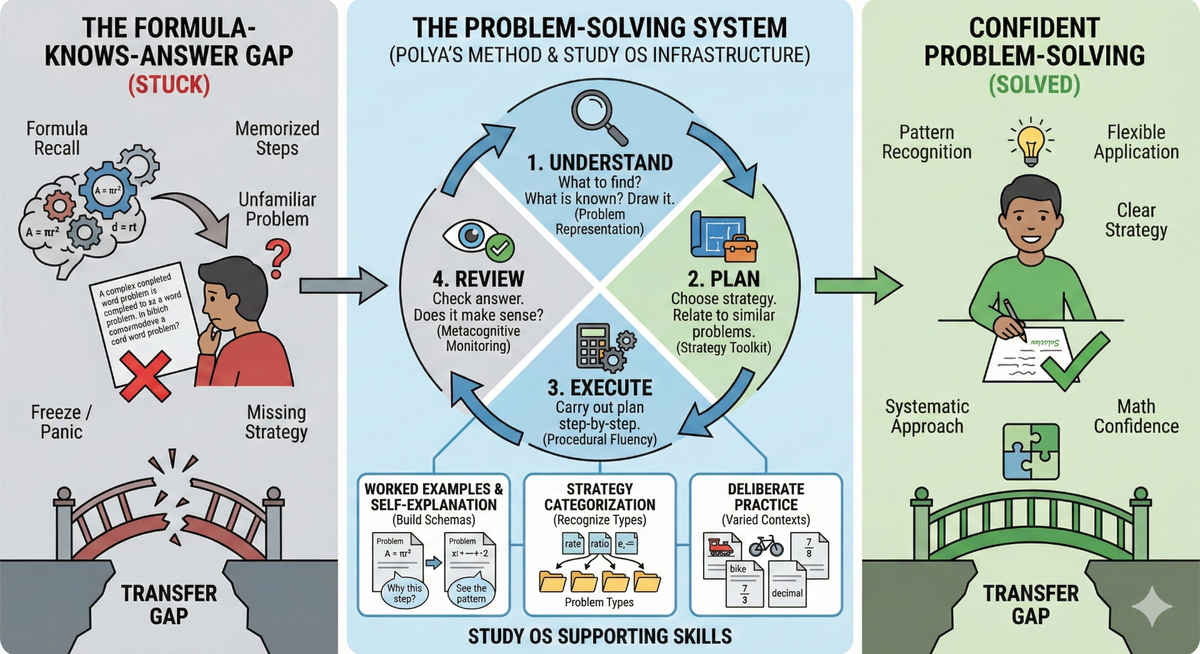
You know the formula. You've memorized the steps. But when a new problem appears, your mind goes blank anyway.
Sound familiar? You're not alone. This disconnect between "knowing math" and "doing math" is one of the most common frustrations students face.
Here's what nobody tells you: memorizing formulas is only the first step. Real math skill means knowing when to use which formula, how to break down an unfamiliar problem, and what to do when you're stuck. That's a completely different skill — and it's trainable.
The good news? Mathematicians have been studying problem-solving for decades. George Polya cracked the code back in 1945, and modern researchers have refined it further. There's an actual system for going from stuck to solved.
The named pattern: The Formula-Knows-Answer Gap
The Formula-Knows-Answer Gap: When you can recite the formula perfectly but freeze when facing a word problem or unfamiliar setup — because knowing what the formula does isn't the same as knowing when to use it.
Here's what happens:
- You study: learn formulas, do practice problems that look just like the examples.
- Test day arrives. The problems look... different.
- You stare at the page thinking, "I know this stuff, why can't I figure this out?"
- You try random formulas, hoping one fits. Sometimes it works. Mostly it doesn't.
The Formula-Knows-Answer Gap isn't about intelligence. It's about transfer — the ability to apply what you've learned to new situations. Transfer doesn't happen automatically. It requires a specific approach.
Quick diagnosis: why knowing the formula isn't enough
Common symptoms of the Formula-Knows-Answer Gap:
- Does fine on homework but struggles on tests
- Can follow along in class but can't solve problems independently
- Knows formulas but doesn't know "which one to use"
- Gets stuck on the first step of word problems
- Skips to trying numbers without planning first
What's actually missing (infrastructure):
- Problem representation skills (turning word problems into mathematical language)
- Strategy selection (matching problem types to solution approaches)
- Metacognitive monitoring (knowing when you're on track vs. off track)
- Self-explanation practice (understanding why steps work, not just what they are)
Here's the uncomfortable truth: most math practice reinforces the gap rather than closing it.
| Type of Practice | What It Builds | What's Missing |
|---|---|---|
| Drilling similar problems | Formula recall | Transfer to new problems |
| Watching someone solve | "That makes sense" feeling | Ability to do it yourself |
| Memorizing steps | Procedural fluency | Understanding of why |
| Checking answers only | Knowing right/wrong | Knowing what went wrong |
Closing the gap requires a different kind of practice — problem-solving practice with a system.
The science: why problem-solving is a learnable skill
Polya's four-step method
In 1945, mathematician George Polya published How to Solve It, identifying the problem-solving process that expert mathematicians use intuitively:
- Understand the problem — What are you trying to find? What do you know?
- Devise a plan — What strategy will you use? Have you seen a similar problem?
- Carry out the plan — Execute your strategy step by step
- Look back — Check your work. Could you solve it a different way?
This isn't just common sense. Research by Alan Schoenfeld showed that when students are explicitly taught these steps, their problem-solving performance improves dramatically—even on problems they've never seen before.
The key insight: novices jump to step 3 (calculating) without doing steps 1 and 2. Experts spend most of their time on understanding and planning.
The worked example effect
Alexander Renkl's research reveals something counterintuitive: studying worked examples (solved problems with explanations) can be more effective than solving problems yourself—but only under specific conditions.
The magic happens when students:
- Compare multiple worked examples to see patterns
- Self-explain each step ("Why did they do that?")
- Gradually transition from examples to independent practice
This is called the worked-example-to-problem fade: start with fully worked examples, then partially worked examples, then independent problems.
| Learning Stage | What You Practice | What You Build |
|---|---|---|
| Watching (passive) | Nothing | Illusion of understanding |
| Self-explaining worked examples | Recognizing patterns | Schema formation |
| Partial examples (fill in gaps) | Applying steps | Procedural knowledge |
| Independent problems (full) | Transfer | Problem-solving skill |
Most students skip the middle stages — and wonder why they can't do it themselves.
Schema acquisition
Schoenfeld's research showed that experts don't just know more formulas — they have problem schemas: mental categories that group problems by their underlying structure, not their surface features.
For example:
- Novice sees: "A train leaves Chicago..." → "A train problem"
- Expert sees: "Distance = Rate x Time" → "Rate problem (use d = rt)"
The novice categorizes by the story. The expert categorizes by the mathematics. This is why novices can solve "train problems" but fail when the same math appears in a "bike problem."
Building schemas requires:
- Comparing multiple problems with the same structure
- Identifying what makes them similar (mathematically, not story-wise)
- Practicing with varied surface features
The Study OS approach: building problem-solving infrastructure
Instead of drilling more problems, a Study OS helps you build the skills that make problem-solving possible:
1) Make "Understand" a required step
Before touching your pencil to calculations, write answers to:
- What am I trying to find? (In words, not symbols yet)
- What do I know? (List every piece of given information)
- What's the connection? (How might the knowns lead to the unknown?)
This forces representation—translating the problem into mathematical terms—which is where most students get stuck.
2) Build a strategy toolkit
Instead of memorizing formulas, categorize problem types and their go-to strategies:
- "Find total when given rate and time" → d = rt
- "Find part of a whole" → fraction or percentage
- "Compare two quantities" → ratio or proportion
- "Find unknown in equation" → isolate the variable
A Study OS tracks which problem types you've mastered and which need work.
3) Use self-explanation as a practice tool
After working through a problem (or studying a worked example), answer:
- "Why did step 2 come after step 1?"
- "What would happen if I did this differently?"
- "Where have I seen this pattern before?"
Self-explanation builds the schemas that make transfer possible.
4) Practice with varied surface features
Don't just do "three more like this." Deliberately practice problems with:
- Different story contexts (trains, bikes, planes, walking)
- Different number types (whole numbers, fractions, decimals)
- Different question framings ("How long..." vs. "Find the time...")
This builds robust schemas, not fragile memorization.
5) Track your sticking points
When you get stuck, don't just look up the answer. Write down:
- Where exactly you got stuck
- What you tried that didn't work
- What you learned from seeing the solution
These "sticking point logs" reveal your actual gaps—not just "I need more practice," but "I struggle with setting up rate problems when time is the unknown."
A concrete Tuesday example (what this looks like in real life)
Grade 7 Math (Two-Step Equations), Tuesday 4:30–4:42 pm (12 minutes)
Goal: Build problem-solving skill, not just calculation speed.
- 3 minutes — Self-explain a worked example
- Look at one solved equation from class or the textbook
- Write why each step was done (not just what)
- Example: "They added 5 to both sides to isolate the term with x"
- Output: 3-4 written self-explanations
- 5 minutes — Solve one problem using Polya's steps
- Understand: "I need to find x. I know this equation: 3x - 7 = 14"
- Plan: "I'll undo the operations in reverse order: add 7, then divide by 3"
- Execute: Show each step with work
- Review: Check by substituting back; ask "Does this make sense?"
- Output: 1 fully-worked problem with all four steps written out
- 2 minutes — Capture what you noticed
- Write: "The pattern I see is: ____"
- Write: "This is similar to ____ because: ____"
- Output: 2 pattern observations
- 2 minutes — Mark your confidence and schedule review
- Rate this problem type: Confident / Getting there / Need help
- If not "Confident," add to tomorrow's practice queue
- Output: Confidence rating + scheduled review
Total output: 1 self-explained example + 1 fully-solved problem with reasoning + 2 pattern observations + 1 review scheduled.
Try this today (10 minutes): The Problem Attack Protocol
Use this routine when facing any unfamiliar math problem. It forces you through Polya's steps instead of panic-calculating.
Total time: 10 minutes (or as needed per problem)
Output: 1 problem solved with full reasoning documented
Step 1: Understand (2 minutes)
Read the problem twice. Then write:
- Find: What am I solving for? (Write it as a question)
- Know: What information is given? (List everything)
- Draw: Can I sketch this? (Even a rough diagram helps)
If you can't answer these, you don't understand the problem yet. Re-read or ask for help.
Step 2: Plan (2 minutes)
Before calculating, decide:
- Similar to: What problem type is this most like?
- Strategy: What formula or approach fits?
- First step: What's the very first thing I'll do?
Write your plan in words before writing any numbers.
Step 3: Execute (4 minutes)
Now do the math:
- Show every step (no skipping)
- Label what you're doing ("Add 5 to both sides")
- Keep checking: "Am I following my plan?"
If you get stuck, go back to Step 1 or 2. You may have misunderstood.
Step 4: Review (2 minutes)
Don't just check if your answer is "right." Ask:
- Substitute: Does my answer work when I plug it back in?
- Sense: Does this answer make real-world sense?
- Alternative: Could I have solved this differently?
Write one sentence about what you learned from this problem.
De-shaming reframe
If you've been frustrated that "you just can't do math," here's the truth: problem-solving is a skill that nobody taught you explicitly. School assumes you'll pick it up through practice, but that's like expecting someone to learn swimming by watching others swim.
You're not bad at math. You were just missing the system. Now you have one.
For parents: how to help with math without solving it for them
Do:
- Ask "What are you trying to find?" before offering any hints
- Let them struggle for a few minutes—struggle is where learning happens
- Praise the process: "I like how you drew a picture to understand it"
- When they're stuck, ask: "What's similar to a problem you've done before?"
Avoid:
- Jumping straight to showing them the steps
- Saying "It's easy, just do this" (it dismisses their experience)
- Doing the first step "to get them started" (robs them of the hardest part)
- Hovering while they work (performance pressure hurts problem-solving)
Better reframe:
"Getting stuck is part of math. Every mathematician gets stuck. What matters is having a system for getting unstuck."
The worked example routine (for building schemas)
If the Problem Attack Protocol feels too hard, start here:
Before independent practice, study 2-3 worked examples:
- Read through the entire solution once
- Cover it up and try to recall the main steps
- Uncover and compare — what did you miss?
- Self-explain — write why each step happens
Then try a similar problem:
- If stuck, peek at the worked example for hints
- Don't copy—understand, then try again without looking
Gradually fade:
- Week 1: Full worked examples before practice
- Week 2: Partial examples (fill in missing steps)
- Week 3: Independent problems with worked examples available
- Week 4: Independent problems without examples
This builds schema formation through the most effective sequence.
Calm Next Step: turn math frustration into math confidence
The Formula-Knows-Answer Gap isn't permanent. It closes when you build problem-solving infrastructure — not through more drilling, but through deliberate practice with the right system.
EaseFactor's Study OS helps you:
- Track which problem types you've mastered vs. which need work
- Schedule the right mix of worked examples and independent practice
- Build strategy libraries that connect problem types to approaches
- Review sticking points so you learn from mistakes, not just correct them
The result? Math that feels less like guessing and more like a solvable puzzle — because now you have a system.
Citations
- Polya, G. (1945): How to Solve It—foundational problem-solving heuristics
- Schoenfeld, A. H. (1985, 1992): Mathematical problem-solving and metacognition research
- Renkl, A. (2014): Worked example effect and self-explanation research
- Sweller, J. (cognitive load and worked examples)
- Chi, M. T. H. (self-explanation effect)
- Atkinson, R. K., Derry, S. J., Renkl, A., & Wortham, D. (2000): Learning from examples
- National Council of Teachers of Mathematics (NCTM): Problem-solving standards
- Jonassen, D. (2000): Toward a design theory of problem solving
TL;DR
- The Formula-Knows-Answer Gap is real: knowing formulas doesn't automatically mean you can solve new problems. Transfer requires specific practice.
- Polya's four-step method (Understand, Plan, Execute, Review) is the infrastructure experts use. Most students skip straight to executing and wonder why they're stuck.
- A Study OS closes the gap by building strategy libraries, tracking problem types, and using worked examples to build schemas—not just more drilling.
- Knowing formulas isn't the same as solving problems—the gap between "I memorized it" and "I can apply it" is the most common math struggle.
- The fix is a four-step problem-solving system (Polya's method): Understand, Plan, Execute, Review.
- Try today: The Problem Attack Protocol—a structured approach that turns confusion into clarity.

Manoj Ganapathi
Founder and Builder of EaseFactor. Passionate about evidence-based learning and helping students build effective study habits through cognitive science principles.
Ready to Study Smarter?
EaseFactor uses these learning science principles to help you build lasting knowledge.