Move to Think: How Exercise Supercharges Your Brain Before (and During) Study
 Manoj Ganapathi
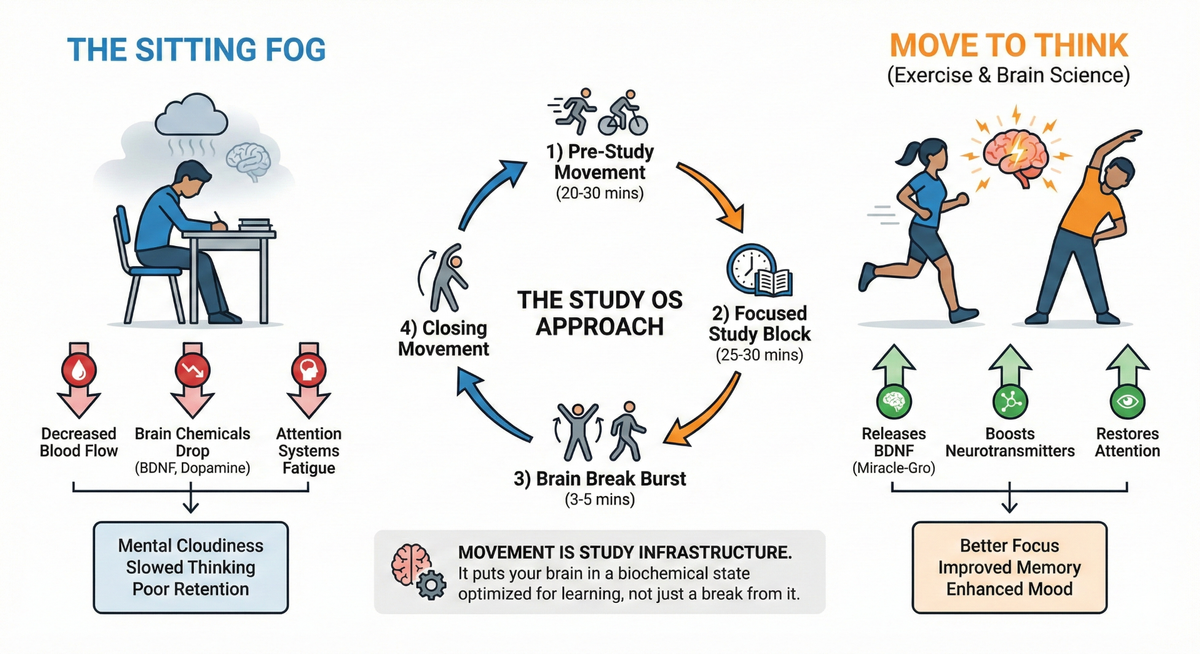
Why sitting still for hours feels productive but actually slows down your learning.
You sit down to study. After an hour, you feel foggy. Your eyes glaze over. You read the same paragraph three times and nothing sticks.
That's not lack of willpower. It's physiology.
Here's what most students don't realize: your brain runs better when your body moves. A brief burst of exercise before studying primes your brain for learning. And movement breaks during study sessions prevent the cognitive fog that makes everything harder.
The problem isn't that students are lazy or distracted. The problem is they're trying to learn in a state their brain wasn't designed for — prolonged stillness that starves the brain of the oxygen, chemicals, and activation it needs to work well.
The named pattern: The Sitting Fog
The Sitting Fog: The gradual mental cloudiness that sets in during prolonged sitting — when your focus fades, your thinking slows, and information stops sticking.
You've felt The Sitting Fog before. You start studying and feel sharp. Thirty minutes later, you're re-reading sentences. An hour in, you're staring at the page but nothing's going in. Two hours later, you wonder why you feel dumber than when you started.
Here's the uncomfortable truth: that long, uninterrupted study marathon? Your brain checked out somewhere around minute 45. But the same material studied with movement breaks? That's when real learning happens.
Quick diagnosis: are you fighting The Sitting Fog?
Common symptoms of students stuck in The Sitting Fog:
- Feels focused at first, then "hits a wall" after 30-45 minutes
- Re-reads paragraphs multiple times without absorbing them
- Feels physically restless but stays seated because "sitting still = studying"
- Gets headaches or feels drained after study sessions
- Studies for hours but can't recall much the next day
- Feels like the brain "just doesn't work" during homework
What's actually happening:
When you sit for extended periods, several things occur:
- Blood flow decreases: Less oxygen and glucose reach your brain
- Brain chemicals drop: BDNF (brain-derived neurotrophic factor), dopamine, and norepinephrine decline
- Attention systems fatigue: Your prefrontal cortex — the CEO of focus —gets tired
- Stress hormones accumulate: Cortisol builds up without physical release
The result? You're asking your brain to learn in a state of mild deprivation. It's like trying to run a race after holding your breath.
The science: what exercise does to your brain
Neuroscientist John Ratey calls exercise "Miracle-Gro for the brain." Here's what the research shows:
The BDNF effect
BDNF (brain-derived neurotrophic factor) is a protein that helps neurons grow, connect, and strengthen. Think of it as fertilizer for brain cells.
Exercise — especially aerobic exercise — dramatically increases BDNF levels. And here's the key finding: BDNF levels stay elevated for hours after exercise, creating a window of enhanced learning.
Charles Hillman's research with schoolchildren found that students who exercised before class showed:
- Better attention during lessons
- Improved working memory for problem-solving
- Higher academic performance on tests that day
The effect isn't subtle. It's measurable and significant.
The neurotransmitter boost
Exercise releases a cocktail of brain chemicals that support learning:
| Chemical | What It Does | Learning Benefit |
|---|---|---|
| BDNF | Grows and strengthens neurons | Better memory formation |
| Dopamine | Drives motivation and reward | Increases engagement and persistence |
| Norepinephrine | Enhances alertness | Sharpens attention and focus |
| Serotonin | Regulates mood | Reduces anxiety that blocks learning |
| Endorphins | Reduces stress | Calms the nervous system for focus |
This isn't about feeling good (though you will). It's about putting your brain in a biochemical state optimized for learning.
The timing research
Kirk Erickson's research on timing shows that exercise's cognitive benefits peak when timed strategically:
- 20-30 minutes of moderate exercise produces the strongest learning benefits
- Benefits begin within 10-15 minutes after exercise ends
- Enhanced state lasts 1-2 hours, gradually tapering off
- Even brief movement (3-5 minutes) can partially reset attention
This means the best time to exercise isn't after studying — it's before.
The movement break research
Studies on "active breaks" during learning show that brief movement interruptions:
- Restore attention that naturally declines during sitting
- Improve information retention compared to continuous sitting
- Reduce fidgeting and off-task behavior (especially for younger students)
- Lower stress hormones that interfere with memory
The brain isn't built for marathon focus. It's built for cycles of engagement and recovery.
The Study OS approach: working with your body
Instead of fighting your physiology, a Study OS helps you leverage it:
1) Front-load exercise before challenging study
The 20-30 minutes before a difficult study session is the perfect time for moderate exercise. This could be:
- A brisk walk or bike ride
- Jumping jacks, dancing, or active play
- A quick sports practice
- Climbing stairs or doing bodyweight exercises
The goal isn't exhaustion — it's elevation. You want to feel energized, not wiped out.
2) Use the "Brain Break Burst" every 25-30 minutes
Long study blocks should be broken up with brief movement:
- 25-30 minutes of focused study
- 3-5 minutes of movement
- Repeat
This rhythm keeps The Sitting Fog from settling in.
3) Match intensity to timing
| When | Intensity | Example |
|---|---|---|
| Before studying | Moderate (slightly breathless) | Brisk walk, bike ride, active play |
| During breaks | Light to moderate | Walking, stretching, jumping jacks |
| Late evening | Light only | Gentle stretching (avoid vigorous exercise close to bedtime) |
4) Treat movement as study infrastructure
Movement isn't a distraction from studying — it's a prerequisite for effective studying. Just like you wouldn't study without your textbook, don't study without movement built into your routine.
5) Notice your fog patterns
Track when The Sitting Fog hits you personally. Some students fog out at 20 minutes; others last 40. Knowing your pattern lets you time breaks perfectly.
A concrete Tuesday example (what this looks like in real life)
Grade 6 Science (Cell Biology), Tuesday 4:00-5:00 pm (60 minutes)
Goal: Use exercise timing to maximize learning.
4:00-4:20 — Pre-study movement (20 minutes)
- Walk home from school (or bike, or play outside)
- If weather's bad: jumping jacks, dancing to music, or climbing stairs
- Target: Feel slightly breathless, heart rate elevated
- Output: Brain primed with BDNF and ready to focus
4:25-4:50 — Focused study block #1 (25 minutes)
- Active recall: "What are the parts of a cell?"
- Note-making or flashcard creation
- Full focus, no phone
- Output: 1-2 concepts deeply processed
4:50-4:55 — Brain Break Burst (5 minutes)
- Stand up and do 10 jumping jacks
- Walk around the room or go outside briefly
- Do 5 arm circles and 5 squats
- Output: Attention reset, fog prevented
4:55-5:20 — Focused study block #2 (25 minutes)
- Practice problems or self-quizzing
- Connect new material to what was learned in block #1
- Output: 1-2 more concepts processed
5:20-5:25 — Closing movement (5 minutes)
- Light stretching while mentally reviewing key points
- Walk to put away materials
- Output: Session complete with physical and mental closure
What happens next: That evening, the material gets consolidated during sleep. Because it was learned in an optimized brain state (post-exercise, with fog-preventing breaks), retention will be significantly better than if you'd sat motionless for an hour.
Try this today (3 minutes): The Brain Break Burst
Use this quick routine when The Sitting Fog starts creeping in.
Total time: 3 minutes
Output: Attention reset, blood flowing, brain chemicals refreshed
Minute 1 — Get vertical and breathe
- Stand up (this alone helps)
- Take 5 deep breaths
- Roll your shoulders 5 times forward, 5 times backward
Minute 2 — Get your heart rate up slightly
- 10 jumping jacks (or march in place if needed)
- 10 arm swings (big circles)
- 5 squats (or chair stands)
Minute 3 — Reset and return
- Walk around the room once
- Look out a window or at something far away (rests your eyes)
- Take 3 deep breaths
- Return to your seat
De-shaming reframe:
If you've been forcing yourself to sit still because "good students don't get up," you weren't being disciplined — you were working against your biology. Moving isn't breaking focus. Moving restores it.
For parents: how to support the exercise-learning connection
- Protect pre-homework movement time: Don't rush kids from car to desk. A 15-20 minute movement buffer between school and homework pays off in focus.
- Reframe breaks: "Take a break" should mean "move your body," not "check your phone." Phone breaks don't reset the brain — movement does.
- Don't punish with stillness: "Sit there until you finish" teaches kids that stillness is the goal. Instead, build movement into the routine.
- Avoid: Scheduling homework immediately after a long car ride or passive activity.
- Better: "Go play outside for 20 minutes, then we'll start homework." Their brain will be ready.
Quick wins: movement for different settings
| Situation | Movement Option |
|---|---|
| At home | Jumping jacks, dancing, stairs, backyard play |
| At school | Walk to water fountain, bathroom break, stretch at desk |
| In the library | Walk between stacks, bathroom break, standing while reading |
| No space | Seated leg lifts, arm stretches, standing up and sitting down 10 times |
| Rainy day | Indoor dance party, yoga stretches, jumping jacks in place |
The key is any movement — even small amounts help more than sitting still.
The pre-exam movement advantage
Movement is especially powerful before tests and exams:
The morning of:
- A 20-minute walk or light jog before leaving for school
- Avoid rushing straight from bed to desk to car
Just before the exam:
- Walk to the exam room (don't arrive by car at the last minute)
- Use bathroom breaks strategically for quick movement
- Even standing while waiting helps
Research shows that students who exercised before exams demonstrated:
- Better recall of studied material
- Improved problem-solving on novel questions
- Lower test anxiety symptoms
- More sustained focus throughout the exam
The sitting vs. moving comparison
| Factor | Prolonged Sitting | Regular Movement |
|---|---|---|
| Blood flow to brain | Decreases over time | Maintained or increased |
| BDNF levels | Low | Elevated for hours |
| Attention span | Declines after 30-45 min | Resets with each break |
| Stress hormones | Accumulate | Released and balanced |
| Memory formation | Impaired | Enhanced |
| Mood and motivation | Declines | Maintained |
| Learning efficiency | Low (feel busy, retain little) | High (retain what you study) |
Common objections (and the research-based responses)
"I don't have time for exercise AND studying."
You don't have time not to exercise. Studying in a foggy brain state means you retain less — so you have to study longer to learn the same amount. Twenty minutes of exercise can make the next two hours of studying significantly more effective.
"My kid can't focus even with breaks."
That might mean they need more movement, not less. Some children need movement before they can sit at all. Start with a longer active period (30+ minutes), then try shorter study blocks (15-20 minutes).
"Exercise makes me tired, not focused."
You might be exercising too intensely or too close to study time. For learning benefits, aim for moderate intensity (can talk but slightly breathless) and give yourself 10-15 minutes to settle before studying.
"I have to sit still at school all day — I can't control that."
You can control after-school movement. And you can advocate for yourself: ask to use the bathroom (walk there slowly), take active breaks when allowed, and use any free moment for movement.
Calm Next Step: make movement part of your Study OS
Your body isn't separate from your learning — it's the foundation of it.
EaseFactor's Study OS helps you:
- Schedule study sessions with movement breaks built in
- Track your focus patterns to find your personal fog threshold
- Build pre-study exercise into your routine
- Learn in a state your brain was designed for
The result? More energy, better focus, and studying that actually sticks — because you're working with your body, not against it.
Citations
- Ratey, J. (2008): Spark: The Revolutionary New Science of Exercise and the Brain—comprehensive overview of exercise-cognition link
- Hillman, C. et al. (2009): The effect of acute treadmill walking on cognitive control and academic achievement
- Erickson, K. et al. (2011): Exercise training increases size of hippocampus and improves memory
- Donnelly, J. et al. (2016): Physical activity, fitness, cognitive function, and academic achievement in children
- Ratey, J. & Loehr, J. (2011): The positive impact of physical activity on cognition during adulthood
- Cotman, C. & Berchtold, N. (2002): Exercise: a behavioral intervention to enhance brain health and plasticity
- Sibley, B. & Etnier, J. (2003): The relationship between physical activity and cognition in children: A meta-analysis
- Tomporowski, P. et al. (2008): Exercise and children's intelligence, cognition, and academic achievement
TL;DR
- The Sitting Fog is real — prolonged stillness creates cognitive decline that makes learning harder, not easier.
- Brief exercise before studying releases BDNF and other brain chemicals that dramatically improve focus, memory, and mood.
- A Study OS builds movement into your routine: exercise before studying, Brain Break Bursts every 25-30 minutes, and recognition that movement is studying infrastructure — not a distraction from it.

Manoj Ganapathi
Founder and Builder of EaseFactor. Passionate about evidence-based learning and helping students build effective study habits through cognitive science principles.
Ready to Study Smarter?
EaseFactor uses these learning science principles to help you build lasting knowledge.