Your Brain's Control Tower: Building the Executive Functions That Power Every Study Skill
 Manoj Ganapathi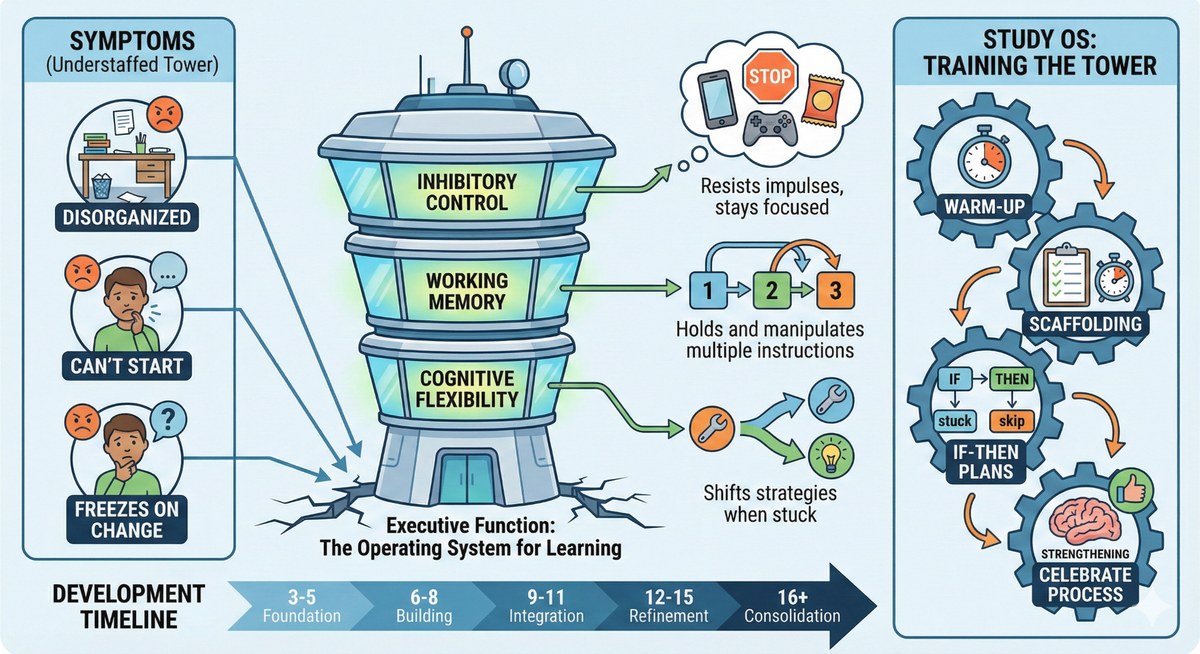
Why your child can ace a concept in tutoring but still lose the worksheet, forget to start the assignment, and get derailed the moment something unexpected shows up on a test.
You've seen it. The student who understands the material but can't organize a binder. The kid who knows the answer but blurts it out at the wrong time. The teenager who plans to study after dinner — every single night — and never actually starts.
The problem isn't intelligence. It isn't laziness. It isn't "not caring enough."
The problem is executive function — the set of brain skills that control everything else. Planning, prioritizing, starting tasks, staying focused, adapting when things change. Every study strategy, every time-management system, every organizational hack depends on these skills working in the background.
And here's the part most people miss: executive functions are trainable. They're not personality traits or character flaws. They're cognitive skills that develop unevenly across childhood and adolescence — and they respond to practice the same way any skill does.
EaseFactor treats executive function as the operating system beneath the Study OS: the foundation that every other learning strategy runs on.
The named pattern: The Control Tower
The Control Tower: Your brain's air traffic control system — the prefrontal cortex directing which thoughts to land, which to hold in a pattern, and which to reroute when conditions change. When the Control Tower is understaffed, planes (tasks, impulses, plans) pile up, crash into each other, or circle endlessly without landing.
Here's what an understaffed Control Tower looks like:
- Teacher gives a multi-step instruction
- Student catches step 1, starts it, forgets steps 2 and 3
- A distraction lands (phone buzz, classmate talking) — no ability to wave it off
- Original task gets lost in the pileup
- Student feels overwhelmed, shuts down or acts out
- Adults interpret this as "not paying attention" or "being lazy"
The student's radar works fine. Their runway works fine. The Control Tower just doesn't have enough trained controllers yet.
Quick diagnosis: symptoms vs infrastructure
Symptoms parents and teachers notice:
- "She's so smart but so disorganized"
- "He can't seem to get started on anything"
- "She knows the material but freezes when the test format changes"
- "He blurts out answers without raising his hand"
- "She loses every worksheet between school and home"
What's actually missing:
Not motivation, not intelligence — executive function infrastructure. These symptoms map directly to three core EF skills:
| Symptom | Missing EF Skill | What it means |
|---|---|---|
| Can't get started | Inhibitory control | Can't suppress competing impulses (phone, snacks, easier tasks) to prioritize the right task |
| Loses track of instructions | Working memory | Can't hold and manipulate multiple pieces of information at once |
| Freezes when plans change | Cognitive flexibility | Can't shift strategies when the first approach isn't working |
| Disorganized materials | Working memory + inhibitory control | Can't maintain organizational systems without external scaffolding |
| "Knows it but can't show it" | All three | Understanding exists but can't be directed, sequenced, and adapted under test conditions |
More tutoring won't fix a Control Tower problem. You need to train the controllers.
The science: three skills, one system
The three core executive functions (Diamond, 2013)
Adele Diamond, Canada Research Chair in Developmental Cognitive Neuroscience at UBC, identified three core executive functions that underpin all higher-order thinking:
1. Inhibitory Control — The ability to stop a dominant response and do something less automatic instead. This includes resisting impulses (don't check the phone), suppressing distracting information (ignore the noise), and overriding habits (don't use the familiar-but-wrong formula).
2. Working Memory — The ability to hold and manipulate information in your mind. Not just remembering a phone number long enough to dial it, but rearranging multi-step instructions, connecting a new concept to something learned last week, or keeping track of where you are in a multi-part problem.
3. Cognitive Flexibility — The ability to shift perspectives, strategies, or mental sets. When Plan A fails, cognitive flexibility lets you pivot to Plan B instead of getting stuck. It's what helps you switch between subjects, adapt to a different test format, or see a problem from a new angle.
These three skills combine to produce everything we call "self-regulation"—planning, organizing, prioritizing, monitoring progress, and adjusting behavior.
The unity/diversity model (Miyake & Friedman)
Akira Miyake and Naomi Friedman's influential research showed that these three EFs are separable but related — they share a common core (unity) but also have distinct components (diversity). This means:
- A student can be strong in working memory but weak in inhibitory control
- Training one EF can partially benefit the others (through the shared core)
- But targeted practice on the specific weak EF produces the biggest gains
EF predicts success better than IQ
Here's the finding that changes everything: executive function in early childhood predicts math and reading achievement more accurately than IQ. Working memory at age 5 is a better predictor of literacy at age 11 than IQ scores. EF accounts for more variance in academic outcomes related to socioeconomic status than either IQ or language ability.
Why? Because IQ measures what you can understand. Executive function determines whether you actually apply what you understand — whether you start the task, stay focused, hold the steps in mind, and adapt when something goes wrong.
A brilliant student with weak EF is like a powerful engine with a broken steering wheel.
EF develops unevenly — and that's normal (Zelazo)
Philip Zelazo's research on EF development shows that the prefrontal cortex — home of the Control Tower — is one of the last brain regions to fully mature, continuing to develop into the mid-20s. But the growth isn't linear:
| Age Range | EF Development Stage | What's emerging |
|---|---|---|
| 3–5 | Foundation | Basic inhibitory control, simple rule-following |
| 6–8 | Building | Working memory expansion, multi-step tasks |
| 9–11 | Integration | Cognitive flexibility, self-monitoring |
| 12–15 | Refinement | Planning, abstract thinking, long-term goal management |
| 16+ | Consolidation | Complex decision-making, impulse regulation under stress |
This means a 10-year-old who can't organize a long-term project isn't failing — their Control Tower is still under construction. Meeting students where their EF actually is, rather than where we wish it were, is the starting point for real progress.
The Study OS approach: training the Control Tower
A Study OS doesn't just use executive functions — it trains them through use. Here's how:
1. Externalize the Control Tower (scaffold, then fade)
Young students need external scaffolds that do what their developing EF can't yet do internally:
- Checklists replace working memory ("What are my steps?")
- Timers replace time awareness ("How long has it been?")
- Visual task boards replace prioritization ("What's most important?")
As EF strengthens, these scaffolds gradually fade. The student who needed a checklist at 8 runs the same process mentally at 12.
2. Warm up before studying (not just the subject)
Athletes don't sprint without warming up. Students shouldn't study without activating their Control Tower. A brief EF warm-up before each session primes inhibitory control, loads working memory, and activates flexible thinking.
3. Build "if-then" plans for flexibility
Cognitive flexibility grows when students pre-plan their responses to obstacles:
- "If I get stuck on a problem, then I'll skip it and come back"
- "If I finish early, then I'll review my weakest topic"
- "If I feel distracted, then I'll take a 2-minute movement break"
These implementation intentions train the brain to shift strategies automatically instead of freezing.
4. Keep sessions short and structured
Long, unstructured study sessions overwhelm developing EF. Short, structured sessions (12–20 minutes) with clear start/stop points and defined outputs let the Control Tower practice managing a workload it can actually handle.
5. Celebrate the process, not just the product
When you notice a student stopping themselves from checking their phone, remembering a step without being reminded, or trying a different approach after getting stuck — that's EF in action. Name it: "You just used your inhibitory control. That's your Control Tower getting stronger."
A concrete Tuesday example (what this looks like in real life)
Grade 7 Science (Cell Biology), Tuesday 4:30 PM (12 minutes)
Goal: Practice all three EF skills while reviewing cell organelles.
- 2 minutes — Control Tower warm-up (inhibitory control) Set a timer. Open your notebook to the right page. Put your phone in another room. Write: "Today I'm reviewing: cell organelles. I will NOT switch to another subject." Output: Phone removed, task defined, commitment written.
- 5 minutes — Retrieval with hold-and-connect (working memory) From memory, list 5 organelles and their functions. Then, without looking, draw arrows showing how at least 2 organelles depend on each other (e.g., ribosomes make proteins → ER packages them). Output: 5 organelles listed + 2 connection arrows drawn from memory.
- 3 minutes — The "What If" challenge (cognitive flexibility) Answer: "What would happen to the cell if the mitochondria stopped working?" Write 2-3 consequences, then flip it: "What if the cell had extra mitochondria?" Output: 2-3 consequences for each scenario.
- 2 minutes — Control Tower debrief Write: "EF win today:" (e.g., "I didn't check my phone for 12 minutes") and "Still building:" (e.g., "I almost forgot the connection step"). Schedule Thursday's session. Output: 1 EF win + 1 growth area + 1 scheduled session.
Try this today (10 minutes): The Control Tower Check
Total time: 10 minutes
Output: 1 inhibition rep + 4 working memory items + 1 flexibility pivot + 1 EF win captured
This routine warms up all three executive functions before any study session. Use it as a pre-study launch sequence.
Step 1: Clear the runway (inhibitory control) — 2 minutes
Remove your top 3 distractions physically. Phone in another room. Browser tabs closed. Snack already prepared (so you don't need to get up).
Write one sentence: "For the next 10 minutes, I am ONLY doing: ________."
This trains inhibitory control—the ability to say no to everything except the task.
Step 2: Load the flight plan (working memory) — 3 minutes
Without looking at any notes, write down:
- What you studied in this subject last time (2 facts)
- What you're supposed to work on today (1 goal)
- One connection between old and new material
This forces working memory to retrieve, hold, and connect—exactly what it needs to do during study.
Step 3: Flex drill (cognitive flexibility) — 3 minutes
Take one concept you're studying and answer TWO questions:
- "How is this SIMILAR to something in a different subject?"
- "What would happen if the OPPOSITE were true?"
This trains perspective-shifting—the ability to see material from multiple angles.
Step 4: Tower log (metacognition) — 2 minutes
Write:
- "My Control Tower win today:" (name one EF skill you used well)
- "My Control Tower goal for next session:" (name one to improve)
De-shaming reframe:
An understaffed Control Tower isn't a character flaw — it's a development stage. Every student's prefrontal cortex is literally under construction until their mid-20s. The point isn't perfection; it's practice. Each session is one more controller being trained.
For parents: how to support executive function without becoming the Control Tower yourself
- Scaffold, don't rescue. Provide checklists, visual schedules, and reminders — but let your child use them rather than doing the organizing for them. The goal is to build their tower, not staff it permanently with yours.
- Name the skill, not the failure. Instead of "Why can't you just get started?" try "Getting started uses inhibitory control — let's do a 2-minute runway clear together." When kids understand EF as a skill set, they stop interpreting struggles as personal defects.
- Expect unevenness. A child might have strong working memory but weak inhibitory control, or vice versa. That's the unity/diversity model in action — it's normal, not a contradiction.
- Shrink the task, not the expectation. If a 30-minute assignment overwhelms their EF, break it into three 10-minute blocks with clear outputs for each. The work gets done; the Control Tower doesn't crash.
Calm next step: make the Control Tower easier to train
Executive function is the invisible skill behind every visible study outcome—but most students never learn to train it directly.
EaseFactor builds EF development into every study session: structured session timers that scaffold inhibitory control, retrieval prompts that exercise working memory, and adaptive difficulty that requires cognitive flexibility. The Control Tower gets stronger every time a student uses the system — not through separate "brain training games," but through the actual work of learning.
Less overwhelm. More follow-through. A Study OS that trains the brain running the show.
TL;DR
- Executive functions are your brain's Control Tower — three core skills (inhibitory control, working memory, cognitive flexibility) that direct every other study skill.
- They're trainable, not fixed: EF predicts academic success better than IQ, and it responds to deliberate practice.
- Your next step: the 10-minute "Control Tower Check" routine that warms up all three EF skills before any study session.
Citations
- Diamond, A. (2013): "Executive Functions," Annual Review of Psychology — foundational review defining three core EFs (inhibitory control, working memory, cognitive flexibility) and establishing that EFs are trainable
- Miyake, A., Friedman, N. P., et al. (2000): "The Unity and Diversity of Executive Functions" — landmark latent variable analysis showing EFs are separable but related
- Miyake, A. & Friedman, N. P. (2012): "The Nature and Organization of Individual Differences in Executive Functions: Four General Conclusions" — updated unity/diversity framework with common EF factor
- Zelazo, P. D. (2015): "Executive Function: Reflection, Iterative Reprocessing, Complexity, and the Developing Brain" — EF development across childhood and adolescence
- Blair, C. & Razza, R. P. (2007): "Relating Effortful Control, Executive Function, and False Belief Understanding to Emerging Math and Literacy Ability in Kindergarten" — EF predicts academic outcomes beyond IQ
- Best, J. R., Miller, P. H., & Naglieri, J. A. (2011): "Relations between Executive Function and Academic Achievement from Ages 5 to 17" — large national sample showing EF-achievement link across age ranges
- Diamond, A. & Lee, K. (2011): "Interventions Shown to Aid Executive Function Development in Children 4 to 12 Years Old" — review of evidence-based EF training approaches
- Molyneux, T. & Diamond, A. (2025): "Integrating Social and Emotional Learning into Mathematics Education" — recent work connecting EF development to academic contexts

Manoj Ganapathi
Founder and Builder of EaseFactor. Passionate about evidence-based learning and helping students build effective study habits through cognitive science principles.
Ready to Study Smarter?
EaseFactor uses these learning science principles to help you build lasting knowledge.