Cross-Curricular Knowledge Networks: How to Stop Studying in Silos and Start Learning Like the Real World
 Manoj Ganapathi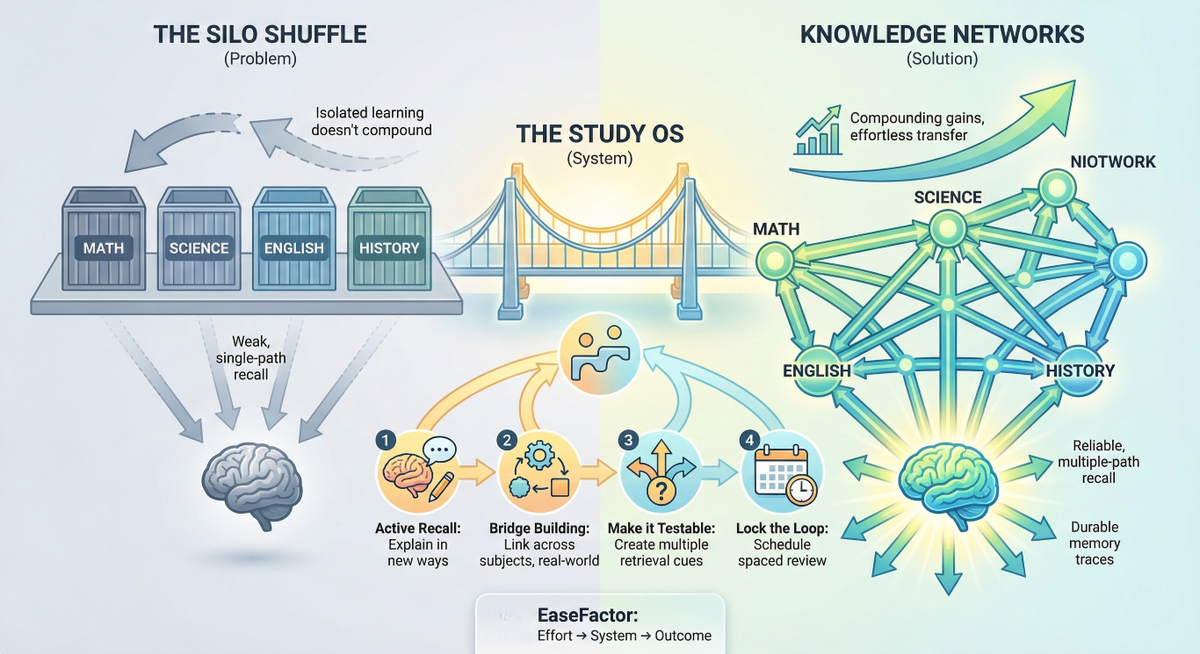
Many students do the "right" things: read notes, highlight, finish worksheets, even attend tutoring - and still freeze during tests or struggle to apply concepts to new questions.
It often isn't laziness or intelligence.
It's the Silo Shuffle:
Silo Shuffle (pattern): A student studies each subject as if it lives in a separate box - Math box, Science box, English box - so knowledge doesn't transfer when a problem mixes boxes (which real-world problems always do).
If learning stays boxed, students may perform in short bursts, but it doesn't compound. The brain remembers paths, not just facts. And isolated facts have fewer paths.
Insight: Your brain is not a filing cabinet — it's a network
When students learn, their brains don't store information like neatly labeled folders. They build associative networks: ideas connected by meaning, context, and use.
That matters because memory works less like "storing" and more like "finding." The question is:
How many routes lead back to the idea when you need it?
- If a concept is linked only to the chapter it came from, retrieval is fragile.
- If it's linked to two other subjects, a real example, and a personal analogy, retrieval becomes far more reliable.
This is why cross-curricular learning isn't "mixing subjects for fun." Done well, it's memory engineering.
The science (made practical): why connections increase retention and transfer
Cross-curricular knowledge networks leverage a few robust learning principles:
1) Elaborative encoding: "Explain it in more than one way"
When students connect a concept to other ideas (even across subjects), they process it more deeply. Deeper processing tends to produce stronger memory traces.
Example:
- Fractions become sturdier when linked to ratios in Science (concentrations), proportions in Geography (map scales), and probability in Games/Sports.
2) Multiple retrieval cues: "More hooks, more recall"
If you can recall a concept through multiple prompts, it's less likely to disappear under pressure.
One concept, many cues:
- A "cycle" can be recalled through: life cycles (Biology), water cycle (Geography), economic cycles (Social Studies), periodic trends (Chemistry), narrative arcs (English), and sine/cosine cycles (Math).
3) Transfer: "Use what you know in a new place"
Transfer isn't automatic. Students don't naturally think, "This History idea helps my Literature essay." They need a system that repeatedly asks:
"Where else does this show up?"
That repeated linking trains interdisciplinary thinking — the skill the world rewards most.
Diagnosis: symptoms vs infrastructure
When students struggle to connect ideas, families often try symptom relief:
What families try (symptom relief) → What it helps → What it misses
- More hours → Short-term completion → Weak recall + low transfer
- Better notes → Cleaner review → Passive familiarity illusion
- Tutoring → Clarifies today's confusion → Doesn't automatically build durable networks
The Study OS approach: build bridges on a schedule
Think of learning like a city. Subjects are neighborhoods. A Study OS is the transit system: routes, transfers, and repeatable commutes that make movement effortless over time.
EaseFactor's philosophy here is simple:
Effort → System → Outcome
- Effort becomes advantage when it's guided by a system.
- A system compounds when it produces consistent, measurable outputs.
- Outputs (not intention) create confidence.
So how do we operationalize cross-curricular networks without making studying longer or messier?
We use a small repeatable protocol.
A concrete Tuesday example (what this looks like in real life)
Grade 7 Science (photosynthesis), 12 minutes after school
Goal: Build a cross-curricular network around one idea, using active recall.
- 2 minutes — Recall first (no notes). Write 4 lines answering: "What is photosynthesis? What goes in? What comes out?"
- 6 minutes — Build 3 bridges (quick, imperfect).
- Math bridge: Where do we see "inputs → outputs" or "rate"? (Graphs, slope, proportional reasoning)
- Geography bridge: How does sunlight/climate affect plants and crops?
- English bridge: Write one analogy: "Photosynthesis is like ______ because ______."
- 3 minutes — Create 3 retrieval questions.
- "If sunlight decreases, what happens to glucose production?"
- "How would a graph of sunlight vs. oxygen output look?"
- "Explain photosynthesis using a city-factory analogy."
- 1 minute — Schedule the next touch. Put a 5-minute review two days later.
Output: 4 recall lines + 3 bridges + 3 questions + next review scheduled.
That's a Study OS session: short, structured, compounding.
Try this today (10–12 minutes): The "3-Bridge Recall" routine
Use this after any homework session to stop the Silo Shuffle.
Step-by-step
Total time: 10–12 minutes
Materials: notebook or EaseFactor notes
- Active recall (3 minutes)
Without looking, write:
- 3 key facts
- 1 process (steps)
- 1 "why it matters" line
- Bridge building (5 minutes)
Add three cross-subject links (one sentence each):
- Math link: measure, graph, ratio, probability, logic
- Humanities link: story, cause-effect, ethics, history, argument
- Real-world link: daily life, news, hobbies, local context
- Make it testable (3 minutes)
Write 3 retrieval questions:
- 1 definition/explain question
- 1 "what if" question
- 1 application question
- Lock the loop (1 minute)
Schedule a review: 2 days later (quick), then 1 week later (short).
Why EaseFactor fits this problem (without replacing effort)
Cross-curricular learning fails when it's left to motivation. It succeeds when it becomes a default workflow.
EaseFactor is designed to make that workflow easier to repeat:
- Active recall prompts that force retrieval before review
- AI support for connection discovery ("What does this concept connect to in Math/History?")
- Spaced repetition and scheduling so bridges aren't built once and forgotten
- Visibility for families: progress becomes observable (outputs), not just hope
This is not "AI doing the thinking." It's AI supporting the system so the student can do more effective thinking, more consistently.
A Calm Next Step
If your child is struggling, ask:
"Is this a knowledge problem — or a connection problem?"
Then try one 10-minute 3-Bridge session and see whether recall and confidence improve within a week.
TL;DR
- Most "forgetting" is a connection problem, not an effort problem: ideas learned in isolation have fewer retrieval paths.
- Knowledge networks form when students repeatedly link concepts across subjects using active recall + simple mapping.
- A Study OS turns cross-curricular learning into a repeatable habit (small sessions, clear outputs, compounding gains).
Citations
- Transfer of learning (Bransford & Schwartz; educational psychology literature)
- Retrieval practice / testing effect (Roediger & Karpicke)
- Elaborative interrogation & elaboration (Dunlosky et al., learning techniques review)
- Schema theory / knowledge organization (Bartlett; later cognitive science work)
- Dual coding (as a support, not a replacement) (Paivio)

Manoj Ganapathi
Founder and Builder of EaseFactor. Passionate about evidence-based learning and helping students build effective study habits through cognitive science principles.
Ready to Study Smarter?
EaseFactor uses these learning science principles to help you build lasting knowledge.