Creating a Learning-Friendly Home Environment
 Manoj Ganapathi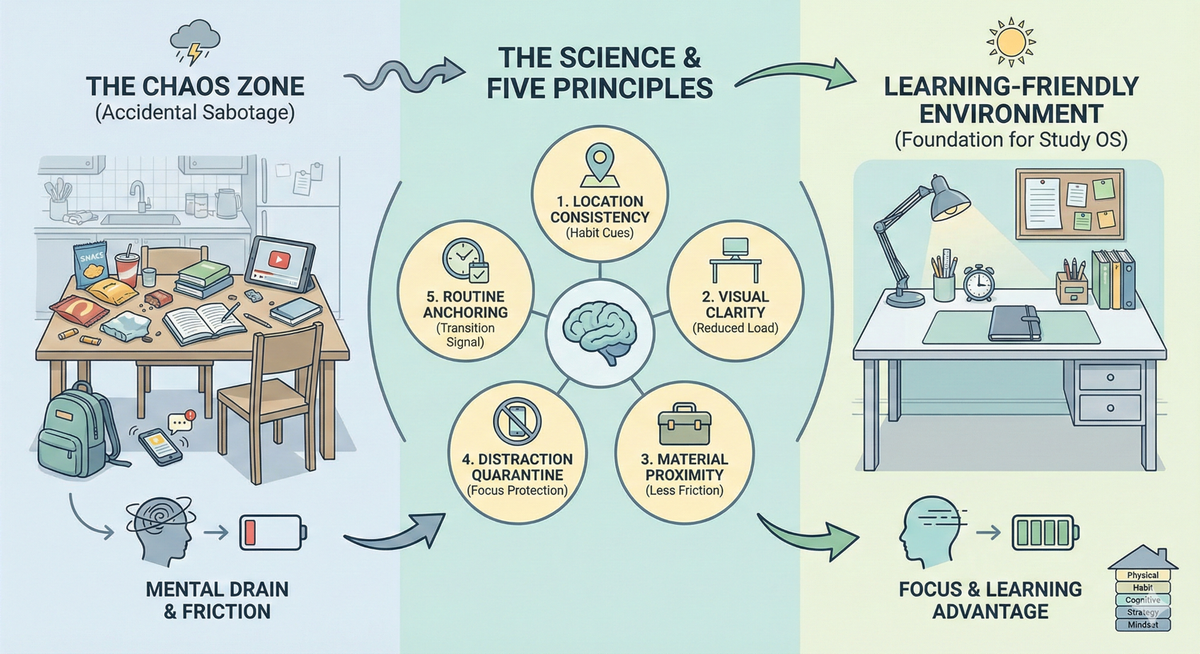
Your child doesn't need a bigger desk. They need a smarter system — where the environment does half the work before they even sit down.
You've bought the desk lamp. The organizers. Maybe even a whiteboard. You've told them to "find a quiet spot" and "stay focused." And yet, every evening dissolves into the same pattern: wandering, snacking, phone-checking, and finally — an hour before bedtime — panic studying.
The problem isn't effort. It's not discipline. It's that most homes are accidentally designed against learning.
Researchers in environmental psychology have shown that physical spaces profoundly shape behavior. The same child who can't focus at the kitchen table might enter flow state in a library. The difference isn't willpower — it's design.
This post will show you how to transform your home from a chaos zone into a learning advantage, using evidence-based principles that work for students from grade 3 through grade 10.
The named pattern: The Chaos Zone
The Chaos Zone: A home learning environment that accidentally sabotages focus through invisible friction — visual clutter, unpredictable timing, competing activities, and unclear boundaries between "study mode" and "everything else."
Symptoms of The Chaos Zone:
- Homework happens in a different spot every night
- The study area doubles as a gaming station, snack zone, or sibling hangout
- Materials are scattered across rooms (backpack here, notebook there, laptop somewhere else)
- There's no clear "start" signal — studying just kind of begins when guilt finally outweighs avoidance
- The phone is always within arm's reach
- Background noise is unpredictable (TV, siblings, conversations)
The Chaos Zone isn't about messy rooms or small apartments. It's about environmental friction — the invisible energy drain that happens when the brain has to manage distractions and learn content simultaneously.
Research by Boyatzis & Varghese (1994) and Fisher, Godwin, & Seltman (2014) shows that visual clutter alone can reduce attention and working memory performance by up to 35%. Your child isn't lacking focus — they're spending it all fighting the environment.
Quick diagnosis: environment vs. child
When studying fails at home, parents often blame the child:
- "Why can't you just concentrate?"
- "You need to try harder"
- "Stop getting distracted"
But environmental psychology suggests we should audit the space first.
Child-level symptoms:
- Can't start without being told
- Constantly getting up for snacks, drinks, or "just one thing"
- Homework takes 3x longer than it should
- Claims to have studied but remembers nothing
What's often missing (environment-level infrastructure):
- A consistent, designated study location
- Materials organized and accessible
- Predictable timing and start ritual
- Physical separation from entertainment/distractions
- Appropriate lighting and noise levels
- A clear boundary between "on" and "off" mode
The child is often responding rationally to an irrational environment. Fix the space, and the behavior often follows.
The science: how environments shape learning
This isn't folk wisdom. Environmental effects on cognition are well-documented in learning science and psychology.
Finding 1: Visual clutter reduces working memory
Fisher, Godwin & Seltman (2014) placed children in two identical classrooms — one with decorated walls and displays, one with bare walls. The result: children in the decorated room were off-task 38% more often and scored lower on assessments.
Why this matters: Working memory is limited (about 4 items for most people). Every poster, notification, or object in the visual field competes for cognitive space. A cluttered desk doesn't just look messy — it actively reduces available mental bandwidth.
Finding 2: Consistent locations strengthen habit formation
Habit research by Wendy Wood and colleagues shows that environmental cues are the most powerful triggers for automatic behavior. When you study in the same place, at the same time, the location itself becomes the cue. The brain doesn't need to "decide" to study — the environment prompts it.
Research finding: People who study in a consistent location build study habits faster and maintain them longer than those who study in varied locations — even if the varied locations are objectively better.
The kitchen table isn't worse than a desk. But a different spot every night requires a new "starting decision" each time.
Finding 3: Noise affects performance differently by task type
A meta-analysis by Szalma & Hancock (2011) found that noise effects depend on what you're doing:
| Task Type | Noise Effect |
|---|---|
| Simple, repetitive | Moderate background noise can help (arousal) |
| Complex, requiring focus | Background noise hurts performance |
| Creative, divergent thinking | Low ambient noise helps; silence can be too "empty" |
| Memory-intensive | Unpredictable noise is worst (conversations, TV) |
For homework — which is usually memory-intensive and requires focus —predictable, low-level background noise (white noise, lo-fi music) is better than either total silence or unpredictable household noise.
Finding 4: Lighting affects alertness and mood
Research on circadian rhythms shows that lighting quality affects cognitive performance:
- Bright, cool light (blue-enriched): Increases alertness, better for daytime studying
- Dim, warm light (yellow/orange): Promotes relaxation, signals wind-down
- Natural daylight: Best for sustained attention and mood regulation
Many homes have the opposite setup: dim overhead lighting in study areas and bright screens everywhere. This mismatch can make it harder to enter "focus mode."
Finding 5: Phone proximity alone reduces cognitive capacity
In a remarkable study by Ward et al. (2017), students took a cognitive test with their phone in one of three conditions: on the desk (face down), in a bag nearby, or in another room entirely.
Results: Students with phones on the desk performed worst — even though the phones were face down and silenced. Performance improved when the phone was in a bag, and was best when the phone was in another room.
The mere presence of the phone consumed cognitive resources. Your child doesn't need to be "on" their phone to be affected by it — just seeing or knowing it's nearby is enough.
The Study Space Blueprint: Five design principles
Based on environmental psychology research, here are five principles for creating a learning-optimized space at home.
Principle 1: Location Consistency (The Same Spot Rule)
The principle: Study happens in the same physical location, every time. Not the couch today, the kitchen tomorrow, and bed on weekends.
Why it works:
- The location becomes a habit cue (you enter the zone and your brain shifts into study mode)
- Materials stay organized in one place
- Family members learn to protect that space during study time
Implementation:
- Designate a specific study spot (desk, table section, even a specific chair)
- If space is shared, define "study mode" with a physical marker (a lamp turned on, a specific placemat, etc.)
- The spot should be used only for studying — not gaming, not eating, not socializing
Small apartment hack: Even in tight spaces, a "study corner" or designated chair can work. The consistency matters more than the size.
Principle 2: Visual Clarity (The Clean Slate Rule)
The principle: The study area should be visually minimal — only what's needed for the current task.
Why it works:
- Reduces cognitive load from visual processing
- Eliminates "what should I do first?" decision fatigue
- Creates psychological separation between study mode and everything else
Implementation:
- Before each session, clear the surface to only: current materials, pen/pencil, water bottle
- Remove decorations from the immediate line of sight (posters behind, not in front)
- Use a "staging area" nearby for materials not currently in use
- End each session by clearing the space for the next day
The 30-second reset: At the end of studying, spend 30 seconds returning the surface to "clean slate" condition. This sets up tomorrow's start.
Principle 3: Material Proximity (The One-Stop Rule)
The principle: Everything needed for studying should be within arm's reach before starting.
Why it works:
- Eliminates "getting up to find things" friction
- Reduces working memory load (not tracking where things are)
- Prevents transitions that become distractions
Implementation:
- Create a "study kit" with common supplies: pens, pencils, highlighters, sticky notes, calculator, headphones
- Each night, stage tomorrow's specific materials before bedtime
- Use vertical organizers or a rolling cart to keep supplies close but not cluttering the surface
The anti-pattern: "I need to get my notebook from my backpack in the other room, and while I'm up I'll just grab a snack, and oh look my phone is charging over there..."
Principle 4: Distraction Quarantine (The Phone-Away Rule)
The principle: Devices and distractions should be physically removed from the study space — not just turned off.
Why it works:
- Phone proximity alone consumes cognitive resources (Ward et al., 2017)
- "Willpower" is a limited resource; physical distance is more reliable
- Removes the temptation loop entirely
Implementation:
- Phone goes in another room during study time (not in a pocket, not face-down on the desk)
- Create a "phone parking spot" outside the study area where devices live during work time
- If a phone is needed for homework (calculator, research), use "Do Not Disturb" mode with only essential apps accessible
- Consider a physical timer instead of phone timer (removes the excuse to touch the phone)
For younger students (grades 3-6): Parents should collect devices before study time. Frame it as "protecting focus," not punishment.
For older students (grades 7-10): Co-design the system. Ask: "Where should your phone live during homework so it doesn't pull your attention?"
Principle 5: Routine Anchoring (The Start Ritual Rule)
The principle: Study sessions begin with a consistent, brief ritual that signals the transition from "home mode" to "study mode."
Why it works:
- Rituals are powerful transition signals that prepare the brain (pre-performance routines in sports, for example)
- Reduces "activation energy" needed to start
- Creates a clear boundary — studying is "on" or "off," not a vague fog
Implementation:
- The ritual should be 1-3 minutes max
- Include physical actions: turn on desk lamp, open materials, take three breaths, set timer
- End the ritual with a specific phrase or action that means "now I begin"
- Keep the ritual identical every session
Example Start Ritual (The Launch Sequence):
- Sit at study spot
- Turn on desk lamp
- Open planner/board to see today's tasks
- Set timer for first work block
- Take three deep breaths
- Say (out loud or silently): "Let's go."
This 60-second sequence becomes automatic within a week, and the brain learns to shift into focus mode when it begins.
A concrete Tuesday example: Before and after
The Chaos Zone Tuesday (before):
4:30 PM — Gets home. Backpack dropped somewhere. Snack. TV on in background.
5:00 PM — Vaguely aware homework exists. Phone in hand.
5:45 PM — Parent asks "Did you start homework?" Defensive response.
6:00 PM — Finally sits at kitchen table. Siblings doing different things nearby. Materials scattered.
6:15 PM — Gets up for charger. Sees phone. "Just one video."
6:45 PM — Actually starts math. Realizes needed book is in backpack. Gets up.
7:30 PM — Frustrated, half-done, arguing with parent about focus.
The Learning-Friendly Tuesday (after):
4:30 PM — Gets home. Snack (pre-staged on counter, 10 minutes). Backpack goes to study spot.
4:45 PM — Phone parked in kitchen charging spot. Move to study desk.
4:50 PM — Start ritual: Lamp on. Planner open. Timer set for 25 minutes. Three breaths. "Let's go."
4:55-5:20 PM — First work block. Materials all within reach. Quiet. No interruptions.
5:20 PM — Timer. 5-minute break. Stretch. Water.
5:25-5:50 PM — Second block. Review what was learned.
5:50 PM — Done. Phone retrieved. Free time until dinner.
Total time working: About 50-55 minutes. Total time in the first scenario: 90+ minutes with less output and more stress.
Try this today (10 minutes): The Study Space Setup
Use this once to establish the environment, then maintain it.
Total time: 10 minutes
Output: A learning-ready space with clear boundaries and minimal friction.
Step 1: Designate the spot (2 minutes)
- Walk through your home. Identify one consistent location for studying.
- Criteria: Can accommodate materials. Can be quiet during study time. Not the bed.
- Mark it somehow — a specific chair, a desk lamp that signals "study mode," a placemat that only appears during homework.
- Tell the child: "This is your study spot. Homework happens here."
Step 2: Clear the visual field (3 minutes)
- With your child, clear the immediate study surface.
- Remove everything except: lamp, pencil holder, water bottle.
- Move decorations and toys to behind or beside, not in front.
- Create a "staging area" nearby (a basket or shelf) for books and materials waiting to be used.
Step 3: Create the study kit (3 minutes)
- Gather supplies into one container: pens, pencils, eraser, sticky notes, calculator, highlighters.
- Place the kit within arm's reach of the study spot.
- This kit lives here — it doesn't travel around the house.
Step 4: Set up the phone parking spot (1 minute)
- Choose a location outside the study area where devices go during work time.
- Could be: a basket by the front door, a charging station in another room, a drawer in the kitchen.
- Name it: "The phone lives here during study time."
Step 5: Create a start ritual (1 minute)
- Write down a simple 3-5 step ritual on a card or sticky note.
- Example: 1) Sit. 2) Lamp on. 3) Timer set. 4) Three breaths. 5) Begin.
- Post it at the study spot as a reminder until it becomes automatic.
For parents: age-appropriate adaptations
Grades 3-4 (Ages 8-10)
What they need:
- Parent-managed setup (they won't do this independently yet)
- Shorter work blocks (10-15 minutes)
- Physical, visible timers
- Study spot near where a parent can be present without hovering
Parent role:
- Set up the space with them
- Do the start ritual with them for the first few weeks
- Gradually shift ownership: "Can you do the lamp step yourself today?"
Grades 5-6 (Ages 10-12)
What they need:
- Some ownership of the space (let them choose the lamp, arrange the kit)
- Work blocks up to 20-25 minutes
- Freedom to listen to study music (test what works for them)
- Clear phone expectations (still parent-managed, but framed as "focus protection")
Parent role:
- Co-design the space; don't impose it
- Check the space weekly, not daily
- Ask: "What would make your study spot work better?"
Grades 7-8 (Ages 12-14)
What they need:
- Full ownership of the space design (within guidelines)
- Work blocks of 25-30 minutes
- Autonomy to manage their own phone parking (with accountability)
- Permission to personalize (as long as the principles are maintained)
Parent role:
- Set the guidelines; let them implement
- "Your study space is your responsibility. Here are the principles. How will you set it up?"
- Trust, but verify occasionally: "How's the space working for you?"
Grades 9-10 (Ages 14-16)
What they need:
- Near-complete autonomy
- Possibly different study locations for different tasks (desk for reading, table for projects)
- Self-managed phone boundaries
- Ability to adjust the system as needed
Parent role:
- Offer support if asked
- Model your own focus environment (they notice)
- If problems arise, ask: "Do you think your space is helping or hurting?"
Common objections (and responses)
"We don't have space for a study area"
You don't need a room — you need consistency. A specific chair at the kitchen table, used only for homework, is better than a dedicated desk used randomly. The "same spot" principle works in any size home.
"My child says they focus better with the TV on"
Research suggests otherwise for most tasks. However, some students do perform better with low, consistent background audio (not TV with changing content). Try an experiment: one week with TV, one week with lo-fi music or white noise. Compare the output and their feeling of focus.
"They need their phone for homework apps"
Fair. In that case:
- Put phone in "Do Not Disturb" mode
- Remove social/entertainment apps from the home screen
- Use device-specific timers or tools that block other apps during study time (Screen Time on iOS, Digital Wellbeing on Android)
- Alternatively, provide a separate device (tablet, old phone) for homework apps, with no other access
"They hate routine and rebel against it"
Involve them in designing the routine. Rigid imposition fails; collaborative design works. Ask: "What would help you start more easily? Let's figure out a system that works for you."
Also check if the pushback is about autonomy (they want control, not chaos). A teen who designs their own ritual will follow it; one who has it imposed will resist.
"This seems like a lot of setup for just homework"
The first setup takes 10 minutes. Maintenance takes 30 seconds per session (the "clean slate" reset). In return, you get:
- Less daily negotiation about starting
- Shorter homework time with better output
- Fewer distractions and arguments
- A system that compounds as habits form
The ROI is enormous.
How the Study OS connects to the study space
A learning-friendly home environment is the physical layer of a complete Study OS.
| Study OS Layer | What It Does | Home Environment Contribution |
|---|---|---|
| Physical Layer | Creates conditions for focus | Quiet, organized, consistent space |
| Habit Layer | Automates starting and stopping | Start ritual, same time/place |
| Cognitive Layer | Manages memory and attention | Reduced clutter, no phone proximity |
| Strategy Layer | Applies effective techniques | (Active recall, spacing—the "what" to do) |
| Mindset Layer | Supports persistence and growth | (Covered in other posts) |
The environment isn't separate from learning — it's foundational. Without the physical layer, everything else requires more willpower, more decision-making, and more energy that should go toward understanding the material.
Calm next step: build the foundation
The Chaos Zone isn't a character flaw. It's a design problem that affects most homes.
An optimized study environment provides:
- Automatic cues that trigger study mode
- Reduced friction so starting doesn't require willpower
- Protected attention so focus isn't fighting distractions
- Visible boundaries so everyone knows when studying is "on"
The result: less conflict, shorter homework time, better retention — and a child who increasingly manages their own learning without you needing to nag.
Citations
- Fisher, A. V., Godwin, K. E., & Seltman, H. (2014): Classroom visual environment study—decorated vs. bare walls affecting attention and learning
- Ward, A. F., Duke, K., Gneezy, A., & Bos, M. W. (2017): "Brain Drain" study—phone proximity reducing cognitive capacity
- Wood, W., & Neal, D. T. (2007): Habit research—environmental cues as triggers for automatic behavior
- Szalma, J. L., & Hancock, P. A. (2011): Meta-analysis of noise effects on cognitive performance
- Mehta, R., Zhu, R., & Cheema, A. (2012): Ambient noise and creativity research
- Boyatzis, C. J., & Varghese, R. (1994): Visual clutter and attention research
- Evans, G. W., & Stecker, R. (2004): Motivational consequences of environmental stress on children's cognitive development
- Duhigg, C. (2012): "The Power of Habit"—cue-routine-reward framework for habit formation
TL;DR
- The Chaos Zone drains cognitive resources before learning even starts—through visual clutter, inconsistent locations, phone proximity, and lack of routine.
- Environment shapes behavior. Research shows that clutter, noise, and distractions directly reduce working memory and attention.
- Five design principles: Consistent location, visual clarity, material proximity, distraction quarantine, and routine anchoring.
- The phone matters more than you think. Even face-down and silenced, its presence reduces cognitive capacity.
- A 10-minute setup creates a learning-ready space. Maintenance takes 30 seconds per session.
- Adapt by age: More scaffolding for grades 3-4, more autonomy for grades 9-10.
- This is the foundation of a Study OS. Without a learning-friendly environment, every other study strategy requires more willpower.

Manoj Ganapathi
Founder and Builder of EaseFactor. Passionate about evidence-based learning and helping students build effective study habits through cognitive science principles.
Ready to Study Smarter?
EaseFactor uses these learning science principles to help you build lasting knowledge.