Mapping Your Knowledge: How Concept Maps Reveal What You Really Know
 Manoj Ganapathi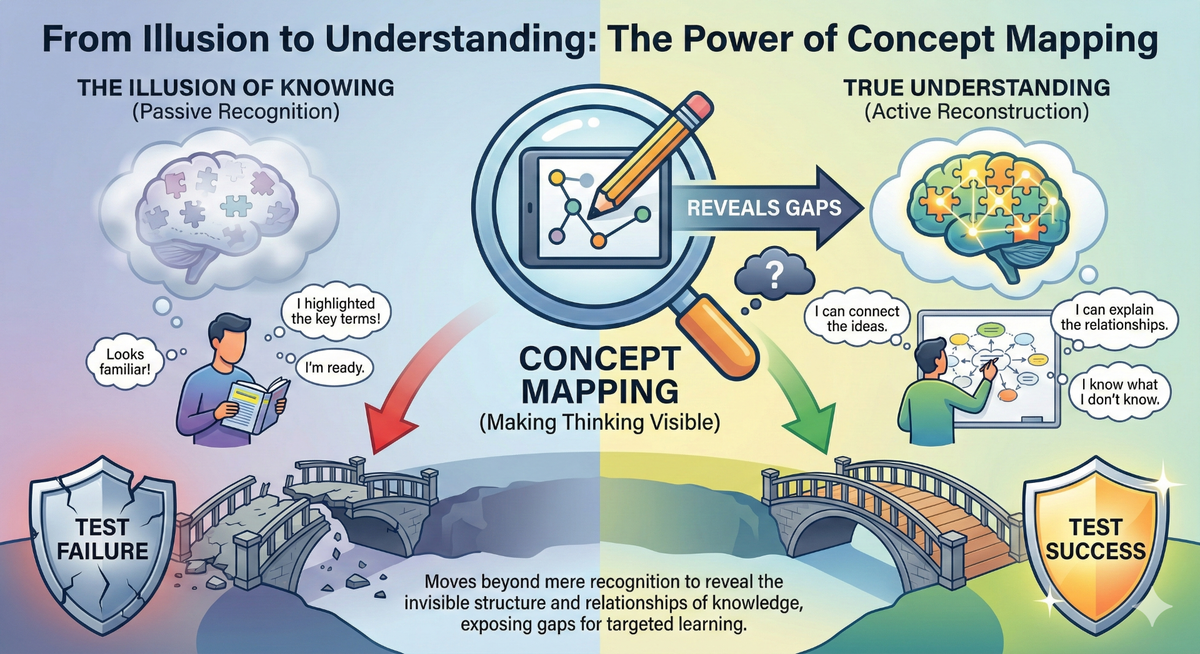
You read the chapter. You highlighted the key terms. You feel ready. But can you actually explain how those ideas connect?
Here's the uncomfortable truth: understanding feels complete until you try to draw it.
Most students can recognize correct information when they see it. Far fewer can organize that information into a web of meaningful relationships — which is exactly what tests, essays, and real-world problem-solving demand.
That's where concept mapping comes in: a visual thinking tool that forces you to externalize the invisible structure in your head. And when you try to draw it, something powerful happens: gaps become visible.
The named pattern: The Illusion of Knowing
The Illusion of Knowing: When a student can recognize information ("That looks right!") but can't reconstruct or connect it ("Wait, how does photosynthesis relate to cellular respiration?").
This illusion is comfortable. It feels like learning. But it breaks the moment someone asks: "Okay, but why?"
Here's what happens:
- Student reads material → feels familiar with terms
- Familiarity feels like understanding
- Test asks for connections between terms
- Student blanks: "I knew this yesterday!"
The problem isn't memory. It's structure. The ideas exist in the student's head like scattered puzzle pieces — but the picture was never assembled.
Quick diagnosis: recognition vs. reconstruction
| What feels like learning | What actually proves learning |
|---|---|
| "I recognize that term" | "I can define it without looking" |
| "That diagram looks familiar" | "I can redraw it from memory" |
| "I read the whole chapter" | "I can explain how the sections connect" |
| "I highlighted the key points" | "I can draw a map showing their relationships" |
If you can only do the left column, you're vulnerable. The Illusion of Knowing will survive until the test — then shatter.
What's missing: A system that forces you to organize knowledge before the high-stakes moment.
The science: why drawing connections changes everything
Concept mapping was developed by Joseph Novak and his team at Cornell University in the 1970s. The core insight: knowledge isn't a list — it's a network.
When you create a concept map, you're not just recording information. You're:
- Selecting the key concepts (What matters most?)
- Organizing them hierarchically (What's the big picture vs. details?)
- Connecting them with labeled links (How do they relate?)
- Revealing what you don't actually understand (Where are the gaps?)
Research findings
Research shows that concept mapping serves as both a cognitive strategy (helps you organize new information) and a metacognitive strategy (helps you monitor your own understanding).
Key findings from the research:
| Finding | Source |
|---|---|
| Concept mapping promotes critical thinking and improved reasoning | Novak & Canas |
| Visual organization increases memory retention vs. linear notes | Educational research reviews |
| Creating connections forces deeper processing than passive reading | Constructivist learning theory |
| Maps reveal gaps that students miss with traditional study methods | Metacognition research |
Here's the practical translation: mapping forces you to think in relationships, not just facts.
And relationships are what tests actually measure.
Why a Study OS beats "just draw a map"
A concept map is powerful. But most students struggle to use it consistently because:
- They don't know when to map (timing matters)
- They don't know how much to include (scope matters)
- They don't revisit maps (spaced review matters)
- They don't compare their maps to expert maps (feedback matters)
A Study OS solves these problems by:
1) Embedding mapping at the right moments
- After reading: Map what you just learned (while it's fresh)
- Before review: Redraw from memory (test your structure)
- Before tests: Compare to your original map (spot decay)
2) Keeping maps small and focused
The biggest mistake: trying to map an entire chapter at once. Start with one section, one concept cluster, one relationship chain.
3) Scheduling map reviews with spaced repetition
A map you create once and never revisit is wasted effort. Spaced reviews strengthen both the content and the connections.
4) Providing feedback loops
In EaseFactor, you can compare your map to model answers, identify missing links, and get specific guidance on what to strengthen.
A concrete Tuesday example (what this looks like in real life)
Grade 7 Science (Ecosystems), Tuesday 6:00–6:12 pm (12 minutes)
Goal: Transform "I read about ecosystems" into "I can explain how ecosystems work."
- 2 min — Recall dump (no notes)
Write down every key term you remember from the ecosystems chapter.
Output: 8-12 scattered terms (producer, consumer, decomposer, food chain, etc.)
- 5 min — Build the map
- Put "Ecosystem" in the center
- Draw lines to related concepts
- Label each line with how they connect ("contains," "eats," "breaks down," etc.)
Output: A rough concept map with 8-12 nodes and labeled connections
- 3 min — Gap check
Circle any connection you're unsure about. Write one question:
"I'm not sure how _____ connects to _____."
Output: 1-2 identified gaps
- 2 min — Schedule the fix
Put a 5-minute gap repair session on your calendar for tomorrow.
Output: Next review scheduled
Total output: One concept map + identified gaps + scheduled follow-up.
That's not just studying. That's metacognition training.
Try this today (10 minutes): The Knowledge Map Routine
Use this to transform any reading session from passive to active.
Total time: 10 minutes
Output: 1 concept map + 1 gap list + next review scheduled
Step 1: Brain dump (2 minutes)
Without looking at your notes, write every key term you can remember from your last study session.
- Don't organize yet — just get them on paper
- Aim for 6-10 terms
Step 2: Build connections (5 minutes)
- Put the main topic in the center of a blank page
- Add your terms around it
- Draw lines between related concepts
- Label each line with the relationship ("causes," "is a type of," "requires," etc.)
The labels are crucial. "Photosynthesis → Glucose" is vague. "Photosynthesis produces Glucose" is meaningful.
Step 3: Find your gaps (2 minutes)
Look at your map and ask:
- Which connections feel shaky?
- Which terms have no links?
- What's missing that should be there?
Write down 1-2 gaps: "I need to understand how _____ relates to _____."
Step 4: Schedule the repair (1 minute)
Add a 5-minute review to your calendar:
- Re-read only the gap areas
- Redraw that section of your map
- Test yourself: can you explain it now?
Success criterion: You have a map that reveals what you actually know — not what you think you know.
For parents: how to support concept mapping without doing it for them
- Ask process questions: "Can you show me how these ideas connect?" (Not: "What does this word mean?")
- Celebrate gaps found: "Great — you figured out what to review next." (Not: "You don't know that?!")
- Model imperfection: Draw your own rough map of something you're learning. Show that messy drafts are part of thinking.
- Don't correct the map directly: Let them discover missing links during review. That's where learning happens.
De-shaming reframe:
Finding gaps in your concept map isn't failure — it's the whole point. A map that reveals no gaps is either too easy or not honest. Real learning happens when you discover what you don't know before the test.
Calm next step: make mapping easier to practice
Concept mapping works because it forces you to organize knowledge visually — and that organization reveals what you really understand.
But the technique only helps if you use it consistently, review your maps with spacing, and track your gap repairs over time.
That's the heart of EaseFactor: a Personal Study OS that turns mapping from a one-time activity into a compounding habit — so every study session builds clearer, more connected understanding.
Citations
- Novak, J.D. & Canas, A.J. — Theory underlying concept maps and how to construct them; concept mapping as meaningful learning tool
- Novak, J.D. & Gowin, D.B. (1984) — Learning How to Learn; concept maps and Vee diagrams as metacognitive tools
- Ausubel, D.P. — Meaningful learning theory; prior knowledge and new concept integration
- Nesbit, J.C. & Adesope, O.O. — Meta-analysis of concept mapping for learning
- Karpicke, J.D. & Blunt, J.R. (2011) — Comparison of retrieval practice and concept mapping; Science publication
- O'Day, G.M. & Karpicke, J.D. (2021) — Comparing and combining retrieval practice and concept mapping
- Research on metacognition and self-regulated learning (Flavell, Zimmerman)
TL;DR
- Concept mapping makes thinking visible — you can't fake understanding when you have to draw the connections.
- The Illusion of Knowing traps students who recognize information but can't reconstruct it.
- A Study OS makes mapping effective by scheduling it at the right moments, keeping scope manageable, and building in spaced review.
- Concept mapping = thinking made visible (a diagram that shows how ideas connect, not just what they are).
- Gaps in your map reveal gaps in your understanding — before the test does.
- Your next step: a 10-minute "Knowledge Map" routine that transforms passive familiarity into active mastery.

Manoj Ganapathi
Founder and Builder of EaseFactor. Passionate about evidence-based learning and helping students build effective study habits through cognitive science principles.
Ready to Study Smarter?
EaseFactor uses these learning science principles to help you build lasting knowledge.