Your Child Reads Every Word But Can't Explain the Page: Building a Comprehension System That Actually Works
 Manoj Ganapathi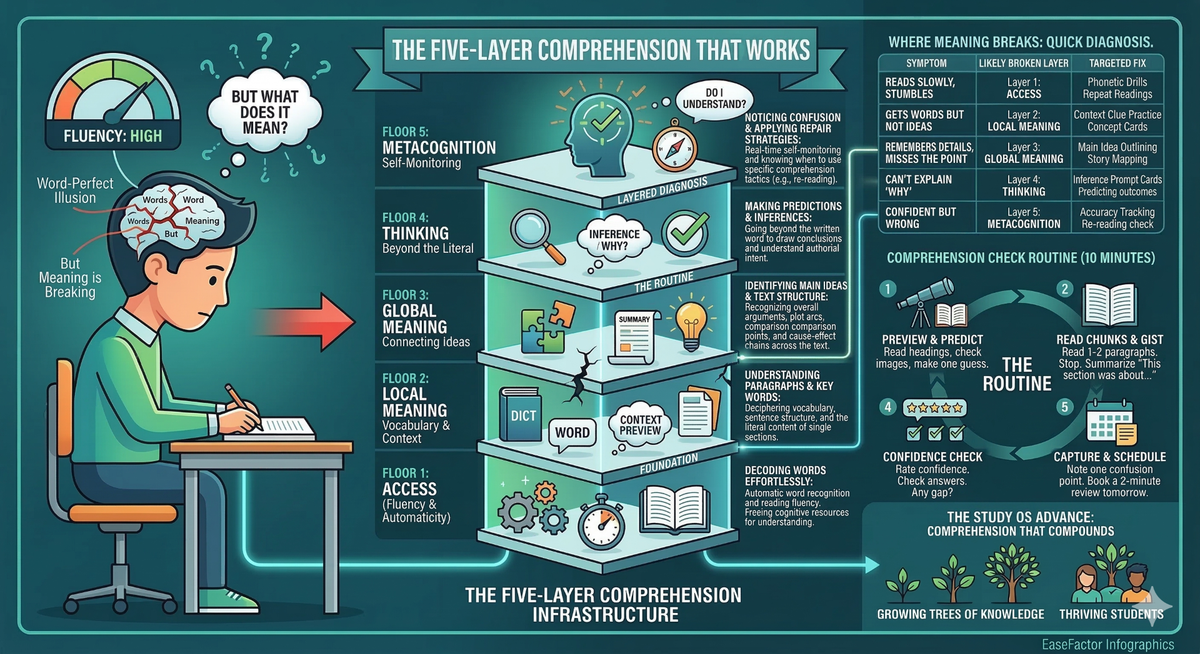
They read the whole chapter. They didn't skip a word. But when you ask "What was it about?" — silence, or a vague sentence that sounds nothing like what they just read.
Here's the thing most parents and students don't realize: reading the words is not the same as understanding the text. A child can decode every syllable on the page and still walk away with almost nothing.
This isn't a reading problem. It's a comprehension infrastructure problem. The child's brain is processing words but not constructing meaning — and nobody has shown them the difference.
Most attempts to fix comprehension focus on the wrong layer. "Read more" doesn't help if the bottleneck is vocabulary. "Try harder" doesn't help if the bottleneck is weak inference. "Slow down" doesn't help if the bottleneck is missing background knowledge.
Reading comprehension isn't one skill. It's five layers stacked on top of each other. When one layer breaks, everything above it collapses. The key to improvement is finding the right layer — and building it.
EaseFactor exists to turn effort into advantage by combining learning science, AI, and disciplined practice — so students build comprehension that transfers to textbooks, novels, articles, and exams.
The named pattern: The Word-Perfect Illusion
The Word-Perfect Illusion: When a child reads every word accurately and fluently but can't summarize, explain, or answer questions about what they just read — because decoding mastery has been mistaken for comprehension mastery.
The Word-Perfect Illusion is particularly dangerous because it's invisible. The child sounds like a strong reader. They don't stumble, they don't skip words, they read at grade level or above. Everyone — parents, teachers, the child themselves — assumes comprehension is fine.
Then the test arrives. Or someone asks, "Why did the character make that choice?" And the child freezes. Not because they didn't read. Because reading the words was the only layer they were training.
Decoding is Layer 1. Comprehension has five layers. The Word-Perfect Illusion happens when Layer 1 is strong but Layers 2 through 5 were never deliberately built.
Quick diagnosis: where does meaning actually break?
What parents and students notice:
- "I read the whole chapter and remember almost nothing."
- "I can answer 'what happened' but not 'why it happened.'"
- "Fiction is fine but nonfiction is a wall."
- "Short passages are okay but longer text loses me."
- "I understand it when reading but can't explain it five minutes later."
What's actually breaking:
These symptoms all look the same on the surface, but they come from different layers. A child who can't summarize has a different problem than a child who can't infer. A child who struggles with science passages but aces stories has a different problem than a child who struggles with everything.
- Reads slowly, loses meaning mid-sentence → Layer 1: Access (fluency). Fix: Fluency practice, phrase-cued reading.
- Understands sentences but misses the big idea → Layer 3: Global meaning. Fix: Main idea practice, text structure awareness.
- Gets literal questions right, misses "why" → Layer 4: Thinking (inference). Fix: Evidence-based questioning, cause/effect chains.
- Thinks they understand, but test says no → Layer 5: Metacognition. Fix: Confidence calibration, self-monitoring.
- Nonfiction collapses but fiction is fine → Layer 2: Local meaning (vocabulary). Fix: Domain vocabulary building, concept previews.
The critical insight: Treating every comprehension problem the same way — "just read more carefully" — is like telling every patient with a headache to take the same pill. Sometimes the headache is dehydration. Sometimes it's eye strain. Sometimes it's stress. Diagnosis comes first.
The science: five layers of comprehension (and why they stack)
Walter Kintsch's Construction-Integration Model: comprehension is building
Cognitive scientist Walter Kintsch's foundational research shows that reading comprehension isn't passive absorption — it's active construction. His model identifies three levels of understanding:
- Surface level: Remembering the exact words (lowest value for learning)
- Textbase: Understanding the basic meaning of sentences
- Situation model: Building a connected mental representation that integrates with prior knowledge
Most struggling readers stop at the textbase. They can repeat what the text said but can't use the information flexibly. The situation model — where real understanding lives — requires active processing that passive reading doesn't trigger.
Palincsar and Brown's reciprocal teaching: comprehension strategies are trainable
In their landmark 1984 research, Annemarie Sullivan Palincsar and Ann Brown demonstrated that comprehension strategies can be explicitly taught through four moves: predicting, questioning, clarifying, and summarizing. Students who learned these strategies showed dramatic improvements — from the 20th percentile to the 50th percentile in comprehension assessments.
The key insight: comprehension doesn't improve just from reading more. It improves from practicing specific cognitive strategies while reading.
P. David Pearson's gradual release of responsibility: scaffolds must fade
P. David Pearson and Margaret Gallagher's research on the "gradual release of responsibility" model shows that effective comprehension instruction follows a clear arc:
- Teacher models the strategy ("Watch how I think through this paragraph")
- Guided practice with support ("Try it—I'll help when you're stuck")
- Independent practice ("Now do it yourself")
The critical design rule: scaffolds that never fade create dependency, not independence. Every support feature should be designed to disappear as the student internalizes the strategy.
Timothy Rasinski's fluency research: the access layer matters
Timothy Rasinski's decades of research on reading fluency reveal that fluency isn't just about speed — it's about automaticity. When a reader has to consciously decode every word, their working memory is consumed by the mechanics of reading, leaving nothing for comprehension.
This is why some students read every word correctly but understand nothing: their decoding is accurate but not automatic. The cognitive cost of word-by-word processing crowds out meaning-making.
Linda Baker and Ann Brown on metacognition: monitoring is the master skill
Baker and Brown's research on metacognition in reading demonstrates that skilled readers constantly monitor their own understanding. They notice when comprehension breaks ("Wait, that doesn't make sense") and apply repair strategies ("Let me re-read that paragraph" or "I need to look up that word").
Struggling readers often lack this monitoring entirely. They read straight through confusion without noticing it. Teaching metacognitive monitoring—the ability to notice "I'm confused here" — is one of the highest-leverage interventions for comprehension improvement.
The five-layer comprehension model: a diagnostic framework
Think of comprehension as a five-story building. Each floor depends on the one below it. If the second floor has a crack, the floors above it are unstable — no matter how strong they look.
Layer 1: Access — Can they process the words and sentences?
This layer covers decoding, fluency, and sentence-level processing. If a student is spending cognitive effort on reading the words themselves, there's little capacity left for meaning.
Signs this layer is the bottleneck:
- Reads very slowly
- Frequently re-reads sentences
- Loses track mid-sentence with complex syntax
- Good oral reasoning but poor silent reading performance
What helps: Fluency practice, phrase-cued reading, repeated reading of slightly-below-level text, multisyllabic word practice.
Layer 2: Local meaning — Can they understand each paragraph?
This layer covers vocabulary, sentence-level meaning, and paragraph-level gist. A student may read fluently but miss meaning because key words or concepts are unknown.
Signs this layer is the bottleneck:
- Struggles more with unfamiliar topics
- Nonfiction is harder than fiction
- Frequently asks "What does this word mean?"
- Can read the words but can't paraphrase the paragraph
What helps: Vocabulary previewing (2-4 key words before reading), morphology awareness (prefix/root/suffix), background knowledge activation, concept cards for unfamiliar domains.
Layer 3: Global meaning — Can they connect ideas across the full text?
This layer covers main idea identification, text structure recognition, sequence, cause/effect, compare/contrast, and theme. A student may understand individual paragraphs but miss how they fit together.
Signs this layer is the bottleneck:
- Remembers details but can't identify the main idea
- Can answer "what happened" but not "what was this passage mainly about?"
- Struggles with summarization
- Better with short passages than long ones
What helps: Main idea practice, text structure instruction (problem/solution, cause/effect, chronological), paragraph-by-paragraph gist building, summary compression exercises.
Layer 4: Thinking — Can they go beyond the literal?
This layer covers inference, prediction, evidence use, author purpose, and synthesis. A student may understand what the text says but not what it means or implies.
Signs this layer is the bottleneck:
- Gets literal questions right but misses inferential ones
- Can't explain why a character made a decision
- Struggles with "What can you conclude?" questions
- Difficulty identifying evidence to support answers
What helps: "What makes you think that?" prompting, evidence highlighting, cause/effect chain building, paired literal vs. inferential questioning, prediction and verification practice.
Layer 5: Metacognition — Can they notice when they're confused?
This layer covers self-monitoring, confidence calibration, and repair strategy use. A student may read through confusion without realizing it, then be surprised when they can't answer questions.
Signs this layer is the bottleneck:
- Thinks they understand but test performance says otherwise
- Rarely asks for help or re-reads
- Can't identify which parts were confusing
- High confidence but low accuracy
What helps: Confidence ratings before and after questions, "mark where you got confused" exercises, self-explanation prompts, prediction check-ins, repair strategy instruction.
The Study OS approach: building comprehension layer by layer
A Study OS doesn't try to fix everything at once. It diagnoses the weakest layer and targets it specifically, while maintaining strength in the layers above and below.
Why generic "read more" advice fails
- "Read more" — More practice at the wrong layer doesn't help. Study OS: Identify the weak layer first, then target it.
- "Read more carefully" — Attention isn't the problem if vocabulary is. Study OS: Build vocabulary before reading, not during.
- "Try harder" — Effort without strategy just creates frustration. Study OS: Teach specific strategies matched to the bottleneck.
- "Take better notes" — Notes from a misunderstood text are worthless. Study OS: Check understanding before note-taking.
- "Read it again" — Re-reading the same way gets the same result. Study OS: Re-read with a specific question or focus.
The scaffold ladder: support that disappears
Effective comprehension support follows a progression from heavy support to independence:
Level 0 — Independent: No hints. Student reads and processes on their own.
Level 1 — Prompt only: "What happened here in one sentence?" The question provides direction but no content help.
Level 2 — Guided prompt: "Who is this paragraph mainly about, and what changed for them?" More specific direction.
Level 3 — Structural cue: Key sentences or signal words are highlighted. The student still has to build meaning, but knows where to look.
Level 4 — Meaning support: A word definition, sentence paraphrase, or background knowledge card is provided.
Level 5 — Worked example: A model answer with reasoning is shown: "Here's how a strong reader would think through this."
The design rule: Track the minimum scaffold level needed for success. Real growth means solving more tasks at lower scaffold levels over time — not just getting more answers right.
A concrete Tuesday example (what this looks like in real life)
Grade 6 Science (Ecosystems and Food Webs), Tuesday 4:15pm (12 minutes)
Goal: Build comprehension of a two-page passage on how energy moves through an ecosystem
- 2 minutes — Vocabulary preview. Check three critical words: producer, consumer, decomposer. For each: read a one-sentence kid-friendly definition and one example. Output: 3 vocabulary cards ready.
- 1 minute — Prediction. Look at the title and any diagrams. Write one prediction: "I think this passage will explain how animals get energy from plants." Output: 1 prediction written.
- 5 minutes — Chunked reading with gist checks. Read paragraph 1. Pause. Write a one-sentence gist: "Plants make energy from sunlight." Read paragraph 2. Pause. Write a gist: "Animals that eat plants are called primary consumers." Read paragraphs 3-4. Pause. Write a gist: "When consumers die, decomposers break them down and return nutrients to the soil." If confused anywhere, mark it with "?" and keep going. Output: 3 gist sentences, confusion points marked.
- 3 minutes — Retrieval from memory. Close the passage. Answer without looking: "Where does the energy in a food web start?" (literal), "What would happen if all the decomposers disappeared?" (inferential), "Which sentence in the passage best supports your answer?" (evidence). Output: 3 answers attempted. Check against text. Note gaps.
- 1 minute — Metacognitive check. Rate confidence 1-5 before checking answers. Compare to actual accuracy. If confidence was high but accuracy was low: that's the Word-Perfect Illusion in action. Output: Confidence-accuracy comparison. One takeaway noted.
Total time: 12 minutes. This 12 minutes builds a situation model with vocabulary support, active processing, retrieval practice, and metacognitive calibration. Passive reading for 12 minutes builds familiarity that fades by Thursday.
Try this today (10 minutes): The Comprehension Check Routine
Total time: 10 minutes
Output: 1 gist per section, 2 questions answered from memory, 1 confusion point identified, confidence calibrated
This routine works with any reading assignment — textbook, novel, article, or worksheet passage.
- (1 min) Preview and predict. Skim the headings, images, and any bold words. Write one prediction about what you'll learn. Don't read the text yet.
- (4 min) Read in chunks, pause for gist. Read one section (usually 1-2 paragraphs). Stop. Write one sentence: "This section was about ___." If you can't write the gist, re-read that section with the question "Who or what is this about, and what happened?" Move to the next section and repeat.
- (3 min) Close and retrieve. Close the text completely. Answer these two questions from memory: What was the most important idea? (tests Layer 3: global meaning) Why does it matter, or what does it connect to? (tests Layer 4: thinking) Check your answers against the text. Were you right? What did you miss?
- (1 min) Confidence check. Before checking, rate your confidence: "How well do I think I understood this?" (1 = lost, 5 = nailed it). After checking, rate your actual accuracy. If there's a gap (high confidence, low accuracy), you've found a metacognition target.
- (1 min) Capture and schedule. Write one thing you want to review tomorrow: a vocabulary word, a concept, or a question you couldn't answer. Put a 3-minute retrieval slot on tomorrow's schedule.
De-shaming reframe: If you read the section and couldn't write the gist, that's not a sign you're bad at reading. It's a sign your brain was on autopilot — which is normal, and fixable. The Comprehension Check Routine trains you to notice the moment meaning slips away, so you can catch it and rebuild.
For parents: how to support comprehension without becoming the textbook
The instinct to explain everything is strong. But comprehension is built by the child's brain, not the parent's explanation. Your job is to ask the right questions, not provide the right answers.
Do:
- After they read, ask "Can you explain that to me like I'm five?" (forces retrieval and simplification — this is the Feynman Technique in disguise)
- Ask "Where did you get confused?" and treat the answer as valuable data, not a problem (normalizes confusion as part of reading, not failure)
- Ask "What would happen if ___?" about the passage (builds inference at Layer 4)
- Celebrate when they say "I don't understand this part" — that's metacognition working
Don't:
- Pre-explain the passage before they read it (removes productive struggle)
- Accept "I read it" as proof of understanding (decoding ≠ comprehension)
- Jump in to explain at the first sign of confusion (give them 30 seconds to try a repair strategy first)
- Compare their reading to other children ("Your sister understood this easily")
Key phrase to use: "What's one thing from that passage you could explain to someone who didn't read it?" If they can explain one thing clearly, they're building a situation model. If they can't explain anything, the reading was surface-level — and that's where the Comprehension Check Routine comes in.
Calm next step: build comprehension that compounds
Reading comprehension isn't a talent. It's infrastructure. And like all infrastructure, it can be built — layer by layer, with the right diagnosis and the right practice at the right level.
EaseFactor works as a Study OS that supports systematic comprehension building:
- Diagnostic profiling that identifies your child's specific bottleneck layer — not just "needs improvement"
- Adaptive reading sessions that match text difficulty, scaffold level, and question types to the learner's current profile
- Retrieval-first design where every reading session ends with explanation from memory, not just recognition
- Scaffold tracking that measures independence, not just accuracy — because needing fewer hints is growth, even when scores stay the same
- Spaced comprehension review so understanding built on Tuesday is still there on Friday
The promise isn't faster reading or higher test scores tomorrow. It's comprehension that compounds — where every passage read builds the vocabulary, inference ability, and self-monitoring skills that make the next passage easier.
A calm, observant system that notices where meaning breaks, helps the child repair it, and then gradually steps out of the way.
TL;DR
- Comprehension = five layers (access, local meaning, global meaning, thinking, metacognition) — and a breakdown at any layer produces the same symptom: "I read it but don't get it."
- The fix isn't reading more. It's diagnosing which layer is broken and targeting that layer specifically.
- Your next step: a 10-minute "Comprehension Check" routine that reveals where meaning breaks and builds the repair habit.
Citations
- Walter Kintsch (1988, 1998): Construction-Integration Model of text comprehension — surface, textbase, and situation model levels of understanding
- Annemarie Sullivan Palincsar & Ann Brown (1984): Reciprocal Teaching — four comprehension strategies (predict, question, clarify, summarize) producing dramatic improvements in struggling readers
- P. David Pearson & Margaret Gallagher (1983): Gradual Release of Responsibility model — scaffolded instruction that moves from teacher modeling to independent practice
- Timothy Rasinski (2004, 2012): Fluency research demonstrating the link between reading automaticity and comprehension capacity
- Linda Baker & Ann Brown (1984): Metacognition in reading — skilled readers monitor their own understanding and apply repair strategies when comprehension breaks
- LaBerge & Samuels (1974): Automaticity theory — when decoding becomes automatic, cognitive resources are freed for comprehension
- Isabel Beck, Margaret McKeown & Linda Kucan (2002): Tiered vocabulary instruction — teaching words that are central to meaning and likely to recur across texts
- Michael Pressley (2000): Comprehension strategies instruction — decades of research on what skilled readers do differently (predicting, questioning, clarifying, summarizing, connecting)

Manoj Ganapathi
Founder and Builder of EaseFactor. Passionate about evidence-based learning and helping students build effective study habits through cognitive science principles.
Ready to Study Smarter?
EaseFactor uses these learning science principles to help you build lasting knowledge.