The Cognitive Budget: Managing Your Brain's Three Accounts
 Manoj Ganapathi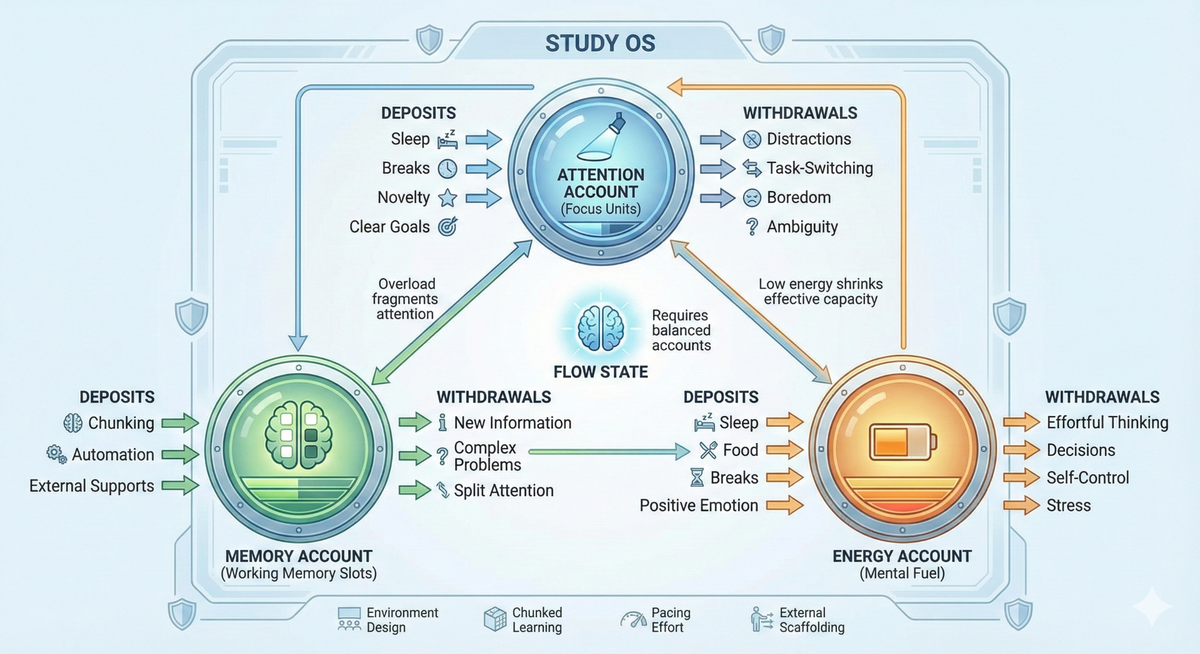
Why some students finish their homework exhausted after 30 minutes while others coast through two hours - and it has nothing to do with intelligence.
You've probably heard the advice: "Work smarter, not harder." But nobody tells you how.
Here's the secret: your brain doesn't run on willpower. It runs on three limited resources that work like bank accounts. Each one can be deposited into, withdrawn from, and - critically - overdrawn.
Most students manage their time. A few manage their energy. Almost nobody manages all three accounts together. That's why even "good" study sessions can leave you fried - you bankrupted one account without realizing it.
This post introduces The Cognitive Budget framework: a unified way to understand and manage the three mental resources that determine whether your study session builds knowledge or just builds frustration.
The named pattern: The Three-Account Cognitive Budget
The Three-Account Cognitive Budget: A framework that treats mental resources like financial accounts - each with deposits, withdrawals, and a balance that constrains what you can accomplish. Unlike time (which you can see), cognitive resources are invisible until you're overdrawn.
The three accounts:
| Account | Currency | What It Does | When It's Empty |
|---|---|---|---|
| Attention Account | Focus units | Controls what enters your awareness | You can't concentrate; everything distracts you |
| Memory Account | Working memory slots | Holds and manipulates information | You can't think through problems; details slip away |
| Energy Account | Mental fuel | Powers effortful processing | You can't start tasks; everything feels hard |
The insight: time is not a cognitive resource. You can have two hours free and still be cognitively broke. Time is the container; these three accounts are the contents.
Quick diagnosis: which account are you overdrawing?
When studying feels hard, most people think they need "more focus" or "better habits." But the real question is: which account is empty?
| Symptom | What it feels like | Account overdrawn |
|---|---|---|
| "I keep getting distracted" | Mind wanders to phone, thoughts drift | Attention Account depleted |
| "I read it but nothing sticks" | Information goes in and immediately leaks out | Memory Account overloaded |
| "I just can't start" | Task feels impossibly heavy, even small ones | Energy Account exhausted |
| "I understand each part but can't see the whole" | Pieces don't connect into meaning | Memory Account at capacity |
| "I made it through but learned nothing" | Finished the chapter, can't recall a thing | Attention Account never engaged |
| "Every problem feels like the first one" | No momentum, constant restart friction | Energy Account draining too fast |
The fix depends on which account needs help. Telling an attention-depleted student to "focus harder" is like telling a broke person to "spend smarter" - it misses the point.
The science: three resources with different rules
Let's look at each account and how it actually works.
1. The Attention Account: Focus Units
What it is: Your capacity to direct awareness toward one thing while filtering out everything else.
The research: Attention operates like a spotlight. The brain uses a limited-capacity system - often described in terms of executive attention - to suppress distractions and maintain focus. Selective attention research shows that focus isn't just concentration; it's active suppression of irrelevant information.
Deposits: Sleep, breaks, novelty, interest, clear goals
Withdrawals: Distractions (each one costs re-focusing energy), task-switching, boredom, ambiguity
The hidden cost: Every distraction isn't just lost time - it's a withdrawal. Research on attention residue shows that after switching tasks, part of your attention remains stuck on the previous task. Check your phone "for one second" and you've made a withdrawal that takes minutes to recover.
Key insight: Attention isn't willpower. It's a resource that depletes with use and replenishes with rest.
2. The Memory Account: Working Memory Slots
What it is: Your brain's mental whiteboard - the space where you hold and manipulate information in the moment.
The research: Cognitive load theory, developed by John Sweller, shows that working memory is severely limited. Most people can hold 4 plus or minus 1 "chunks" of information at once. When you exceed that capacity, learning stops and confusion starts. The overload isn't about difficulty - it's about how much you're asking your mental whiteboard to hold simultaneously.
Deposits: Chunking (grouping information), automation (practiced skills don't take slots), external supports (notes, diagrams)
Withdrawals: New information, complex problems, multi-step reasoning, split attention
The hidden cost: Unlike attention, you can't feel memory overload approaching until it hits. One moment you're following along; the next moment, you've lost the thread entirely. That's not failure - it's exceeding capacity.
Key insight: Difficulty isn't the problem. Simultaneous demands are. A hard problem with clear steps is easier than an easy problem with scattered pieces.
3. The Energy Account: Mental Fuel
What it is: The metabolic and psychological resources that power effortful thinking.
The research: Mental effort depletes a limited resource. The brain consumes roughly 20% of the body's energy despite being only 2% of body mass. Demanding cognitive tasks draw heavily on this energy. Studies on ego depletion (while debated in scope) and decision fatigue consistently show that effortful self-control and complex reasoning draw from a limited pool.
Deposits: Sleep (the major deposit), food, breaks, positive emotion, physical movement
Withdrawals: Any effortful thinking, decisions, self-control, emotional processing, stress
The hidden cost: Energy depletes even when you're not actively working. Background stress, unresolved decisions, and emotional processing all make withdrawals. A student who "rested" but worried about tomorrow's test didn't actually deposit anything.
Key insight: Energy explains why the same task feels easy in the morning and impossible at night. It's not motivation - it's fuel.
How the three accounts interact
Here's what makes the Cognitive Budget powerful: the accounts affect each other.
The Attention-Memory Connection
When your Attention Account is low, information doesn't enter properly - so your Memory Account doesn't get the right inputs to work with. You read the same paragraph three times because attention failures prevent encoding.
When your Memory Account is overloaded, attention fragments to cope. You can't hold the whole problem in mind, so you keep checking notes - each check is an attention withdrawal.
Practical impact: If you're constantly re-reading, the problem might be attention (didn't encode) OR memory (can't hold it all). The fix is different for each.
The Memory-Energy Connection
Working memory operations are energy-expensive. Holding something in mind while manipulating it requires fuel. When energy runs low, working memory capacity effectively shrinks - you can hold less because you can't afford the processing.
Practical impact: Late-night studying isn't just harder because you're tired - your effective working memory is smaller. Problems you could solve with 4 chunks in the morning might require 5-6 chunks worth of capacity at night. You haven't gotten dumber; you've gotten poorer.
The Energy-Attention Connection
Low energy makes attention control harder. The brain's executive systems that suppress distractions run on the same fuel as everything else. As energy depletes, your ability to resist distraction weakens - not because you lack willpower, but because you can't afford the attention investment.
Practical impact: That "I'll just check my phone once" impulse gets stronger as energy depletes. It's not moral failure; it's resource depletion.
The System: Why a Study OS manages all three accounts
A Study OS doesn't just organize your tasks. It manages your cognitive budget.
1. Protecting the Attention Account
A Study OS creates conditions that minimize attention withdrawals:
- Environment design: Eliminating distraction sources before they cost focus
- Clear task definition: "Study Chapter 4" is expensive; "Answer 5 retrieval questions on photosynthesis" is cheaper
- Novelty injection: Varied practice formats prevent boredom-driven attention drift
- Progress visibility: Seeing advancement maintains interest-based attention
2. Respecting the Memory Account
A Study OS keeps demands within working memory capacity:
- Chunked learning: Breaking content into pieces that fit the mental whiteboard
- External scaffolding: Notes, diagrams, and summaries that hold information you don't need to keep in your head
- Sequenced complexity: Building from simple to complex so automation reduces load
- Retrieval practice: Strengthening memory traces so recall takes fewer slots
3. Pacing the Energy Account
A Study OS distributes effort to prevent crashes:
- Session duration limits: Stopping before energy bankruptcy
- Strategic breaks: Scheduled deposits, not just "when you feel tired"
- High-effort task timing: Difficult work when energy is highest
- Decision reduction: Pre-planned sessions remove choice fatigue
The flow state connection: when all three accounts balance
Here's something interesting: the state known as "flow" - that feeling of effortless, absorbed focus - happens when all three accounts are in a specific balance.
Flow requires:
- Attention Account: Fully invested in one task (no competing demands)
- Memory Account: Challenged but not overloaded (skill meets difficulty)
- Energy Account: Sufficient fuel for sustained effort (not depleted)
Flow breaks when:
- A distraction forces an attention withdrawal
- Complexity exceeds working memory capacity
- Energy runs out mid-session
Csikszentmihalyi's flow research describes the balance between challenge and skill. The Cognitive Budget framework explains why that balance matters: flow is what happens when all three accounts are simultaneously healthy.
A concrete Tuesday example (what this looks like in real life)
Grade 7 Science (Cell Biology), Tuesday 4:30-5:00 pm (30 minutes)
Goal: Study without overdrawing any account.
Phase 1: Pre-session account check (2 min)
Before starting, quick assessment:
Attention Account: "Did I just switch from something? Do I need a minute to settle?"
Memory Account: "Is my mind already full of other stuff? Do I need to write it down first?"
Energy Account: "Did I eat? Did I move around? Am I running on fumes?"
Today's check: Finished math 15 minutes ago. Energy okay. Mind clear.
Phase 2: Chunked retrieval (12 min)
Break the topic into three chunks of 4 minutes each:
Chunk 1: Cell parts and functions (4 min)
- Write: "Name 4 cell organelles and what each does."
- No notes. Retrieve from memory.
- Check. Mark right/wrong.
Chunk 2: Animal vs. plant cells (4 min)
- Write: "List 3 differences between animal and plant cells."
- No notes. Retrieve.
- Check. Mark.
Chunk 3: Cell membrane function (4 min)
- Write: "Explain what the cell membrane does in your own words."
- No notes. Retrieve.
- Check. Mark.
Budget accounting:
- Attention: Protected by single-topic focus and timed chunks
- Memory: Each chunk stays within 4-item capacity
- Energy: Short bursts with built-in momentum
Phase 3: Energy break (3 min)
Stand up. Walk around room. Look out window.
No phone. No new information. Actual break.
Budget accounting: Energy deposit. Attention clearing.
Phase 4: Connection questions (8 min)
Now combine chunks (this is expensive - schedule after the break):
- "How does the cell membrane work differently in plant vs. animal cells?"
- "If a cell's mitochondria stopped working, what would happen?"
Write answers. Check against notes.
Budget accounting: Higher memory load, but energy refreshed and attention sharp.
Phase 5: Account close-out (5 min)
Review session performance:
- "Which chunk felt hardest?" (identifies memory overload)
- "When did I drift?" (identifies attention leak)
- "How's my energy now?" (checks remaining fuel)
Schedule next session: Thursday 4:30 pm.
Output: 3 chunks retrieved + 2 connection questions + next session scheduled.
Total budget impact: Moderate withdrawals from all accounts, no overdrafts, session ends with reserve.
Warning signs: how to tell when you're about to overdraw
Attention Account Warning Signs
- You've read the same sentence 3+ times
- Your mind keeps drifting to other tasks/worries
- You're physically restless (shifting, looking around)
- You feel the pull to check something else
Emergency response: Don't push through. Take a 2-minute attention reset: close eyes, breathe, look at something far away, then return.
Memory Account Warning Signs
- You understood each step but lost the thread
- You can't explain what you just read
- You're flipping back and forth in your notes
- Simple things feel confusing
Emergency response: Externalize. Write down what you're trying to hold. Draw a diagram. Reduce the active load.
Energy Account Warning Signs
- Everything feels harder than it should
- You're making careless errors
- Starting the next problem feels like climbing a mountain
- You're choosing easy tasks over necessary ones
Emergency response: Stop studying. Eat something. Move your body. Sleep if possible. No amount of "pushing through" refills this account.
Try this today (10 minutes): The Budget Check-In Routine
Total time: 10 minutes
Output: Account status + one adjustment + planned session
Step 1: Account Assessment (3 min)
Rate each account 1-5:
Attention Account:
- 5: Laser focused, distractions don't tempt me
- 3: Normal, can focus with effort
- 1: Everything pulls at my attention
Memory Account:
- 5: Mind is clear, can hold complex ideas
- 3: Normal, can work through things
- 1: Can't follow my own thoughts
Energy Account:
- 5: Sharp and ready, could do hard problems
- 3: Normal, steady but not unlimited
- 1: Running on empty
Write your scores: Attention ___ Memory ___ Energy ___
Step 2: Identify the Limiting Account (2 min)
Your lowest score is your constraint. The other accounts don't matter if one is empty.
Write: "My limiting account right now is ___ because ___."
Step 3: Match Task to Budget (3 min)
Based on your limiting account:
If Attention is lowest:
- Use external structure (timers, specific questions)
- Shorter session with defined endpoint
- Remove distractions physically
If Memory is lowest:
- Simpler material or review (not new learning)
- Use notes and diagrams as support
- Break content into smaller pieces
If Energy is lowest:
- Easy retrieval practice (not new material)
- Consider postponing to tomorrow morning
- If you must study, make it short and light
Write: "Given my budget, I will ___."
Step 4: Plan Tomorrow's High-Budget Session (2 min)
Identify when your accounts are typically fullest (usually morning or after a break).
Write: "Tomorrow, I'll do my hardest task at ___ when my ___ account is highest."
For parents: how to support cognitive budgeting
Your child can't see their cognitive accounts, but you can often see the symptoms.
Signs of attention overdraft:
- Can't seem to start homework despite sitting at desk
- Constantly getting up, fidgeting, checking things
- "What was I doing?" moments
Parent response: Don't say "focus." Help reduce attention demands: quiet environment, clear task definition, remove distractions.
Signs of memory overload:
- Frustration during multi-step problems
- "This doesn't make any sense" (even for familiar material)
- Flipping through notes repeatedly
Parent response: Don't say "think harder." Help chunk the problem: "Let's just do the first step" or provide a scratch paper diagram.
Signs of energy bankruptcy:
- Unusually resistant to starting
- Lots of careless errors
- Everything is "too hard"
Parent response: Don't say "try harder." Ask: "When did you eat last? Did you sleep okay? Want to take a 10-minute break first?"
The key insight for parents: When your child seems unmotivated, check the accounts before checking the attitude. They might be overdrawn, not unwilling.
The Cognitive Budget and the Study OS
The Cognitive Budget framework explains why a Study OS works.
Without a system:
- Attention is unprotected (constant distraction costs)
- Memory is unmanaged (overload without warning)
- Energy is unbudgeted (crashes feel random)
With a Study OS:
- Sessions are designed to stay within budget
- Tasks are pre-chunked to respect memory limits
- Effort is distributed across time to prevent energy crashes
- Progress is visible (reducing uncertainty that drains all accounts)
A Study OS doesn't give you more cognitive resources. It helps you spend the ones you have wisely.
Calm next steps: budget your brain like you budget your time
Most students track time. Few track cognitive resources. But running out of attention, memory capacity, or mental energy will stop your session just as surely as running out of hours.
EaseFactor is designed as a Study OS that protects all three accounts:
- Attention protection: Focused sessions with clear prompts and reduced distraction
- Memory respect: Chunked content that fits working memory capacity
- Energy pacing: Session lengths and timing that prevent crashes
The promise isn't more hours of studying. It's more learning per hour - because every session stays within budget.
Progress becomes calm, visible, and sustainable.
Citations
Cognitive Load Theory
- Sweller, J. (1988): Cognitive load during problem solving
- Sweller, J., van Merrienboer, J.J.G., & Paas, F.G.W.C. (1998): Cognitive architecture and instructional design
- Paas, F. & Sweller, J. (2012): An evolutionary upgrade of cognitive load theory
Working Memory
- Cowan, N. (2001): The magical number 4 in short-term memory
- Baddeley, A. (2003): Working memory - looking back and looking forward
- Miller, G.A. (1956): The magical number seven (historical foundation)
Attention Research
- Posner, M.I. (1980): Orienting of attention
- Leroy, S. (2009): Attention residue in task switching
- Ophir, E., Nass, C., & Wagner, A.D. (2009): Cognitive control in media multitaskers
Flow State
- Csikszentmihalyi, M. (1990): Flow - The Psychology of Optimal Experience
- Nakamura, J. & Csikszentmihalyi, M. (2002): The concept of flow
Mental Energy / Decision Fatigue
- Baumeister, R.F. et al. (1998): Ego depletion research
- Vohs, K.D. et al. (2008): Making choices impairs subsequent self-control
- Danziger, S., Levav, J., & Avnaim-Pesso, L. (2011): Extraneous factors in judicial decisions (decision fatigue)
Time Management
- Macan, T.H. (1994): Time management research
- Britton, B.K. & Tesser, A. (1991): Time management and academic performance
TL;DR
- The Cognitive Budget has three accounts: Attention (focus), Memory (working memory), and Energy (mental fuel).
- Each account has different deposits and withdrawals. Time is the container; these accounts are the contents.
- Overdrawing any account crashes your session, even with time left. Symptoms differ by account.
- The accounts interact: low energy shrinks effective memory; attention failures prevent encoding; memory overload fragments attention.
- A Study OS manages all three: protecting attention, respecting memory limits, and pacing energy expenditure.
- Your next step: Run the 10-minute Budget Check-In to identify which account limits you most.

Manoj Ganapathi
Founder and Builder of EaseFactor. Passionate about evidence-based learning and helping students build effective study habits through cognitive science principles.
Ready to Study Smarter?
EaseFactor uses these learning science principles to help you build lasting knowledge.