Brain Food: What to Eat for Better Focus and Memory
 Manoj Ganapathi
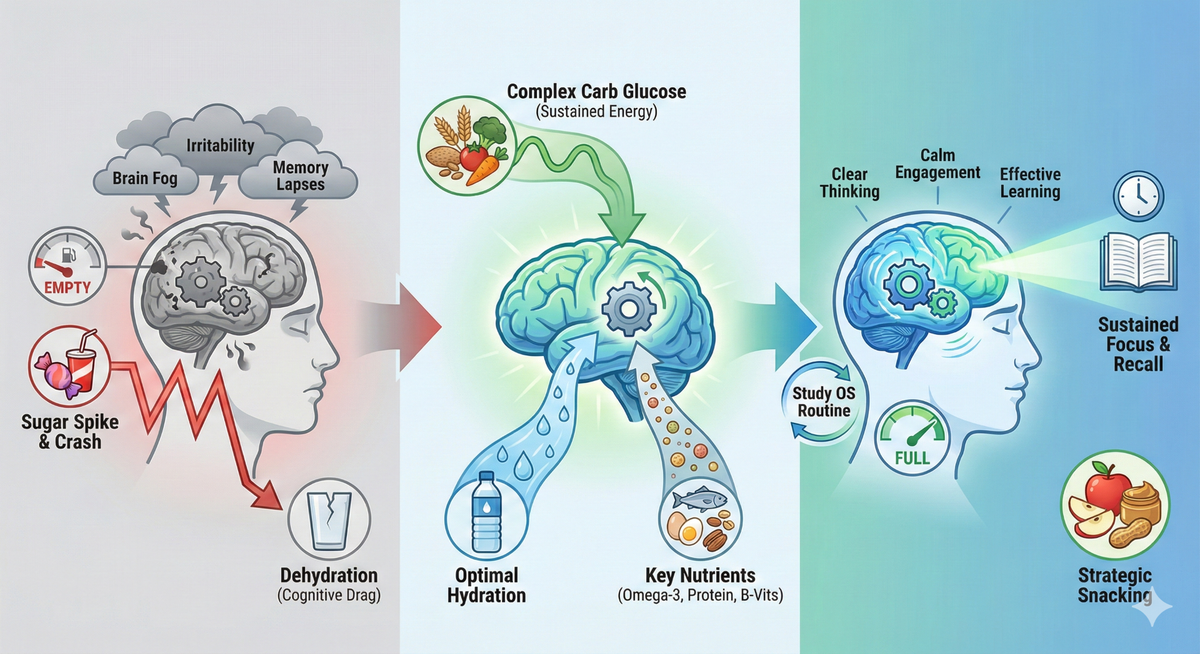
Why you feel sharp some study sessions and foggy others — even when you slept the same amount.
You sit down to study. Some days, concepts click. Other days, you read the same paragraph four times and nothing sticks. Your brain feels like it's running on empty.
That's not random. It's fuel.
Here's what most students don't realize: your brain is an energy hog. It uses about 20% of your body's energy — more than any other organ. What you eat, when you eat, and how much water you drink directly affects your ability to focus, remember, and learn.
The problem isn't that students don't care about nutrition. The problem is they're trying to learn while running their brain on the wrong fuel — or no fuel at all. That foggy, can't-focus feeling? It often has a simple cause: your brain is starving for what it needs.
The named pattern: The Hungry Brain
The Hungry Brain: When cognitive performance drops because your brain isn't getting the fuel it needs — whether from skipped meals, dehydration, or blood sugar crashes.
Most students don't connect what they eat to how they think. They blame themselves ("I just can't focus today") when the real problem is simpler: their brain is running on fumes.
Here's the uncomfortable truth: that afternoon study session where nothing stuck? Your brain may have been literally underpowered. But a study session after the right breakfast and a glass of water? That's when learning happens.
Quick diagnosis: is the Hungry Brain affecting your learning?
Common symptoms of the Hungry Brain:
- Sharp in the morning, foggy by afternoon
- Can't concentrate when studying after school
- Headaches during homework
- Feeling irritable or "hangry" while trying to learn
- Craving sugary snacks during study sessions
- Reading the same thing over and over without absorbing it
What's actually happening:
Your brain is incredibly demanding:
- Glucose depletion: Your brain runs on glucose (blood sugar). When levels drop, thinking gets harder
- Dehydration effects: Even mild dehydration (1-2% body weight) impairs attention and memory
- Nutrient gaps: Missing key nutrients (omega-3s, iron, B vitamins) limits brain function
- Blood sugar rollercoaster: Sugary snacks cause spikes and crashes that wreck concentration
The result? You're asking your brain to work hard while starving it of what it needs. It's like trying to drive a car with an empty tank.
The science: what your brain needs to work well
Nutrition researcher Fernando Gomez-Pinilla puts it simply: "Food is like a pharmaceutical compound that affects the brain."
Here's what the research shows:
The breakfast effect
Multiple studies confirm what teachers have always suspected: students who eat breakfast perform better academically. Research shows that breakfast consumption improves:
- Attention during morning classes
- Memory for new information
- Problem-solving ability
- Overall academic performance
The effect is especially strong for students whose nutritional status is already compromised. Skipping breakfast doesn't just make you hungry — it makes your brain work harder with less.
The hydration threshold
Water accounts for 75% of your brain's mass. Even mild dehydration affects cognition:
| Dehydration Level | What Happens to Your Brain |
|---|---|
| 1% body weight loss | Attention and memory start declining |
| 2% body weight loss | Significant impairment in tasks requiring attention, psychomotor skills, and immediate memory |
| Severe dehydration | Short-term memory, visual perception, and mood all suffer |
Research on students found that bringing water to exams was associated with better performance. One study on children ages 9-11 showed that high water intake improved working memory by 34%.
The glucose connection
Your brain is picky about fuel. It runs primarily on glucose, but not all glucose sources are equal:
| Food Type | Brain Effect | Learning Impact |
|---|---|---|
| Complex carbs (whole grains, vegetables) | Steady, sustained glucose release | Stable focus over hours |
| Simple sugars (candy, soda, juice) | Spike then crash | Brief alertness, then worse focus than before |
| Protein + complex carbs | Balanced, long-lasting energy | Optimal for study sessions |
Research consistently shows that simple sugar intake is linked to cognitive decline, while complex carbohydrates support both short- and long-term memory.
The omega-3 factor
Your brain is about 60% fat, and it needs the right fats to function well. DHA (a type of omega-3 fatty acid) comprises nearly 25% of total brain fatty acids.
Research shows that omega-3 fatty acids:
- Support memory formation and learning
- Maintain the structure of brain cell membranes
- Help signals travel between neurons efficiently
- Are associated with better reading and working memory in children
The problem? Most students don't get enough. The body can't make omega-3s on its own — they must come from food.
Key nutrients for learning
| Nutrient | Brain Function | Good Sources |
|---|---|---|
| Iron | Carries oxygen to brain; supports attention | Lean meats, beans, fortified cereals, spinach |
| B Vitamins | Energy production; nerve function | Whole grains, eggs, leafy greens, dairy |
| Omega-3s (DHA) | Brain cell structure; memory | Fatty fish, walnuts, flaxseed, fortified eggs |
| Zinc | Memory and learning | Meat, shellfish, legumes, seeds |
| Protein | Neurotransmitter production | Eggs, dairy, meat, beans, nuts |
The Study OS approach: fueling your brain for learning
Instead of hoping you'll feel sharp when it's time to study, a Study OS helps you create the conditions for focus:
1) Protect breakfast (especially before demanding learning)
The morning meal isn't optional — it's brain infrastructure. Aim for:
- Protein (eggs, yogurt, nut butter) for sustained energy
- Complex carbs (whole grain toast, oatmeal) for steady glucose
- Some healthy fat (nuts, avocado) for brain cell support
2) Hydrate before you study
Don't wait until you're thirsty — by then, you're already mildly dehydrated:
- Drink water with breakfast and lunch
- Keep water at your study space and sip regularly
- Target 6-8 glasses per day (more if active)
3) Time your snacks strategically
For study sessions longer than 45 minutes:
- Have a brain-friendly snack ready (not candy or chips)
- Eat before the session or during a planned break
- Combine protein + complex carbs for sustained energy
4) Avoid the sugar trap
Sugary snacks feel like quick energy but cause crashes:
- Replace candy with fruit + nuts
- Swap soda for water
- Choose whole foods over processed snacks
5) Build omega-3s into your week
Most students are low in these brain-building fats:
- Aim for fatty fish (salmon, sardines) twice per week
- Add walnuts or flaxseed to breakfast
- Consider omega-3 fortified eggs
A concrete Tuesday example (what this looks like in real life)
Grade 7 History, Tuesday 4:30-5:00 pm (30 minutes)
Goal: Set up The Hungry Brain's antidote — proper brain fuel.
3:45 pm — After-school snack (10 minutes before starting homework)
- Glass of water (8 oz)
- Apple slices with peanut butter
- Output: Brain fueled with protein + complex carbs + hydration
4:30 pm — Pre-study check
- 1 minute — Hydration check
- Water bottle at desk? Refill if needed
- Take 3-4 sips before starting
- Output: Hydration baseline established
- 25 minutes — Focused study block
- Active recall: "What were three causes of the Revolution?"
- Note-making or flashcard creation
- Sip water every 10-15 minutes
- Output: 2-3 concepts deeply processed
- 4 minutes — Brain break + fuel check
- Stand, stretch, walk around
- Drink remaining water
- If session continuing: small handful of nuts or cheese
- Output: Brain reset and refueled for next block
What happens next: Because your brain had steady fuel (not a sugar spike), you actually remember what you studied. Tomorrow's quick review will feel easier because today's learning stuck.
Try this today (5 minutes): The Brain Fuel Protocol
Use this routine before any study session to prime your brain for learning.
Total time: 5 minutes
Output: Brain properly fueled and hydrated for optimal learning
- 1 minute — Hydration check
- Fill a water bottle or glass (12-16 oz)
- Drink about half of it now
- Place the rest at your study space
- Output: Hydration initiated
- 2 minutes — Fuel assessment
- When did you last eat? (If 3+ hours ago, get a snack first)
- What did you eat? (Sugar-heavy? Expect a crash. Protein + carbs? You're set)
- If needed: grab a brain-friendly snack (fruit + nuts, cheese + crackers, yogurt)
- Output: Fuel status assessed and addressed
- 1 minute — Set your sip reminder
- Set a quiet timer for every 15 minutes OR
- Place water bottle in your line of sight as a visual cue
- Commit: "I'll take 2-3 sips every time I see my bottle"
- Output: Hydration system in place
- 1 minute — Future fuel planning
- If studying for 60+ minutes: have a snack ready for your break
- If studying in the evening: plan to eat dinner first OR have substantial snack
- Output: Study session fuel secured
De-shaming reframe:
If you've been trying to study while hungry or thirsty and blamed yourself for not focusing, you weren't lazy — you were underfueled. Your brain literally couldn't do what you were asking. Now you know: fuel first, then focus.
For parents: how to support brain nutrition without food fights
- Stock brain-friendly snacks: Make healthy choices the easy choices. Nuts, cheese sticks, fruit, whole grain crackers, yogurt.
- Protect breakfast: Even a small breakfast beats skipping. Aim for protein + complex carbs.
- Model hydration: Keep water visible. If parents drink water, kids are more likely to.
- Avoid: "You can't study until you eat your vegetables" (creates negative associations).
- Better: "Let's get you a snack and water before homework—your brain needs fuel."
- Don't use food as reward: "Candy if you finish homework" teaches that unhealthy food is special.
Quick wins: brain-friendly snacks for studying
The best study snacks combine protein (for sustained energy) with complex carbs (for glucose) and healthy fats (for brain support):
| Snack | Why It Works |
|---|---|
| Apple + peanut butter | Complex carbs + protein + healthy fats |
| Cheese + whole grain crackers | Protein + complex carbs |
| Yogurt + berries | Protein + antioxidants + natural sugars |
| Trail mix (nuts + dried fruit) | Healthy fats + protein + natural sugars |
| Hard-boiled egg | Pure protein + B vitamins + choline |
| Banana + handful of almonds | Complex carbs + potassium + healthy fats |
| Hummus + vegetables | Protein + fiber + complex carbs |
Snacks to avoid during study:
- Candy and chocolate bars (sugar crash)
- Chips (empty calories, no brain benefit)
- Soda and energy drinks (sugar spike + crash)
- Highly processed snacks (little nutritional value)
The exam day nutrition plan
What you eat the morning of a test matters more than what you ate the night before:
The night before:
- Eat a normal dinner with protein, vegetables, and complex carbs
- Avoid heavy, greasy food (harder to digest, disrupts sleep)
- Stay hydrated but don't overdo it (you don't want bathroom disruptions)
The morning of:
- Eat breakfast even if you're nervous (your brain needs fuel)
- Choose protein + complex carbs: eggs + toast, oatmeal + nuts, yogurt + fruit
- Avoid pure sugar: donuts, sugary cereal, pastries (crash will hit mid-test)
- Drink water but not excessive amounts
During the test:
- Bring water if allowed (research shows this helps performance)
- If permitted: small, quiet snack for long tests (nuts, not crinkly wrappers)
The Hungry Brain vs Fueled Brain comparison
| Factor | Hungry Brain | Fueled Brain |
|---|---|---|
| Attention span | Keeps drifting, hard to concentrate | Sustained focus |
| Memory formation | Information doesn't stick | Learning transfers to memory |
| Reading comprehension | Re-reading same paragraphs | Processing on first read |
| Problem-solving | Feels impossible | Clear thinking |
| Mood during study | Irritable, frustrated | Calm, engaged |
| Energy level | Fading fast | Sustained throughout |
| After the session | Exhausted, nothing retained | Productive, material learned |
Common objections (and the research-based responses)
"I'm not hungry in the morning."
Your brain still needs fuel. Start small: even a glass of milk and a banana is better than nothing. Your appetite often increases once breakfast becomes a habit.
"Healthy snacks are expensive."
Many brain-healthy options are affordable: bananas, eggs, peanut butter, oatmeal, canned beans. You don't need expensive "superfoods."
"I don't have time to eat before studying."
You don't have time NOT to eat. Studying hungry means slower processing, worse memory, and more time needed to learn the same material. Five minutes eating saves thirty minutes of foggy re-reading.
"Energy drinks help me focus."
Short-term, maybe. But the sugar crash and caffeine jitters often hurt more than they help. Water + a balanced snack provides steadier, longer-lasting focus.
"I eat healthy but still can't focus."
Nutrition is one piece of the puzzle. Check hydration (most people underestimate their water needs), sleep (see "The Night Shift" post), and exercise (see "Move to Think" post). The Body-Brain Connection series covers all three.
Calm next step: make brain nutrition part of your Study OS
Your brain isn't separate from your body. What you eat directly affects what you can learn.
EaseFactor's Study OS helps you:
- Schedule study sessions at times when you're fueled, not starving
- Build in breaks that include hydration and snacks
- Track what conditions help you focus best
- Create the physical foundation for cognitive performance
The result? Sharper focus, better memory, and studying that actually sticks — because you're giving your brain what it needs to work.
Citations
- Gomez-Pinilla, F. (2008): "Brain foods: the effects of nutrients on brain function" - Nature Reviews Neuroscience
- Adolphus, K. et al. (2013): "The effects of breakfast on behavior and academic performance in children and adolescents" - Frontiers in Human Neuroscience
- Benton, D. & Parker, P.Y. (1998): "Breakfast, blood glucose, and cognition" - American Journal of Clinical Nutrition
- Masento, N.A. et al. (2014): "Effects of hydration status on cognitive performance and mood" - British Journal of Nutrition
- Edmonds, C.J. & Burford, D. (2009): "Should children drink more water?: the effects of drinking water on cognition" - Appetite
- Montgomery, P. et al. (2013): "Fatty acids and sleep in UK children: subjective and pilot objective sleep results" - Journal of Sleep Research
- McNamara, R.K. & Carlson, S.E. (2006): "Role of omega-3 fatty acids in brain development and function" - Prostaglandins, Leukotrienes and Essential Fatty Acids
- Hoyland, A. et al. (2009): "A systematic review of the effect of breakfast on the cognitive performance of children and adolescents" - Nutrition Research Reviews
TL;DR
- The Hungry Brain is real — when your brain doesn't get the fuel it needs (glucose, water, key nutrients), focus and memory suffer dramatically.
- What you eat before studying matters as much as how you study — protein + complex carbs + hydration sets you up for success.
- A Study OS builds brain nutrition into your routine: protect breakfast, hydrate before studying, snack strategically, and avoid the sugar trap — so you're working with a fueled brain, not a hungry one.
- Your brain needs fuel to think — skipping meals or eating the wrong foods tanks your focus and memory.
- The fastest way to improve study sessions is often what you eat before and during studying, not just how you study.
- Your next step: the Brain Fuel Protocol — a 5-minute pre-study routine that sets your brain up for success.

Manoj Ganapathi
Founder and Builder of EaseFactor. Passionate about evidence-based learning and helping students build effective study habits through cognitive science principles.
Ready to Study Smarter?
EaseFactor uses these learning science principles to help you build lasting knowledge.