Bouncing Back: What to Do After a Bad Grade
 Manoj Ganapathi
Why a disappointing test score feels like proof that you're "not smart enough" - and how to turn it into fuel instead of failure.
Every student will face this moment: the paper comes back, the number is lower than expected, and the stomach drops.
What happens next matters more than the grade itself.
Most students don't have a system for what to do after a setback. So they spiral: shame leads to avoidance, avoidance creates bigger gaps, and those gaps make the next test even harder. Or they swing the other way - frantic cramming driven by panic rather than strategy.
Neither path leads to real improvement.
EaseFactor exists to help students build setback recovery infrastructure - so that bad grades become data points, not verdicts about who you are.
The named pattern: The Grade Spiral
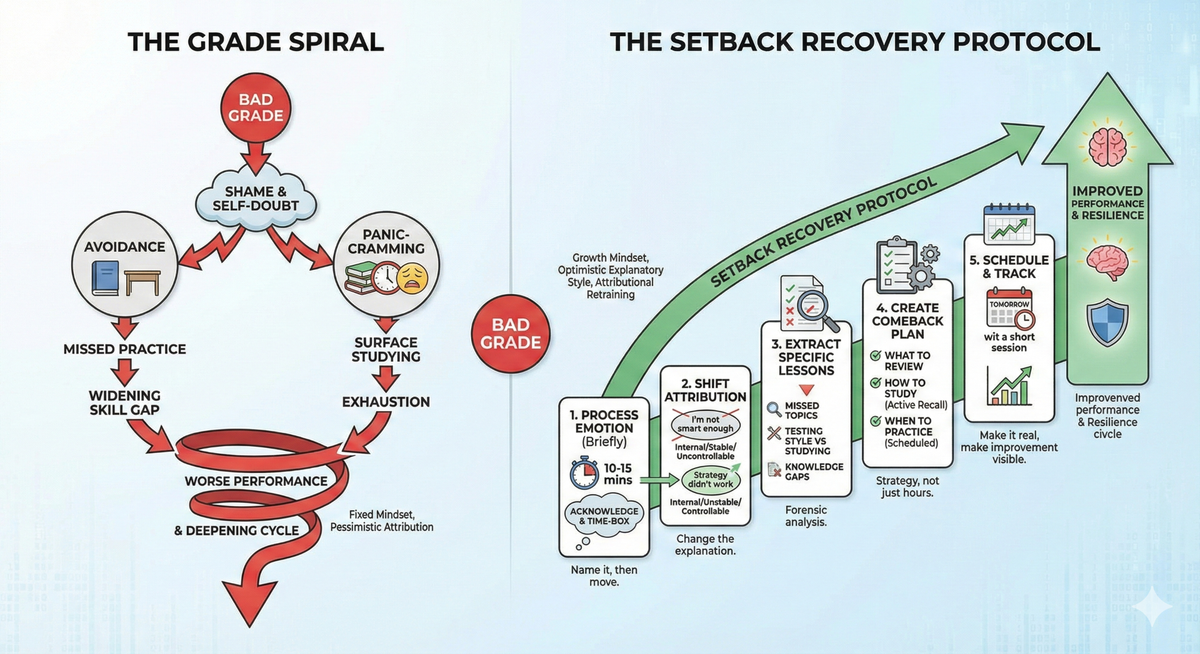
The Grade Spiral: When a disappointing grade triggers shame, shame leads to either avoidance or panic-cramming, and both responses create conditions for more disappointing grades - a self-reinforcing cycle that turns one setback into a pattern.
It works like this:
- Bad grade arrives -> Shame, embarrassment, self-doubt
- Shame response -> Either avoidance ("I'm not a math person") OR panic-cramming ("I'll study 5 hours tonight")
- Avoidance path -> Missed practice, widening skill gap, worse performance
- Panic path -> Surface studying without strategy, exhaustion, mediocre results
- Next setback -> "See? I knew I couldn't do it" (cycle deepens)
The spiral isn't about being weak or lazy. It's what happens when a brain without recovery infrastructure meets a painful outcome.
Breaking the spiral requires changing what happens in that critical moment after the grade arrives.
Quick diagnosis: symptoms vs infrastructure
When a student gets a bad grade, the usual responses are:
Student responses:
- "I'm just not good at this subject"
- "I studied so hard - what's the point?"
- "Whatever, I don't care" (but they do)
- "I'll just study way more next time"
Parent responses:
- "You should have studied harder"
- "What happened?"
- "It's okay, you're smart" (without analysis)
- Adding more tutoring hours immediately
None of these build infrastructure. They're all either blame or rescue.
Common symptoms of missing recovery infrastructure:
- Performance drops further after initial setback
- Increasing avoidance of the subject
- Emotional shutdown when grades are mentioned
- "I don't care" attitude masking hurt
- Cramming cycles that never lead to lasting improvement
What's actually missing:
- A way to process the disappointment without getting stuck in it
- A framework for explaining the setback constructively (attribution)
- A method to extract specific lessons from the failure
- A system for turning those lessons into better preparation
- A scheduled comeback attempt that makes improvement visible
The science: why how you explain failure matters
Two research traditions explain what's happening when students respond to setbacks - and how to respond better.
1. Attribution Theory (Weiner)
Psychologist Bernard Weiner's attribution theory shows that how students explain their failures predicts their future behavior more than the failure itself.
Students make attributions along three dimensions:
| Dimension | Question | Examples |
|---|---|---|
| Locus | Is the cause inside or outside me? | Ability, effort (internal) vs. test difficulty, luck (external) |
| Stability | Will this cause be present next time? | Ability (stable) vs. effort, mood (unstable) |
| Controllability | Can I change this cause? | Effort, strategy (controllable) vs. ability, luck (uncontrollable) |
The combination determines emotional response and future behavior:
| Attribution Pattern | Emotional Response | Behavior |
|---|---|---|
| "I'm not smart enough" (internal, stable, uncontrollable) | Shame, hopelessness | Avoidance, giving up |
| "I was unlucky" (external, unstable, uncontrollable) | Frustration | No change in approach |
| "I didn't study the right way" (internal, unstable, controllable) | Guilt but hope | Strategy change, effort |
| "I didn't prepare enough" (internal, unstable, controllable) | Regret but motivation | More effective practice |
The key insight: Students who attribute failure to controllable, unstable factors (effort, strategy, preparation) recover better than those who attribute to uncontrollable, stable factors (ability, intelligence).
This is teachable. It's called attributional retraining.
2. Learned Optimism (Seligman)
Psychologist Martin Seligman's research on explanatory style shows that how we habitually explain setbacks shapes our resilience.
Seligman identified three dimensions of explanatory style:
| Dimension | Pessimistic Explanation | Optimistic Explanation |
|---|---|---|
| Permanence | "I'll always be bad at this" | "This time didn't go well" |
| Pervasiveness | "I'm failing at everything" | "I struggled with this specific topic" |
| Personalization | "It's all my fault - I'm stupid" | "The test was hard AND I could have prepared differently" |
Students with optimistic explanatory styles:
- Recover faster from setbacks
- Try harder after failure
- Show less depression and anxiety
- Perform better academically over time
Students with pessimistic explanatory styles:
- Feel defeated longer
- Reduce effort after failure
- Show more learned helplessness
- Underperform relative to ability
The critical point: Explanatory style is learned - and can be relearned.
3. Growth Mindset Connection (Dweck)
Carol Dweck's growth mindset research shows that beliefs about whether ability is fixed or malleable predict response to setbacks.
Fixed mindset + bad grade = "I'm not smart enough" (identity threat)
Growth mindset + bad grade = "I haven't mastered this yet" (challenge)
The Grade Spiral is powered by fixed mindset thinking. Breaking it requires growth mindset infrastructure - not just believing "I can improve" but having a system that makes improvement visible and achievable.
This is where Weiner, Seligman, and Dweck converge: the explanation matters, and the explanation can be trained.
Why traditional responses backfire
| Response | What it does | Why it fails |
|---|---|---|
| "You should have studied harder" | Blames effort without analyzing strategy | Creates shame without useful direction |
| "It's okay, you're smart" | Dismisses the setback | Reinforces fixed mindset (ability-based identity) |
| Adding more tutoring | Addresses symptoms | Doesn't fix the recovery system; can create dependency |
| Panic-cramming | Increases hours | Without strategy change, hours don't compound |
| "Whatever, I don't care" | Self-protection | Avoidance prevents learning from the setback |
De-shaming reframe:
A bad grade is data about your current preparation system, not evidence about your intelligence.
The question isn't "Why am I bad at this?" It's "What specifically didn't work, and what will I try differently?"
The Study OS approach: building setback recovery infrastructure
A Study OS treats setback recovery like any other skill: trainable, repeatable, and systematic.
1. Process the emotion (don't skip or wallow)
Before strategy, acknowledge the feeling. Skipping this creates suppression that resurfaces as avoidance. Wallowing creates paralysis.
- Name it: "I'm disappointed/frustrated/embarrassed" is more useful than "I'm stupid"
- Time-box it: Give yourself 10-15 minutes to feel bad. Set a timer.
- Then move: After the timer, shift from feeling to analysis
2. Analyze the attribution (change the story)
Ask: "How am I explaining this to myself?"
Listen for danger patterns:
- "I'm just not a [subject] person" (stable, uncontrollable)
- "I'll never get this" (permanent)
- "I'm failing at everything" (pervasive)
Redirect to constructive attributions:
- "My preparation strategy didn't match what was tested" (controllable)
- "I didn't practice the right type of problems" (specific, changeable)
- "I need to adjust my approach, not my identity" (growth-oriented)
3. Extract specific lessons (the forensic step)
Don't just feel bad - get useful information.
Questions to ask:
- Which specific topics/problems did I miss?
- Did I run out of time, or not know the material?
- What did I think I knew but actually didn't?
- How did I study, and did it match how I was tested?
- What would I do differently in the same amount of time?
4. Create a comeback plan (strategy, not just hours)
More studying isn't a plan. A plan is:
- What specifically to review (the missed topics)
- How to study (active recall, not re-reading)
- When to practice (scheduled sessions, not "I'll study more")
- How to test yourself (practice problems matching test format)
5. Schedule the first comeback session (make it real)
Put the first study session on the calendar within 48 hours. Make it:
- Short (15-20 minutes)
- Specific (one topic from the missed material)
- Output-focused (something tangible produced)
This breaks the avoidance pattern by creating immediate forward motion.
6. Track the recovery (make improvement visible)
After the comeback work:
- What can you now do that you couldn't before the setback?
- What evidence shows improvement?
- How will you maintain this before the next assessment?
Visibility prevents the "nothing ever works" pessimistic spiral.
A concrete Tuesday example (what this looks like in real life)
Grade 7 Science (Ecosystems Unit Test), Tuesday 4:15-4:27 pm (12 minutes)
Goal: Process a 62% test score and create a comeback plan.
Context: Emma got her test back today. She studied for 2 hours the night before but still scored lower than expected. She's upset and saying "I'm terrible at science."
- 2 min - Process the emotion (time-boxed)
- Set timer for 2 minutes
- Emma writes: "I feel disappointed and embarrassed. I worked hard and it didn't show."
- Timer ends. Deep breath. Move to analysis.
- Output: Emotion acknowledged, time-boxed
- 3 min - Analyze the attribution (change the story)
- Mom asks: "What's your first explanation for what happened?"
- Emma: "I'm just not good at science."
- Redirect: "Let's make that more specific. What part of science? What exactly didn't work?"
- New explanation: "I didn't practice the food web diagrams enough. I read about them but didn't draw them myself."
- Output: Attribution shifted from ability to strategy
- 4 min - Extract specific lessons (forensic analysis)
- Review the test together:
- Lost 15 points on food web diagram (couldn't remember producer/consumer arrows)
- Lost 10 points on energy transfer calculations (knew concept but made math errors)
- Lost 8 points on vocabulary (definitions were close but not exact)
- Key insight: "I recognized everything but couldn't reproduce it from memory"
- Output: 3 specific skill gaps identified
- Review the test together:
- 3 min - Create comeback plan + schedule first session
- Plan for this week:
- Wednesday: 15 min - Draw 3 food web diagrams from memory, check, correct
- Thursday: 10 min - Practice 5 energy calculation problems with units
- Friday: 10 min - Active recall quiz on 10 key vocabulary terms
- Output: 3 sessions scheduled, first one tomorrow
- Plan for this week:
Total output: Emotion processed + attribution redirected + 3 gaps identified + 3 sessions scheduled
Try this today (10 minutes): The Setback Recovery Protocol
Use this after any disappointing grade. The goal is to transform the setback from an identity event into a learning opportunity.
Total time: 10 minutes
Output: Emotion log + attribution shift + 3 lessons + comeback session scheduled
Step 1: Acknowledge and time-box (2 min)
Write down:
- "I feel ______ about this grade."
- "The story I'm telling myself is ______."
Feel it for 2 minutes. Then stop. Move forward.
Step 2: Rewrite the attribution (2 min)
Look at your story. Is it:
- About your intelligence/ability? (dangerous)
- About something you can't change? (unhelpful)
- About something permanent? (inaccurate)
Rewrite it as:
- "My strategy of ______ didn't work because ______."
- "I didn't practice ______ the way I was tested on it."
- "Next time I will ______ differently."
Step 3: Extract three specific lessons (3 min)
Look at what you got wrong. Write:
- "I missed ______ because ______."
- "I missed ______ because ______."
- "I missed ______ because ______."
Be specific. Not "I don't know the material" but "I couldn't draw the diagram from memory."
Step 4: Plan the comeback (2 min)
For each lesson, write one action:
- "To fix ______, I will ______."
- "To fix ______, I will ______."
- "To fix ______, I will ______."
Step 5: Schedule the first session (1 min)
Put the first action on your calendar:
- When: [specific day and time within 48 hours]
- Duration: 15-20 minutes
- Focus: [the first gap you're addressing]
- Output: [what you'll produce to prove you did it]
Success criterion: You transformed a bad grade from a verdict into a plan. The emotion doesn't have to be gone - but you have forward motion.
For parents: how to respond to a bad grade without making it worse
When your child brings home a disappointing grade, your response shapes their recovery trajectory.
What to avoid:
- "You should have studied harder" - Blames without diagnosing; creates shame
- "It's okay, you're so smart" - Dismisses the setback; reinforces fixed mindset
- "What happened?" (in accusatory tone) - Triggers defensiveness
- Immediately adding tutoring/study hours - Treats symptoms without understanding cause
What to do instead:
- Validate first: "I can see you're disappointed. That's a hard feeling."
- Ask diagnostic questions:
- "What parts did you feel confident about?"
- "What surprised you on the test?"
- "How did you study, and how were you tested?"
- Shift attribution gently: "So it sounds like the strategy didn't match the test, not that you can't do this."
- Help create a specific plan: Not "study more" but "practice drawing diagrams from memory for 15 minutes tomorrow"
- Praise the recovery, not just results: "You came back from that setback with a real plan - that's the skill that matters long-term"
The lighthouse principle:
Your job is to be stable and visible - not to steer their ship. Help them see the shore and build their own navigation skills.
For younger students (grades 3-5):
- Keep the analysis shorter (2-3 minutes)
- Focus on one specific lesson, not three
- Make the comeback plan very concrete ("Draw one diagram tomorrow")
- Emphasize "not yet" language: "You're learning to do this. You're not done yet."
For older students (grades 6-10):
- Give more space for independent analysis
- Ask questions rather than provide answers
- Help them build their own recovery system
- Connect setbacks to long-term goals: "Every expert failed many times while learning. This is part of the path."
Calm next step: make setback recovery easier to practice
A bad grade is inevitable. What's not inevitable is the spiral that follows.
A Study OS builds recovery infrastructure:
- Attribution training that turns "I'm stupid" into "I need a different strategy"
- Forensic analysis that extracts specific lessons from every setback
- Comeback planning that turns lessons into scheduled action
- Progress visibility that proves improvement is happening
EaseFactor helps students build a system where bad grades become data - not disasters. Where setbacks lead to strategy changes, not identity crises. Where resilience is trained, not hoped for.
Citations
- Weiner, B. (1985, 2010): Attribution theory - how students explain success and failure along dimensions of locus, stability, and controllability; emotional and behavioral consequences of attributions
- Seligman, M. E. P. (1990, 2006): Learned optimism - explanatory style (permanence, pervasiveness, personalization) and its impact on resilience and performance
- Dweck, C. S. (2006): Growth mindset - beliefs about intelligence and their effect on response to setbacks and challenges
- Perry, R. P., Hladkyj, S., Pekrun, R. H., & Pelletier, S. T. (2001): Attributional retraining - changing students' causal attributions to improve academic outcomes
- Blackwell, L. S., Trzesniewski, K. H., & Dweck, C. S. (2007): Implicit theories of intelligence predict achievement across adolescent transition
- Yeager, D. S., & Dweck, C. S. (2012): Mindsets that promote resilience - when students believe that personal characteristics can be developed
- Pekrun, R. (2006): Control-Value Theory of achievement emotions - how control beliefs interact with setback experiences
- Gross, J. J. (2002): Emotion regulation - strategies for processing negative emotions constructively
TL;DR
- A bad grade triggers the Grade Spiral when shame leads to avoidance or panic - both of which prevent real learning and set up the next setback.
- How you explain the failure matters more than the failure itself - attribution theory (Weiner) and explanatory style (Seligman) show that controllable, temporary, specific explanations lead to better recovery.
- The Setback Recovery Protocol gives students a system: process the emotion briefly, shift the attribution, extract specific lessons, create a comeback plan, and schedule the first session.
- A Study OS makes resilience trainable - so setbacks become data points for improvement, not evidence of permanent limitation.
- A bad grade is feedback, not identity - how you explain the setback determines what happens next.
- The Grade Spiral traps students when shame leads to avoidance or panic-cramming, both of which prevent actual learning.
- The Setback Recovery Protocol gives students (and parents) a structured way to process disappointment, extract lessons, and create a comeback plan.

Manoj Ganapathi
Founder and Builder of EaseFactor. Passionate about evidence-based learning and helping students build effective study habits through cognitive science principles.
Ready to Study Smarter?
EaseFactor uses these learning science principles to help you build lasting knowledge.