Bloom's Taxonomy Isn't a Pyramid You Memorize. It's a Workout Plan You Run.
 Manoj Ganapathi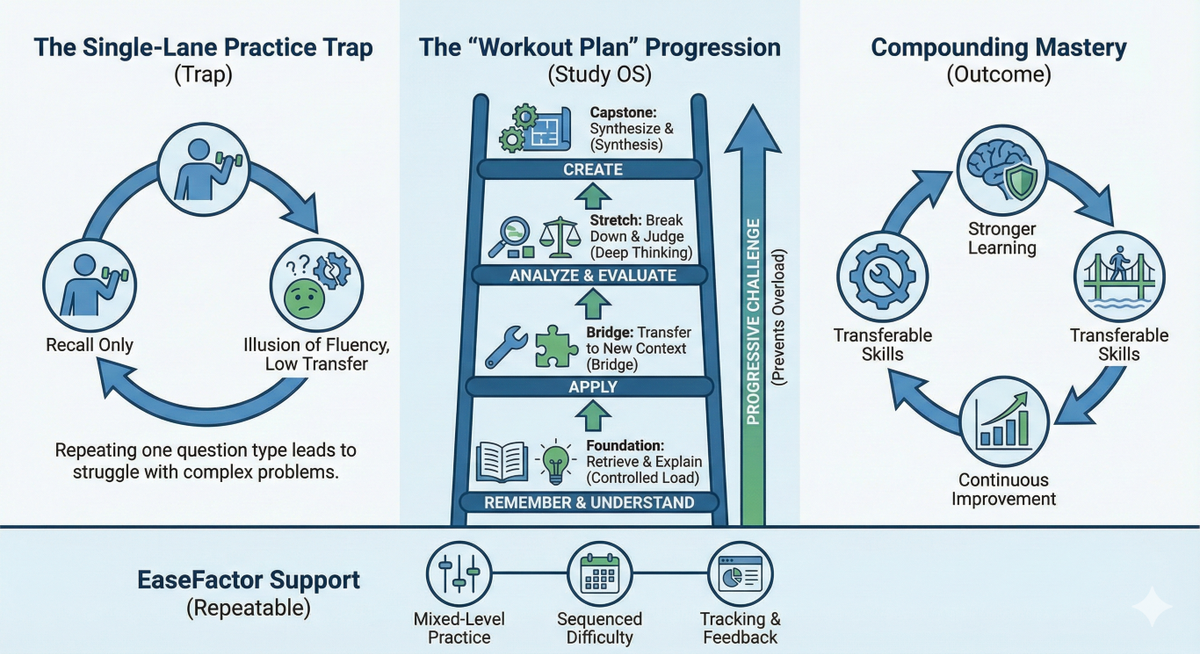
The real friction: "I studied… but the test felt different."
Most students don't fail because they didn't "work hard." They fail because their practice didn't match the thinking the exam demanded.
They did a lot of:
- definitions, summaries, re-reading, highlight-and-hope
…but the test asked for:
- applying a concept to a new scenario
- comparing two ideas
- judging evidence
- creating an explanation or solution
That mismatch is the hidden gap Bloom's taxonomy helps you close—systematically.
Diagnosis: the learning gaps Bloom helps fix
Symptoms students report
- "I know it when I see it, but I can't answer."
- "I understood in class, then forgot."
- "I can do the easy ones, but case-based questions destroy me."
Infrastructure issues underneath
- Illusion of fluency: recognition feels like knowing, but recall fails under pressure.
- Low transfer: practice never forces the brain to use knowledge in a new context.
- Unmanaged cognitive load: jumping straight to hard questions without scaffolding leads to shutdown.
Bloom's taxonomy is not "more work." It's better targeting.
A named pattern you can recognize: The Single-Lane Practice Trap
Single-Lane Practice Trap (SLPT): When a student practices only one type of question (usually recall), they become "fast" in that lane—but can't navigate turns, intersections, or detours (application, analysis, evaluation).
A Study OS solves SLPT the way training solves athletic plateaus: structured variation + progression + feedback.
Bloom's Taxonomy as a training ladder (not a pyramid)
Think of Bloom like a ladder in a mental gym:
- You don't start with the heaviest weight (Evaluate/Create).
- You don't only do warm-ups forever (Remember/Understand).
- You progress rung-by-rung so challenge is productive, not overwhelming.
This aligns with what your original draft emphasizes: diverse assessment formats and systematic progression while managing cognitive overload.
The Exercise Design Matrix
Use Bloom to ensure every topic gets a balanced cognitive workout.
The sequencing rule: build strength without overload
Your piece correctly warns about cognitive overload when students jump too fast.
A practical progression that works across grades:
- Start: 2–4 items at Remember/Understand (fast wins, foundation)
- Bridge: 1–2 Apply questions (transfer begins)
- Stretch: 1 Analyze/Evaluate question (deep thinking with guardrails)
- Capstone (optional): 1 Create prompt (small, bounded—not a full project)
This is how effort becomes advantage: the same study time produces stronger, more transferable learning.
What this looks like on a Tuesday
Grade 7 Science (Photosynthesis), 12 minutes after school
1) Remember (2 min)
- Write 3 facts from memory: inputs, outputs, where it happens.
2) Understand (2 min)
- Explain photosynthesis in your own words in 2–3 sentences.
3) Apply (3 min)
- Scenario: "A plant is kept in low light for a week. Predict two changes you'd observe and why."
4) Analyze (3 min)
- Compare photosynthesis vs respiration: make a 2-column table in your notebook (purpose, inputs/outputs, when).
5) Evaluate/Create (2 min)
- Evaluate: "Which factor matters more for photosynthesis here—light or CO₂? Defend your choice."
- or Create: "Design a simple experiment to test light intensity's effect. What would you measure?"
Try this today: the 10–12 minute Bloom Mix (repeatable routine)
Goal: Build a mini "question set" that trains multiple cognitive levels without overwhelm.
Timer: 12 minutes. Output: 6 answers + 1 next-review plan.
- (2 min) Remember: write 2 recall questions and answer them from memory.
- (2 min) Understand: write 1 explain-like-I'm-teaching answer (2–3 sentences).
- (3 min) Apply: solve 1 scenario that changes the context.
- (3 min) Analyze: do 1 compare/contrast or "find the mistake" item.
- (2 min) Evaluate/Create: write 1 judgment (with criteria) or 1 mini-design (bounded).
- (30 sec) Schedule: set the next review: 48 hours later, redo the same mix with new questions.
If you do this 4 times a week, you're not just studying—you're running a Study OS loop: retrieve → explain → apply → analyze → justify/design → schedule.
Where EaseFactor fits
Bloom's taxonomy is powerful, but students struggle to apply it consistently because it requires planning, variation, and tracking.
A Study OS approach (like EaseFactor) makes it repeatable by:
- generating mixed-level practice instead of single-format quizzes
- sequencing difficulty to prevent overload
- tracking which cognitive levels are under-trained (so effort goes where it matters)
TL;DR
- Different question types train different thinking muscles—a good practice set is a balanced workout, not a single rep repeated 30 times.
- Progression matters: foundations first (Remember/Understand), then challenge (Apply/Analyze/Evaluate/Create) with controlled cognitive load.
- A Study OS makes this repeatable: consistent question-mix + spacing + feedback turns effort into compounding mastery.
Further Reading
The ideas in this article build on decades of cognitive science research:
- Bloom et al. (1956), Taxonomy of Educational Objectives (cognitive domain)
- Anderson & Krathwohl (2001), revised Bloom's taxonomy
- Dunlosky et al. (2013), practice testing and effective learning techniques
- Roediger & Karpicke (2006), the testing effect (retrieval practice)
- Sweller (Cognitive Load Theory), managing intrinsic/extraneous load
- Bjork & Bjork (desirable difficulties), spacing and challenge for durable learning

Manoj Ganapathi
Founder and Builder of EaseFactor. Passionate about evidence-based learning and helping students build effective study habits through cognitive science principles.
Ready to Study Smarter?
EaseFactor uses these learning science principles to help you build lasting knowledge.