Training Your Focus Muscle: The Science of Attention and How to Strengthen Yours
 Manoj Ganapathi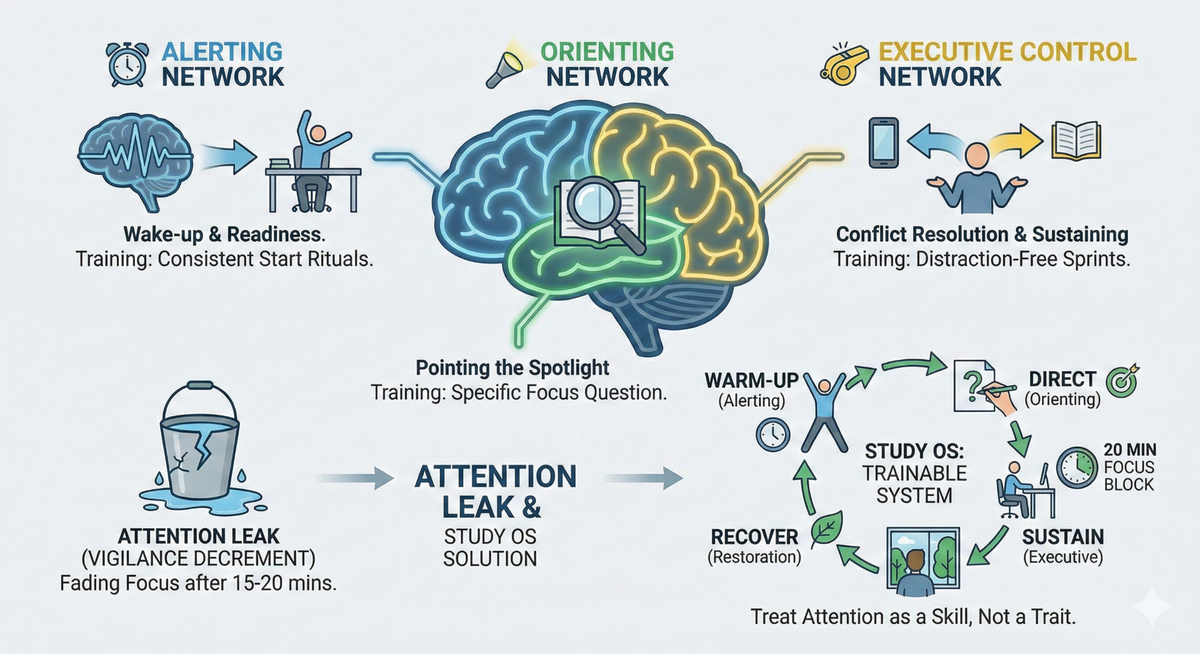
Why you can concentrate on a video game for three hours straight but lose focus on homework after eight minutes — and why that's not a character flaw.
You've felt it. You sit down to study, open the textbook, read the first paragraph... and then suddenly you're thinking about lunch, or checking your phone, or staring at the wall while the words blur into meaningless shapes. Twenty minutes later, you've "studied" but absorbed nothing.
Your parents say, "just focus." Your teacher says, "pay attention." But nobody explains how — because most people treat attention like an on/off switch you either flip or you don't.
Here's what neuroscience actually says: attention isn't a single thing you have or lack. It's a system with three separate networks, each doing a different job. And like any system, it can be understood, maintained, and trained.
The reason you can focus on a game but not on homework isn't because you're broken. It's because games are designed to manage your attention for you — alerting you to threats, directing you to targets, keeping difficulty perfectly matched. Homework does none of that. So, your brain has to do all three jobs manually, and nobody taught it how.
EaseFactor treats attention as a trainable skill — part of your Study OS — not a personality trait you're stuck with.
The named pattern: The Attention Leak
The Attention Leak: The gradual, invisible loss of focus during a study session — not a dramatic distraction but a slow drip where mental energy escapes through tiny cracks: a wandering thought, a quick phone check, background noise you "don't notice," switching between tabs. Each leak seems harmless, but after 20 minutes the bucket is empty and you're staring at the page with nothing going in.
Here's what The Attention Leak looks like in real life:
- You sit down to study history at 4:15 PM
- First five minutes: actually reading, absorbing content
- Minute 6: a notification sound — you don't check it, but your brain wonders what it was (leak #1)
- Minute 9: you realize you've been reading the same paragraph twice without processing it (leak #2)
- Minute 12: you switch to a "quick" YouTube video "for research" (leak #3)
- Minute 18: you're three videos deep into something unrelated
- Minute 25: you look at the clock, feel guilty, and try to restart—but now you're tired and behind
The student didn't choose to lose focus. Focus leaked. And without a system to plug the holes, the same pattern repeats every session.
Quick diagnosis: why "just concentrate harder" fails
Symptoms students show:
- "I keep rereading the same sentence"
- "I can focus at school but not at home"
- "I get distracted by every tiny thing"
- "I start strong but fade fast"
- "I can't focus unless it's something I like"
What's actually missing:
Not willpower. Not discipline. Attention infrastructure. Your brain runs three separate attention systems, and "just focus" doesn't tell any of them what to do.
- Can't get alert enough to start — Alerting network — Brain hasn't shifted from rest mode to study mode — no activation signal
- Gets pulled away by every noise or notification — Orienting network — Brain keeps redirecting toward novel stimuli instead of holding on the task
- Starts strong but fades after 10-15 minutes — Executive network — Brain can't sustain conflict resolution between "this is boring" and "keep going"
- Can focus on games but not homework — All three — Games manage alerting, orienting, and difficulty automatically; homework requires you to do it yourself
- "Brain fog" after 20+ minutes — Vigilance decrement — Normal neurological fatigue—attention always fades without breaks and recovery
More effort won't fix a leaky system. You need to understand the three networks — and train each one.
The science: your brain's three attention networks
Posner's Attention Network Theory
Michael Posner, one of the most influential cognitive psychologists alive, demonstrated that attention isn't one skill — it's three separate neural networks working together. Think of them like three different muscles that all contribute to "focus."
1. The Alerting Network — "Getting ready"
This is your brain's wake-up system. It controls your general state of readiness: are you drowsy and drifting, or sharp and prepared? The alerting network responds to signals that something important is about to happen.
In studying: This is the difference between sitting down and actually being mentally present versus having your body at the desk while your brain is still in lunchtime mode.
Training it: Consistent start rituals (same time, same spot, same first action) give your alerting network a reliable activation signal — like warming up before exercise.
2. The Orienting Network — "Pointing the spotlight"
This network directs your attention toward specific information. It's the spotlight your brain aims at what matters right now. When it works well, you zoom in on the relevant paragraph and filter out the noise. When it doesn't, every movement, sound, or thought pulls the spotlight away.
In studying: This is the difference between reading with purpose ("What caused the French Revolution?") and reading with open eyes but no target—where everything gets equal (minimal) attention.
Training it: Giving yourself a specific question before reading or studying directs the orienting network. "What am I looking for?" gives the spotlight a target.
3. The Executive Attention Network — "The referee"
This is the network that resolves conflict between competing demands. When part of your brain says "check your phone" and another part says "finish this paragraph," the executive network decides who wins. It's also what keeps you going when the task is boring or hard.
In studying: This is the difference between pushing through the difficult paragraph and giving up because "I'll just do it later." It's the referee that keeps the boring-but-important task ahead of the fun-but-irrelevant distraction.
Training it: Practice choosing the harder thing in small doses. Short study sprints where you deliberately resist one distraction strengthen this network like reps in a gym.
The vigilance decrement: why fading is normal
Here's what nobody tells students: attention is supposed to fade. Research consistently shows that sustained attention starts declining after as little as 10-20 minutes on a single task. This is called the vigilance decrement, and it happens to everyone — even air traffic controllers and surgeons.
The overload theory (Warm, Parasuraman & Matthews) explains why: sustaining attention consumes limited neural resources. When those resources deplete, performance drops — not because you're lazy, but because the tank is empty.
What this means for studying: If your focus fades after 15-20 minutes, that's not failure. That's biology. The question isn't "How do I focus for two hours straight?" but "How do I build a study rhythm that works with my brain's natural attention cycle?"
Attention Restoration Theory: nature refills the tank
Rachel and Stephen Kaplan's Attention Restoration Theory (ART) explains how directed attention recovers. Their research showed that natural environments have four qualities that restore depleted attention:
- Being away — Mentally shifting from the demanding task — Step away from the desk, change your visual environment
- Extent — The restorative environment feels immersive, not fragmented — Look out a window at nature, step outside, or even look at nature images
- Soft fascination — Gentle, effortless engagement (leaves moving, clouds drifting) — Passive sensory input that doesn't demand concentration
- Compatibility — The environment matches what you want to do (rest) — No pressure, no decisions, just recovery
Recent research (2024-2025) confirms that even brief exposures to nature — looking out a window for 40 seconds, a 5-minute walk outside — measurably improve attentional control afterward.
Temporal attention: your brain predicts the future
Anna Nobre's pioneering research at Yale shows that attention isn't just reactive — it's predictive. Your brain constantly extracts timing patterns from the environment and uses them to anticipate what's coming next. When you know when something will happen, you can prepare your attention in advance.
In studying: This is why consistent routines work so well. When your brain knows "at 4:00 PM we study, for 20-minute blocks with 5-minute breaks," it can pre-allocate attention resources. Random, unpredictable study sessions force your brain to figure out what's happening while it's happening — wasting precious cognitive fuel on logistics instead of learning.
The Study OS approach: managing attention like a system, not a wish
A Study OS doesn't demand superhuman focus. It builds an attention-management system that works with your brain's natural rhythms.
1. Warm-up your alerting network (2 minutes)
Don't just sit down and start the hardest thing. Give your brain an activation signal:
- Same time, same place, same starting action (cue-routine-reward from your Study OS habit loop)
- One easy recall question from yesterday's material (alerting + retrieval practice)
- Phone physically out of the room (remove competing activation signals)
2. Direct your orienting network (before each task)
- Write ONE question you're trying to answer this session
- Set a single target: "I'm reading pages 42-45 to find three causes of the Civil War"
- Close every tab, app, and resource you don't need right now
3. Respect the vigilance decrement (every 20-25 minutes)
- Work in 20-minute focus blocks, not marathon sessions
- Take a 5-minute restorative break: step outside, look at nature, or do gentle movement
- After the break, re-state your focus question before continuing
4. Train your executive network (daily micro-reps)
- Practice the "urge surf": when a distraction impulse hits, notice it, name it ("that's the phone urge"), and return to the task. Don't fight it — acknowledge it and let it pass.
- Start with 10-minute distraction-free blocks and add 2 minutes per week
- Track your longest unbroken focus time — watch it grow like a streak
5. Recover your attention (strategically)
- Use nature exposure during breaks (even 40 seconds of looking at trees helps)
- Alternate between demanding subjects and lighter ones
A concrete Tuesday example (what this looks like in real life)
Grade 7 Science (Ecosystems), Tuesday 4:00 PM (12 minutes)
Goal: Study food webs using attention-management techniques.
- 2 minutes — Alerting warm-up
Sit at study spot. Phone in the other room. Write yesterday's recall: "3 things I remember about producers and consumers." Don't check notes — just write what comes to mind.
Output: 3 recall attempts (right or wrong).
- 1 minute — Orienting target
Write one focus question at the top of the page: "How does removing one species affect the whole food web?"
Output: 1 written focus question.
- 6 minutes — Focused study block
Read textbook section on food web disruption with the question in mind. When you find information that answers it, underline and write a one-sentence note in the margin. When a distraction urge hits, notice it ("that's the phone urge") and return to the question.
Output: 3-4 margin notes answering the focus question.
- 3 minutes — Recovery + receipt
Stand up, look out the window for 60 seconds (attention restoration). Then sit back down and write:
- "I can explain: how removing a predator causes prey overpopulation"
- "I'm still unclear on: what happens to energy when a species disappears"
- "Longest focus stretch: about 4 minutes before first distraction urge"
Output: 1 strength, 1 gap, 1 focus-tracking data point.
Total: 12 minutes. Attention managed, not just demanded.
Try this today (10 minutes): The Focus Reset
Total time: 10 minutes
Output: 1 attention audit + 1 environment fix + 1 focused study block + 1 focus receipt
This routine trains all three attention networks in one session.
- 2 minutes — The Attention Audit (alerting network)
Before studying, rate yourself 1-10 on three scales:
- Alertness: "How awake and ready am I?" (1 = foggy, 10 = sharp)
- Direction: "Do I know exactly what I'm studying?" (1 = vague, 10 = specific)
- Resolve: "How confident am I that I can resist distractions?" (1 = low, 10 = high)
Write down your three numbers. If any is below 5, address it before starting:
- Low alertness → 30 seconds of movement (jumping jacks, stretching)
- Low direction → write one specific focus question
- Low resolve → move your phone to another room
Output: Three self-ratings + one fix action.
- 1 minute — The Spotlight Set (orienting network)
Write ONE question at the top of your study page. This is your orienting target — everything you read, write, or solve points toward answering this question.
Example: "What are the three main causes of World War I?"
Output: 1 written focus question.
- 5 minutes — The Distraction-Free Sprint (executive network)
Set a timer for 5 minutes. Study with one rule: every time a distraction urge appears, say "noticed" silently and return to the task. Don't fight the urge. Don't feel bad about it. Just notice and return. Count how many times you "noticed" during the sprint.
Output: Study notes + distraction count.
- 2 minutes — The Recovery Receipt (restoration)
Stop studying. Stand up. Look at something natural for 60 seconds — out a window, at a plant, or even a nature photo on your wall. Then sit back down and write:
- "Today I focused for ___ minutes with ___ distractions noticed"
- "My focus question answer so far: ___"
- "Tomorrow I'll try to beat ___ noticed-count"
Schedule your next Focus Reset in 48 hours.
Output: 1 focus receipt + 1 scheduled next session.
De-shaming reframe: Noticing distractions isn't failure — it's training. Every "noticed" is a rep for your executive attention network. A count of 12 distractions in 5 minutes isn't embarrassing; it's 12 reps of attention training. Athletes don't feel bad about doing 12 bicep curls. You shouldn't feel bad about 12 focus reps.
For parents: how to support focus without becoming the focus police
- Don't say "just focus" — it's like telling someone to "just be taller." Instead, ask: "Do you have a specific question you're trying to answer this session?" (this activates the orienting network)
- Help with the environment, not the willpower. Offer to hold their phone during study time. Set up a consistent study spot. These reduce the demands on their executive network so more resources go to learning.
- Normalize the fade. If your child's attention drops after 15 minutes, that's biology, not laziness. Help them build a study rhythm with breaks instead of demanding longer marathon sessions.
- Notice the improvement, not just the performance. "You focused for 8 minutes before your first break last week, and today you hit 12 — that's real growth." This builds self-efficacy for attention itself.
- Model attention management. Put your own phone away during family homework time. Children learn focus habits by watching adults manage theirs.
Calm next step: make focus easier to practice
You don't need perfect concentration. You need a system that helps you warm up, direct, sustain, and recover your attention in manageable cycles.
EaseFactor's Study OS builds this system into every study session:
- Alerting warm-ups that shift your brain from rest mode to study mode
- Focus targets that give your orienting network something to lock onto
- Timed study blocks that work with the vigilance decrement instead of fighting it
- Recovery prompts that restore attention between blocks
- Focus tracking that turns attention management into visible, growing evidence of improvement
Attention isn't a gift some students have. It's a muscle every student can train — one 10-minute Focus Reset at a time.
TL;DR
- Attention is three separate brain networks (alerting, orienting, executive)— not a single on/off switch. Each can be trained independently, and focus naturally fades after 15-20 minutes (that's biology, not laziness).
- A Study OS manages attention like a system: warm-up rituals activate alerting, focus questions direct orienting, timed blocks respect the vigilance decrement, and nature breaks restore capacity.
- Start today: Try the 10-minute Focus Reset — audit your readiness, set one spotlight question, do a 5-minute distraction-free sprint, and capture your focus receipt.
Citations
- Posner, M. I. & Petersen, S. E. (1990): Attention Network Theory—identified the three separate neural networks (alerting, orienting, executive control) that comprise the human attention system
- Kaplan, R. & Kaplan, S. (1989): Attention Restoration Theory—demonstrated that exposure to natural environments restores depleted directed attention through "soft fascination"
- Nobre, A. C. (2018): Temporal attention and prediction—pioneered research showing the brain extracts timing patterns to proactively allocate attention resources
- Warm, J. S., Parasuraman, R. & Matthews, G. (2008): The vigilance decrement—demonstrated that sustained attention reliably declines after 15-20 minutes, and that this reflects resource depletion rather than motivational failure
- Ariga, A. & Lleras, A. (2011): Brief diversions improve sustained attention—showed that short breaks during prolonged tasks prevent the vigilance decrement
- Rueda, M. R., Rothbart, M. K., McCandliss, B. D., Saccomanno, L. & Posner, M. I. (2005): Attention network training in children—demonstrated that attention networks are trainable in school-age children through structured practice
- Luna-Rodriguez, A., Wendt, M., Kerner auch Koerner, J., Gawrilow, C. & Jacobsen, T. (2018): Attentional networks in adolescents—showed all three networks continue developing through adolescence (ages 10-19)

Manoj Ganapathi
Founder and Builder of EaseFactor. Passionate about evidence-based learning and helping students build effective study habits through cognitive science principles.
Ready to Study Smarter?
EaseFactor uses these learning science principles to help you build lasting knowledge.