Ask Like Socrates, Explain Like Feynman
 Manoj Ganapathi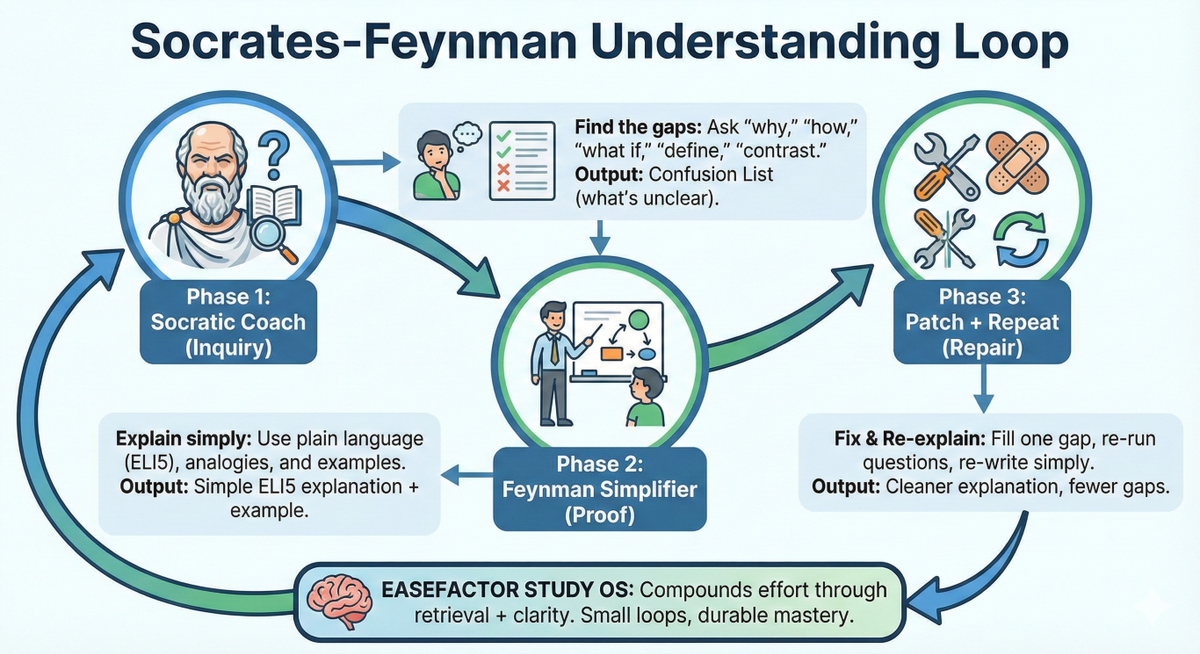
The diagnosis: why smart students still blank out on tests
Most students don't fail because they didn't "study." They fail because they studied in a way that felt like learning.
Here's the learning gap underneath:
- Illusion of competence: "I've read it, so I know it." Familiarity gets mistaken for understanding.
- Weak metacognitive checks: There's no reliable moment where the student proves, "Yes—I can actually use this."
A named pattern you'll recognize: The Highlight-Reel Trap
You reread notes, highlight a few lines, and everything looks familiar—like watching a highlight reel of a match you didn't really play. Then the test asks you to produce the answer, not recognize it—and the confidence evaporates.
EaseFactor's Study OS exists to replace that trap with infrastructure: a repeatable loop that turns effort into durable understanding.
The insight: deep learning needs a loop, not a trick
The Socratic Method and the Feynman Technique are often taught as separate "study hacks." In a Study OS, they're better treated as one cohesive system:
- Socratic Method = Inquiry (find the cracks). Strategic "why/how/what changes if…" questions reveal what you don't actually understand.
- Feynman Technique = Proof (seal the cracks). If you can explain it simply, you've built a usable mental model—not just a memory of words.
Together, they form a single Understanding Loop:
- Ask to uncover
- Explain to confirm
- Repair and repeat
The science: why this works better than rereading
This loop is effective because it forces two learning moves that passive study avoids:
1) Active recall (retrieval)
- When you answer questions without looking, your brain practices pulling knowledge out—exactly what tests and real-life application require.
- This also improves metacognition: you see what you truly know versus what only feels familiar.
2) Elaborative processing (building a model)
- Explaining in simple language forces you to connect ideas, define terms, and make the logic coherent.
- Gaps become obvious because vague understanding can't survive a clear explanation.
A useful way to remember this:
Reading is input. The loop is training. In EaseFactor language: effort compounds only when the system demands retrieval + clarity.
The system: the Socrates–Feynman Understanding Loop (Study OS version)
Think of learning like building a house:
- Socrates is the architect who asks the uncomfortable questions so the foundation is solid.
- Feynman is the safety inspector who checks every connection is so clear that even a child could see it's built correctly.
You want both—every time.
The loop in one table
| Phase | Role | What you do | What you produce |
|---|---|---|---|
| 1) Socratic Coach | Inquiry | Ask "why/how/what if" until the gaps show | A short Confusion List (what's unclear) |
| 2) Feynman Simplifier | Proof | Explain in plain language (ELI5) | A simple explanation + one example |
| 3) Patch + Repeat | Repair | Fill one gap, then re-explain | A cleaner explanation and fewer gaps |
Phase 1: The Socratic Coach (Inquiry)
Use questions that force structure, not just memory. Start with these:
- Define it: "What does this term mean in one sentence?"
- Mechanism: "How does it work, step by step?"
- Why: "Why does that step happen?"
- Contrast: "How is this different from ___?"
- Change one variable: "What happens if ___ increases/decreases?"
- Prediction: "Given this situation, what should happen next—and why?"
In EaseFactor, this maps naturally to AI-powered coaching: the assistant doesn't just answer—it can keep asking the next best question until the student's thinking becomes visible.
Phase 2: The Feynman Simplifier (Proof)
Now you "own" the idea only if you can explain it clearly.
A simple template students can actually use:
- Big idea (one line): "This is about…"
- Story (3–5 lines): "First… then… because…"
- Example: "For instance…"
- One common mistake: "People often think… but actually…"
In EaseFactor, this aligns with the ELI5 challenge and the teach-back philosophy: "If you can teach it simply, you truly understand it."
Phase 3: Patch + Repeat (Repair)
Errors are data, not identity.
Your next 5–10 minutes should look like this:
- Pick one confusion item.
- Fix it using one reliable source (textbook, class notes, teacher video).
- Re-run a shorter Socratic set.
- Re-write the ELI5 explanation in fewer words.
That's compounding: small repairs, repeated.
A concrete Tuesday example (what this looks like in real life)
Grade 7 Science — Photosynthesis (12 minutes after school, Tuesday)
Goal: Not "memorize the equation," but explain the process like you own it.
1) 2 minutes: Socratic warm-up (no notes)
- "What is photosynthesis for?"
- "Where does it happen?"
- "What are the inputs and outputs?"
Write what you can. Circle what feels fuzzy.
2) 5 minutes: Socratic drill-down (find the real gap)
- "How does light help?"
- "What changes inside the leaf?"
- "If there's no light, what stops first—and why?"
Create a Confusion List with 2 bullets max.
3) 4 minutes: Feynman ELI5
- Write a 6–8 sentence explanation using the template.
- Add one simple analogy (leaf = kitchen; light = stove power; CO₂ + water = ingredients).
4) 1 minute: Patch plan
- Schedule one 5-minute review for Thursday: "Answer 3 questions + re-ELI5 in 4 sentences."
Result: The student leaves with proof of understanding, not just "I looked at it."
Try this today (10–12 minutes): "Ask like Socrates, Explain like Feynman"
You need: a notebook (or EaseFactor) + a timer.
1) 1 minute — Pick one concept
- Example: "Linear equations," "Water cycle," "Parts of speech," "Mughal administration"—anything.
2) 4 minutes — Socratic sprint
- Write 6 questions (use the prompts above).
- Answer without notes.
Output: 6 attempted answers + 2-item Confusion List.
3) 5 minutes — Feynman ELI5
- Explain the concept in 6–8 sentences.
- Include one example and one common mistake.
Output: 1 ELI5 explanation.
4) 2 minutes — Patch + schedule
- Fix one confusion item (quick reference).
- Schedule a 5-minute review in 48 hours.
Output: A calendar note or Study OS task.
Why this belongs in a Study OS, not a one-off technique
Socratic questions and Feynman explanations are powerful—but most students abandon them when they're tired, rushed, or unsure what to do next.
That's what a Study OS is for.
EaseFactor turns effort into advantage by combining learning science, structured practice, and AI-guided reflection—so progress is calm, visible, and repeatable. When the system prompts the loop, students don't need perfect motivation; they need a reliable next step.
TL;DR
- Socrates finds the gaps. Feynman proves you fixed them. Together they form an Understanding Loop.
- The goal is outputs: confusion list + simple explanation + a scheduled review.
- Consistency beats cramming: small loops compound into durable mastery.
Citations
- Retrieval practice / testing effect (Roediger & Karpicke)
- Illusions of competence & effective study strategies (Dunlosky et al.)
- Elaborative interrogation & self-explanation (Chi; Pressley)
- Desirable difficulties (Bjork & Bjork)
- Metacognition and calibration (Nelson & Narens)

Manoj Ganapathi
Founder and Builder of EaseFactor. Passionate about evidence-based learning and helping students build effective study habits through cognitive science principles.
Ready to Study Smarter?
EaseFactor uses these learning science principles to help you build lasting knowledge.