AI-Powered Personalized Learning
 Manoj Ganapathi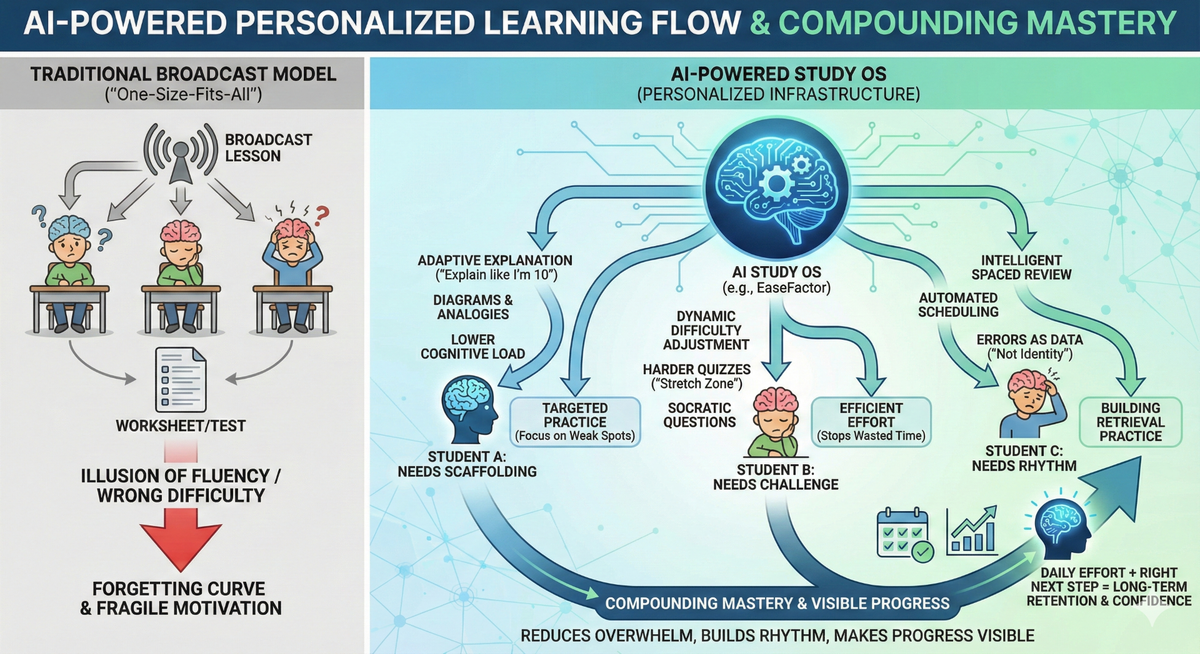
The emotional truth: "I studied… so why am I still forgetting?"
If you're a student, you've probably had this moment: you spend an hour "studying," feel confident, and then the quiz comes and your brain goes blank.
If you're a parent, you've probably watched the cycle: a burst of effort right before tests, a few wins, then the same panic returns next week.
This isn't laziness. It's not a character flaw. It's a system problem.
And the biggest system problem in school is that most learning still runs on a "broadcast model": one lesson, one pace, one worksheet, one test—designed for an imaginary average student.
But real students aren't averages. They're individuals.
Diagnosis block: what's actually breaking?
Here are the most common learning gaps hiding underneath "I need to study more":
- Illusion of fluency: reading notes feels familiar, so it seems learned—until you have to recall it without help.
- Wrong difficulty: practice is either too easy (boring) or too hard (overwhelming), so the brain disengages.
- No review rhythm: learning is treated like a one-time event, not a schedule of revisits.
- Low visibility: students can't tell what's improving, so motivation becomes fragile.
AI-powered personalization is useful because it can respond to these gaps in real time—like a learning coach that notices patterns you can't easily see.
The named pattern: The "Same Page, Different Brains" Problem
Same Page, Different Brains: Two students read the same chapter. One understands it in 10 minutes. The other needs 3 examples, a diagram, and a simpler explanation first.
Traditional systems treat them the same. Personalized systems don't.
This is where AI can help—not by doing the learning for the student, but by adapting the path so each student gets the right kind of struggle.
The core science: the "just-right challenge" zone
Learning tends to work best when difficulty is calibrated—not so easy that you coast, not so hard that you shut down. You can think of it like strength training: if the weights are always light, you don't grow; if they're always impossible, you quit.
Psychology calls this the Zone of Proximal Development (often associated with Lev Vygotsky): the space where a learner can succeed with the right support, and gradually needs less support over time.
A good Study OS does three things repeatedly:
- Set the next challenge
- Add scaffolding when needed
- Remove scaffolding as mastery grows
AI can make this scalable by adjusting difficulty, explanations, and review schedules based on what the student actually does—not what we hope they do.
Symptom relief vs infrastructure: where tutoring fits (and where it doesn't)
Let's be fair: tutoring can be excellent. It often improves performance today.
But tutoring alone is frequently symptom relief:
- It helps you finish homework.
- It clarifies a topic.
- It boosts a test score.
A Study OS is infrastructure:
- It builds retrieval practice into the week.
- It schedules review automatically.
- It tracks what's sticking vs slipping.
- It keeps difficulty "just right" across time.
Nuance: tutoring works best when paired with a Study OS—because the student arrives with clear questions, a confusion list, and a review plan, not just last-minute panic.
What AI personalization actually means (in student language)
Think of a Study OS like your phone's operating system: it doesn't "do life" for you, but it organizes your tools, reduces friction, and keeps things running smoothly.
AI-powered personalization inside a Study OS typically shows up in five practical ways:
1. Explanation style adaptation
What you experience: "Explain it like I'm 10" or "show steps" or "ask me questions"
Why it matters: Matches cognitive load to the learner
2. Adaptive practice questions
What you experience: More practice where you miss, less where you've mastered
Why it matters: Stops wasted time
3. Dynamic difficulty adjustment
What you experience: Quizzes get harder or easier to keep you in the stretch zone
Why it matters: Maintains motivation + growth
4. Intelligent spaced review
What you experience: You're reminded to review right before forgetting
Why it matters: Builds long-term retention
5. Learning analytics
What you experience: "Here's what improved this week" and "here's what needs attention"
Why it matters: Makes progress visible
This is the practical promise: effort becomes more efficient because the next step is clearer.
A concrete Tuesday example (what this looks like in real life)
Grade 7 Science, Tuesday 6:10–6:22 PM (12 minutes)
Topic: "Photosynthesis basics"
1. Quick recall (2 minutes, no notes)
Student answers 6 questions from memory:
- What is photosynthesis?
- What does a plant need?
- What does it produce?
- Where does it happen?
- Why is chlorophyll important?
- What's one common confusion?
2. AI-guided correction (6 minutes)
The system notices the student mixes up inputs/outputs. It offers a diagram explanation + one simple analogy ("plants are like tiny factories").
3. Targeted practice (3 minutes)
3 questions only on the input/output confusion (not the whole chapter).
4. Schedule the next review (1 minute)
The Study OS schedules a 5-minute review for Thursday and a short check next week.
Output of the session:
- 6 answered recall questions
- 1 confusion identified ("inputs vs outputs")
- 3 targeted corrections
- next review scheduled
This is not "studying longer." This is studying with direction.
The de-shaming reframe students need (and what to do next)
When a student gets something wrong, the brain often says: "I'm bad at this."
We replace that with: Errors are data, not identity.
Next action (5–10 minutes):
- Circle the wrong step
- Write one sentence: "I confused ___ with ___"
- Do 3 questions focused only on that confusion
- Schedule the next check
That's how confidence becomes calm: not by avoiding mistakes, but by using them correctly.
Try this today: the 10-minute "Personalized Recall Loop"
Goal: create personalized learning without overwhelm.
Time: 10 minutes.
Materials: a notebook + your Study OS (or any tool that can generate questions).
Step 1: Pick one micro-topic (1 min)
Example: "Fractions: adding unlike denominators" or "Mughal Empire causes of decline."
Step 2: Retrieval first (4 min, no notes)
Answer 6 questions from memory (write short answers).
- If you don't know, write "?" and move on.
Step 3: Personalize the fix (3 min)
For the 2 hardest questions, request one of these:
- "Explain with a diagram"
- "Explain with a story"
- "Explain step-by-step"
- "Ask me 3 Socratic questions to help me figure it out"
Step 4: One targeted drill (1 min)
Do 3 practice questions only on the weak spot.
Step 5: Schedule the next review (1 min)
Put a reminder for 2 days later for a 5-minute re-check.
Your output:
- 6 recall answers
- 2 identified weak spots
- 3 targeted questions completed
- 1 review scheduled
Do this four times a week and you will feel the "compounding" effect: the same effort starts producing bigger returns.
Where EaseFactor fits (gentle, practical)
EaseFactor's role is not to replace teachers, parents, or effort. It's to provide the Study OS layer:
- the rhythm (what to do today),
- the scaffolding (how to understand),
- the spacing (when to review),
- and the visibility (what's improving).
When families have that infrastructure, studying becomes less about willpower and more about a reliable routine.
TL;DR
- Most students don't need more study time—they need the right next step at the right difficulty.
- AI helps personalize how you practice (explanations, questions, review timing), but it doesn't replace effort—it directs effort.
- A Study OS (like EaseFactor) is learning infrastructure: it reduces overwhelm, builds rhythm, and makes progress visible—session by session.
Further reading
The concepts in this article are grounded in educational research:
- Lev Vygotsky: Zone of Proximal Development (ZPD)
- Bloom (1984): the "2 sigma problem" and tutoring vs group instruction
- Retrieval practice / testing effect (Roediger & Karpicke)
- Spaced repetition and forgetting curve (e.g., Ebbinghaus; modern replications)
- Desirable difficulties (Bjork)
- Cognitive Load Theory (Sweller)
- RAND research on personalized learning (Pane et al.)
- Reviews on AI in education (e.g., Zawacki-Richter et al.)

Manoj Ganapathi
Founder and Builder of EaseFactor. Passionate about evidence-based learning and helping students build effective study habits through cognitive science principles.
Ready to Study Smarter?
EaseFactor uses these learning science principles to help you build lasting knowledge.