Will This Understanding Survive the Test?
 Manoj Ganapathi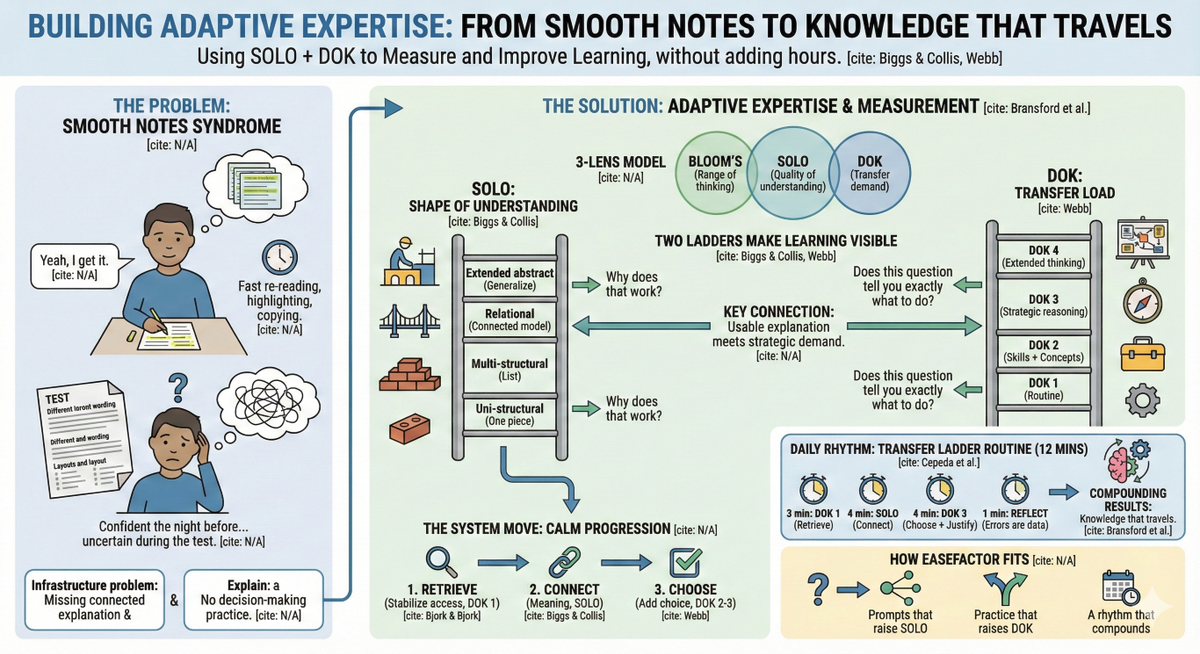
Read Part 1 (the foundation): Adaptive Expertise: The Skill That Makes Learning Stick When Life Changes
The diagnosis: the "Smooth Notes" illusion
There's a common moment in grades 3–10:
- A student can read the notes and say, "Yeah, I get it."
- They can follow an example while looking at the steps.
- They feel calm — until the question changes its wording, layout, or context.
Let's name this pattern so families can spot it quickly.
The Smooth Notes Syndrome
Smooth Notes Syndrome = studying feels easy because the material is visible, not because understanding is usable.
Symptoms (what it looks like):
- Fast re-reading, highlighting, copying.
- "I understand it when I see it."
- Confident the night before… uncertain during the test.
Infrastructure problem (what's actually missing):
- The student hasn't built a connected explanation.
- The student hasn't practiced decision-making (choosing an approach when the path isn't obvious).
This is not a motivation problem. It's a measurement problem.
If you can't see the level of understanding and transfer demand, you can't reliably improve them.
Two ladders that make learning visible: SOLO and DOK
Part 1 made the case for adaptive expertise: knowledge that travels.
This companion post answers the practical question families ask next:
"Okay… but how do we know if understanding is deep enough, and what should we do next?"
Ladder 1: SOLO tells you the shape of understanding
SOLO (Structure of Observed Learning Outcomes) focuses on how well ideas connect.
- Uni-structural: one correct piece (a term, a rule)
- Multi-structural: several correct pieces (a list) but not connected
- Relational: pieces connect into an explanation (a working model)
- Extended abstract: the student generalizes (applies the idea in a new way, or creates a rule/analogy)
Ladder 2: DOK tells you the transfer load of the task
Webb's Depth of Knowledge (DOK) separates routine execution from strategic transfer.
- DOK 1: recall / routine procedure
- DOK 2: skills + concepts (organize, compare, explain with some decisions)
- DOK 3: strategic reasoning (justify, choose an approach, non-routine)
- DOK 4: extended thinking (investigate, synthesize over time)
The 3-lens model (simple, not "taxonomy soup")
Used together, these lenses prevent a common mistake: mistaking busy work for transfer-ready practice.
Bloom's measures the range of thinking (remember → create). It's good for ensuring variety across question types and prevents "We did only definitions, so we covered it."
SOLO measures the quality of understanding (list → model). It's good for diagnosing whether the student has a usable explanation and prevents "They know many facts, so they'll apply them."
DOK measures the transfer demand (routine → strategic). It's good for making sure practice includes decision-making and prevents "They can do 20 similar problems, so they'll handle a twist."
This is the key connection:
- SOLO answers: How well does the student understand this?
- DOK answers: How demanding is the task they're being asked to do?
When a student struggles, you can often locate the mismatch:
- High DOK task + low SOLO understanding = confusion and guessing.
- High SOLO understanding + only low DOK practice = confidence that collapses on novel questions.
A parent-friendly audit (8 minutes, no arguing)
Pick one topic your child studied this week. Then grab two items:
- one "easy" practice question they got right
- one "harder" question they missed or avoided
Now label them quickly.
Step A: SOLO check (shape)
Ask: "Explain it like you're teaching a friend who missed class."
- If the explanation is a single fact → uni-structural
- If it's a list of facts → multi-structural
- If it's a cause-and-effect explanation → relational
- If they can generalize (new example, analogy, rule) → extended abstract
Step B: DOK check (transfer load)
Ask: "Does this question tell you exactly what to do?"
- If yes (routine) → DOK 1–2
- If no (choose, justify, argue, design) → DOK 3
- If it requires extended synthesis → DOK 4
Result: you now have a calm, concrete diagnosis.
- If SOLO is low: build connections first.
- If DOK is low: add choice/justification practice.
The system move that works: raise SOLO first, then raise DOK
Here's a reliable sequence (especially for students who freeze under pressure):
- Stabilize access (retrieval): can the idea be produced without looking?
- Connect meaning (SOLO): can they explain why it works?
- Add choice (DOK): can they select an approach when the path isn't given?
Think of it like training:
- SOLO is building strength and coordination.
- DOK is applying that strength under changing conditions.
If you jump to high DOK too early, the student experiences repeated failure and loses confidence. If you stay only in low DOK, confidence becomes fragile.
The goal is calm progression, not constant challenge.
What this looks like on a Tuesday
Grade 8 Math — Linear equations (slope) — 13 minutes after school
Goal: move from "I can follow examples" to "I can choose and justify."
1) 2 minutes — Retrieval burst (DOK 1)
- Without notes: write the slope formula and define slope in your own words.
- Output: 1 formula + 1 sentence definition.
2) 4 minutes — Build a relational explanation (SOLO: multi → relational)
- Prompt: "Why does slope stay the same along a straight line?"
- Encourage: connect rate of change → constant increase → straight line.
- Output: 4–6 sentences with cause-and-effect.
3) 5 minutes — Decision practice (DOK 2 → 3)
- Provide two quick questions:
- Q1 (DOK 2): Given two points, find the slope.
- Q2 (DOK 3): You're given a graph and a word story. Decide whether the slope is positive/negative/zero, and justify using evidence from both representations.
- Output: 2 answers + 1 justification sentence that cites the graph/story.
4) 2 minutes — System monitor (metacognition)
- "Where did I hesitate?" (choose one)
- "What cue will help next time?" (write one)
- Schedule a 6-minute review in 48 hours.
Try this today (12 minutes): the "Transfer Ladder" routine
Output: 3 answers + 1 explanation + 1 next-step note
Pick one concept from today (any subject).
1) 3 minutes — DOK 1 (retrieve):
- Write the definition/rule from memory.
2) 4 minutes — SOLO (connect):
- Add three "because" links.
- Aim for a chain: claim → reason → mechanism/example.
3) 4 minutes — DOK 3 (choose + justify):
- Create a prompt that forces a decision, such as:
- "Which method would you use and why?"
- "Which evidence supports your answer?"
- "What changes and what stays the same if we change one condition?"
- Answer your own prompt.
4) 1 minute — Errors are data, not identity:
- Write one line: "My confusion is…"
- Write one line: "Next action (tomorrow): …"
This is the simplest "compounding" mechanism families can run consistently: small sessions, measurable outputs, rising transfer capacity.
How EaseFactor fits (without adding pressure)
A Study OS is valuable because it removes the guesswork.
EaseFactor supports this in three practical ways:
- Prompts that raise SOLO: guided self-explanation and "teach-back" questions that turn lists into models.
- Practice that raises DOK: calibrated "decision" questions and mixed formats that train strategy selection.
- A rhythm that compounds: spaced review scheduling plus short reflection loops so fragile areas become visible early.
It's not about doing more. It's about making each session do the job it's supposed to do.
A Calm Next Step
If Part 1 helped you see the why behind adaptive expertise, use this post as your measurement and action layer.
- Start with the 8-minute audit to label one topic with SOLO + DOK.
- Then run the 12-minute Transfer Ladder three times this week.
TL;DR
- Many students don't need more studying; they need a way to check the quality of understanding and the transfer demands of tasks.
- SOLO tells you the shape of understanding (fact-pile → connected model → generalization). DOK tells you the transfer load (routine → strategic → extended).
- A simple weekly rhythm can reliably move students up both ladders: retrieve → connect → choose → reflect → schedule.
Citations
- Biggs & Collis — SOLO Taxonomy (Structure of Observed Learning Outcomes)
- Norman L. Webb — Depth of Knowledge (DOK)
- Bransford, Brown, & Cocking (NRC) — How People Learn (transfer and learning conditions)
- Bjork & Bjork — desirable difficulties and durable learning
- Cepeda et al. — spacing effect (distributed practice)

Manoj Ganapathi
Founder and Builder of EaseFactor. Passionate about evidence-based learning and helping students build effective study habits through cognitive science principles.
Ready to Study Smarter?
EaseFactor uses these learning science principles to help you build lasting knowledge.