Adaptive Expertise: The Skill That Makes Learning Stick When Life Changes
 Manoj Ganapathi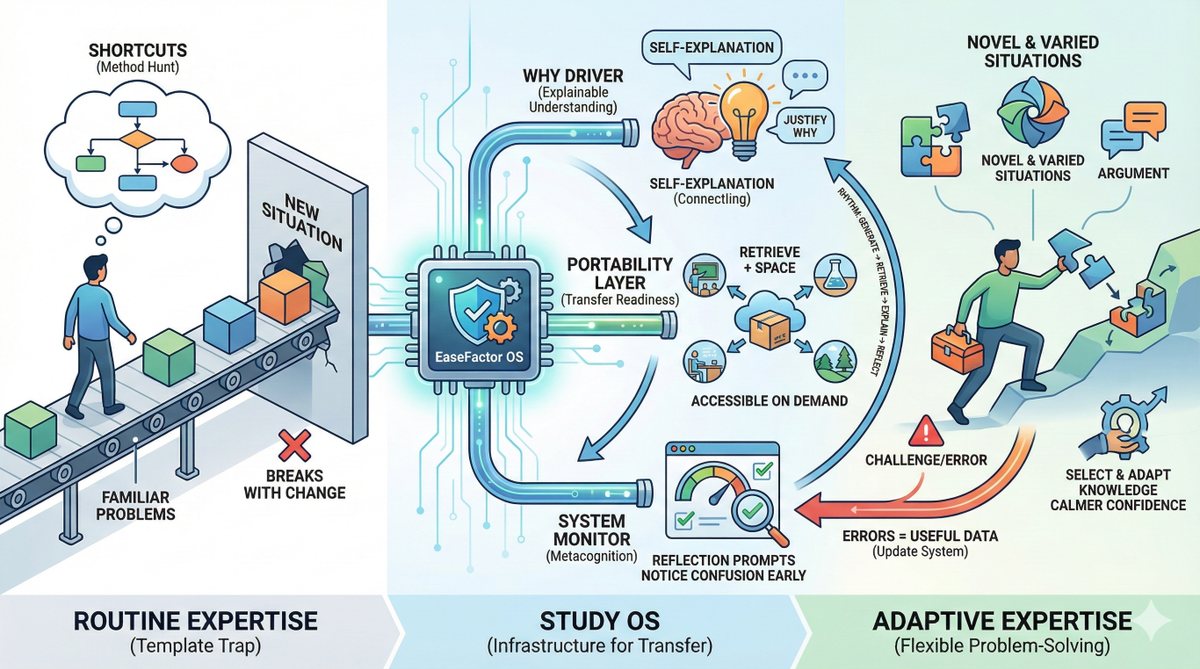
Most students don't struggle because they're "not smart." They struggle because school often rewards a specific kind of competence: doing familiar problems in familiar formats.
Then the format changes.
A word problem looks different. A science question mixes two chapters. A history prompt asks for an argument, not a definition. Suddenly, yesterday's "I understand this" doesn't travel.
That gap has a name: adaptive expertise—the ability to apply what you know flexibly in new situations, not just repeat procedures you've seen before.
The pattern: The "Template Trap"
Template Trap = when learning becomes a hunt for the right steps instead of building a reason you can reuse.
It feels efficient… until the question stops matching the template.
You can spot it when a student says:
- "I knew it yesterday, but this question is different."
- "Tell me the method for this type."
- "I can do the examples, but not the homework twist."
This is not laziness. It's a predictable outcome of how our brains optimize: we store shortcuts when they work. The problem is that shortcuts don't transfer well.
Diagnosis: Symptoms vs infrastructure
Many fixes give symptom relief:
- More notes
- More worksheets
- More hours
- More tutoring focused on repeating the same question types
These often improve performance today.
But adaptive expertise is infrastructure: it improves performance reliably over time, because it trains the learner to select and adapt knowledge, not just execute it.
Nuance: tutoring and practice absolutely help—best when paired with a Study OS that builds transfer, reflection, and retrieval into the weekly rhythm.
What makes expertise "adaptive"?
Think of learning like an operating system:
- Routine expertise is a single app that works great for one task (fast, accurate, familiar).
- Adaptive expertise is the OS + drivers: it helps you run the app and handle updates, new peripherals, and unfamiliar tasks.
In practical terms, adaptive expertise comes from three "OS capabilities":
- Explainable understanding (the "Why Driver") — You can justify why something works, not just what to do.
- Transfer readiness (the "Portability Layer") — You can recognize the same idea wearing different clothes.
- Metacognition (the "System Monitor") — You can notice confusion early and choose a better strategy.
The learning science behind it (translated into Tuesday behavior)
Adaptive expertise is strongly supported by strategies that force the brain to generate, retrieve, and explain—instead of re-reading or copying.
Two especially high-leverage moves:
1) Self-explanation (turn steps into reasons)
When students explain why a step makes sense, they build connections—not just memory traces. This improves transfer because the idea is stored with a rationale, not a recipe.
2) Retrieval + spacing (make knowledge usable on demand)
If learning is only "in the notebook," it won't show up under exam pressure. Retrieval practice builds access. Spacing keeps it available over time—so it can be applied later in new contexts.
This is the OS principle: effort → system → outcome. Not more effort in random directions—effort routed through a structure that compounds.
A concrete Tuesday example
Grade 7 Science (Heat & Temperature), Tuesday 6:20–6:32 PM (12 minutes after school)
Goal: move from "definitions" to "transfer."
- 2 min – Retrieval burst (no notes): Write answers to 6 quick prompts: Define conduction, convection, radiation (in your own words). One example of each from daily life. What changes: heat or temperature?
- 6 min – "Why Driver" self-explain: Choose one example (e.g., spoon in hot tea). Explain: Why is it conduction and not convection? What is actually moving?
- 2 min – Twist question (transfer): "Why does a fan cool you even if the room temperature doesn't drop quickly?" Answer using two concepts, not one.
- 2 min – System Monitor (metacognition): Write a Confusion List: "I'm not fully sure about…" (1–2 items). Schedule a 7-minute review for Thursday.
Output: 6 retrieval answers + 1 self-explanation + 1 twist response + 1 confusion list item + 1 scheduled review.
That is adaptive expertise training in a realistic, repeatable rhythm.
Errors are data, not identity
When a student gets the twist question wrong, the right response is not "I'm bad at science."
It's:
"Good—this is useful data. What did I assume? What concept did I miss? What's my next step in 10 minutes?"
Next step options (pick one):
- Re-answer with notes closed after one minute of review
- Ask a "why/how" question to clarify the mechanism
- Create one new retrieval question for the next session
Adaptive expertise grows because you meet the edge of what you can do—and then update your system.
How EaseFactor builds adaptive expertise
EaseFactor is designed as a Study OS: not another pile of content, but a workflow that makes understanding explainable, knowledge retrievable, and progress visible.
- Socratic "Why" prompts (Why Driver): moves students from answers to reasons
- Retrieval + spaced review (Portability Layer): keeps knowledge accessible for future application
- Reflection prompts + analytics (System Monitor): helps students notice what's fragile early—before exams
If you want calmer confidence, don't aim for "covering the syllabus."
Aim for an OS that makes learning portable.
Try this today (10 minutes) — The "One Concept, Three Skins" routine
Purpose: train transfer in one short session.
Timer: 10 minutes. Output: 3 answers + 1 confusion list item.
- Pick one concept (1 min): Example: fractions, photosynthesis, forces, nouns, temperature.
- Write it in 3 skins (6 min):
- Skin A: Definition in your words (2 min)
- Skin B: Real-life example (2 min)
- Skin C: A twist question you invent + answer (2 min)
- System Monitor (3 min):
- Rate confidence 1–5
- Write one confusion item
- Schedule a 6–8 minute revisit in 2 days
Do this 3 times a week and you will feel the difference: less panic when questions change, more control when they don't.
TL;DR
- Adaptive expertise is knowing when and how to use knowledge in new situations, not just repeating templates.
- Build it with a Study OS rhythm: retrieval + self-explanation + reflection + spacing.
- A 10-minute "One Concept, Three Skins" routine trains transfer without overwhelm.
Citations
- Hatano & Inagaki: routine vs adaptive expertise (two courses of expertise)
- Chi et al.: self-explanation effects on learning and transfer
- Roediger & Karpicke: retrieval practice (test-enhanced learning)
- Spacing effect literature (e.g., Cepeda et al.)
- Dewey: education as lived experience and application
- Dweck: growth mindset framing (effort + strategy + support)
- Flavell (1979): coined the term metacognition (supports "System Monitor" concept)
- Schraw & Dennison (1994): Metacognitive Awareness Inventory (practical metacognition framework)
- Bransford, Brown & Cocking (2000): *How People Learn* (NRC report on transfer and expertise)
- Kapur (2008, 2016): Productive Failure (directly supports "errors are data" section)
- Marton & Säljö (1976): deep vs surface approaches to learning (supports "why" vs "what" distinction)
- Spiro et al. (1988): Cognitive Flexibility Theory (supports "Portability Layer" concept)
- Dreyfus & Dreyfus (1986): five-stage model of skill acquisition (alternative expertise framework)

Manoj Ganapathi
Founder and Builder of EaseFactor. Passionate about evidence-based learning and helping students build effective study habits through cognitive science principles.
Ready to Study Smarter?
EaseFactor uses these learning science principles to help you build lasting knowledge.