Active Reading Isn't Highlighting: Study Strategies That Actually Work for Textbooks
 Manoj Ganapathi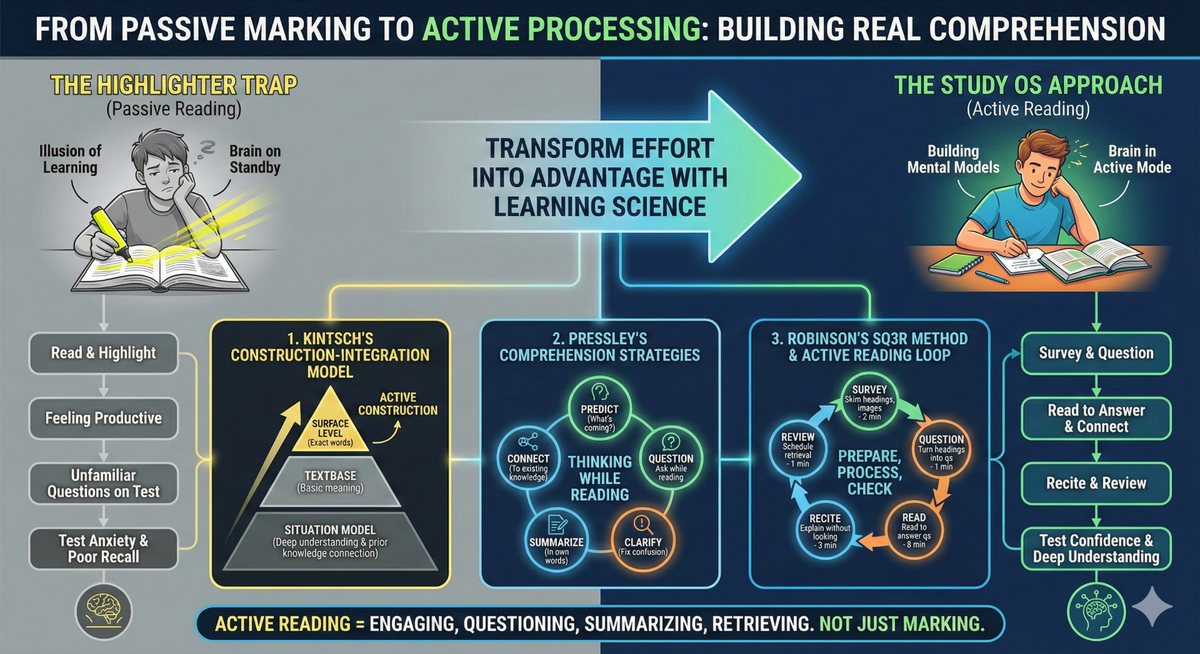
Why your textbook is covered in yellow highlighter but your brain feels empty when the test arrives.
You did the reading. You highlighted the important parts. You even underlined key sentences twice. So why does the test feel like you're seeing this material for the first time?
Most students don't struggle with reading because they can't read. They struggle because they've been taught to mark text instead of process it. Highlighting creates the comforting illusion of learning without the actual work of building understanding.
Reading is the foundation of nearly every subject. Yet most students use the same passive strategies for textbooks that they use for scrolling social media: eyes move across the page, brain stays on standby.
EaseFactor exists to turn effort into advantage by combining learning science, AI, and disciplined practice, so students build reading comprehension that actually shows up on test day.
The named pattern: The Highlighter Trap
The Highlighter Trap: Marking text with colors and underlines without actually processing what it means, creating the illusion of studying while the brain stays in passive mode.
The highlighter makes you feel productive. The yellow streaks are visible proof you "did the reading." But highlighting is recognition work, not retrieval work. You're saying "this looks important" without forcing your brain to answer "what does this actually mean?"
The result: familiar-looking text that becomes unfamiliar-sounding questions on the test.
Quick diagnosis: symptoms vs infrastructure
Symptoms you may notice:
- "I read the whole chapter but remember almost nothing."
- "It makes sense when I'm reading it, but I can't explain it."
- "I have to re-read the same paragraph multiple times."
- "My textbook is colorful but my test scores aren't."
What's missing:
- A way to interact with text while reading (not after)
- A way to check understanding before moving on
- A structure that forces active processing instead of passive absorption
Tutoring, reading more slowly, and better note-taking can help, but they work best when paired with a reading system. A Study OS makes comprehension reliable, not accidental.
The science: why passive reading fails
Walter Kintsch's Construction-Integration Model: reading is building, not receiving
Cognitive scientist Walter Kintsch developed the Construction-Integration model, which explains how comprehension actually works. His key insight: reading isn't about receiving information; it's about building a mental model.
According to Kintsch, comprehension involves three levels:
| Level | What it means | Example |
|---|---|---|
| Surface level | The exact words | "Photosynthesis converts light energy..." |
| Textbase | The basic meaning | Plants use sunlight to make food |
| Situation model | Deep understanding connected to prior knowledge | "Oh, that's why plants die without sun, and why leaves are green to absorb light" |
Most students stop at the textbase level. They can repeat what the text said but can't use it flexibly. The situation model, where real understanding lives, requires active construction that passive reading doesn't trigger.
Michael Pressley's comprehension strategies: what skilled readers do differently
Michael Pressley spent decades researching what separates good readers from struggling ones. His finding: skilled readers don't just read differently, they think differently while reading.
Good readers:
- Predict what's coming before they read it
- Question the text while reading
- Clarify confusing parts immediately
- Summarize sections in their own words
- Connect new information to what they already know
These aren't just "good habits." They're cognitive strategies that force the brain to process text actively rather than passively.
Francis Robinson's SQ3R: a system that works
In 1941, educational psychologist Francis Robinson developed SQ3R (Survey, Question, Read, Recite, Review) as a structured approach to textbook reading. Research during World War II showed significant improvements: up to 10% better comprehension and 19% faster work rate.
The key insight behind SQ3R: you need to prepare your brain before reading and check your brain after reading. Just reading the middle part isn't enough.
| Step | What you do | Why it works |
|---|---|---|
| Survey | Skim headings, images, summaries first | Activates prior knowledge, creates mental hooks |
| Question | Turn headings into questions | Creates purpose, tells brain what to look for |
| Read | Read to answer your questions | Focused attention, not wandering eyes |
| Recite | Explain each section aloud or in writing | Forces retrieval, reveals gaps |
| Review | Summarize the whole, review your notes | Consolidates understanding, creates retrieval cues |
The Study OS approach: turning reading into retrieval
Here's the mental model to keep in mind:
Reading without processing is like walking through a museum with your eyes closed. You were there. You spent the time. But you didn't actually see anything.
A Study OS transforms reading from a passive experience into an active training session. Instead of hoping understanding happens, you build systems that guarantee it.
Why highlighting fails (and what to do instead)
| Passive habit | Study OS habit | Why it matters |
|---|---|---|
| Highlight important sentences | Write a one-sentence summary after each section | Forces processing, not just marking |
| Re-read confusing parts | Ask "What exactly confuses me?" and write it down | Converts confusion to specific questions |
| Read straight through | Stop every heading to predict what's coming | Activates prior knowledge, creates hooks |
| Finish and close the book | Finish and write 3 questions you could answer | Creates retrieval practice, proves comprehension |
The three-level reading check
After reading any section, check which level you've reached:
- Can I recognize it? (If someone reads the text, does it sound familiar?) - This is NOT enough
- Can I explain it? (Can I state the main idea in my own words?) - Getting closer
- Can I use it? (Can I answer a question, solve a problem, or make a prediction?) - THIS is comprehension
If you can only recognize but not explain, you're stuck in the Highlighter Trap.
A concrete Tuesday example (what this looks like in real life)
Grade 7 Social Studies (The Industrial Revolution), Tuesday 4:30pm (15 minutes)
Goal: Actually understand Section 2.3 on factory working conditions
- 2 minutes - Survey the section
Flip through: read the title, subtitles, look at any pictures or charts, read the summary box at the end.
Output: Mental map of what's coming.
- 1 minute - Turn headings into questions
"Working Conditions in Early Factories" becomes "What were working conditions like in early factories?"
"Child Labor" becomes "Why did children work in factories? What was it like?"
Output: 3-4 questions written in notebook.
- 8 minutes - Read to answer your questions
Read actively looking for answers. When you find one, pause and mentally answer your question.
If something confuses you, write a "?" in the margin and keep going.
Output: Mental answers forming, confusion spots marked.
- 3 minutes - Recite without looking
Close the book. For each question you wrote:
- Try to answer it out loud or in writing
- Check: were you right? What did you miss?
Output: 3-4 answers written + 1 "confusion note" for anything still unclear.
- 1 minute - Schedule the retrieval
Put a 5-minute review on Thursday: "Can I still answer my Industrial Revolution questions?"
Output: 1 scheduled review.
Total time: 15 minutes. But this 15 minutes builds a situation model. The old way (read passively for 15 minutes) only builds familiarity that fades.
Try this today (15 minutes): The Active Reading Loop
Total time: 15 minutes
Output: 4 questions written, 4 answers attempted, 1 confusion captured, next review scheduled
Before reading (3 minutes)
- (1 min) Survey the terrain
Look at the section title, subheadings, bolded words, and any pictures/charts.
Don't read yet. Just see the shape of what's coming.
- (2 min) Write your questions
Turn 3-4 headings or bolded terms into questions.
Example: "Causes of World War I" becomes "What were the causes of World War I?"
Write these questions at the top of your notes page.
During reading (8 minutes)
- (8 min) Read to answer
Read with your questions in mind. When you find an answer, pause and mentally confirm it.
If something confuses you, put a "?" in the margin and keep moving.
Don't highlight. Don't underline. Just read and think.
After reading (4 minutes)
- (3 min) Recite without the book
Close everything. Try to answer each question you wrote, out loud or on paper.
Check your answers against the text.
For any you got wrong or couldn't answer: write a "confusion note" (one sentence about what you don't get).
- (1 min) Schedule your retrieval
Put a 5-minute slot on your calendar in 2 days: "Can I still answer my [topic] questions?"
De-shaming reframe:
If you couldn't answer a question after reading, that's not failure. That's data. You now know exactly what needs more attention. The old way (read passively, feel confident, bomb the test) hides the gaps until it's too late.
For parents: how to support reading comprehension without reading for them
Supporting reading isn't about sitting next to your child and explaining things. It's about teaching them to notice when they don't understand and do something about it.
Do:
- Ask "What was that section about?" after they read (forces recitation)
- Ask "What's one thing that was confusing?" (normalizes confusion as data, not failure)
- Ask "What question might be on a test about this?" (builds retrieval thinking)
Don't:
- Pre-explain the content before they read (removes the productive struggle)
- Let "I read it" be the endpoint (reading isn't understanding)
- Highlight or take notes for them (they need to do the processing)
Key phrase to use: "Can you explain that to me like I haven't read it?" This forces situation-model-level understanding, not just textbase recognition.
Gentle CTA: make active reading easier to practice
The Active Reading Loop works with any textbook, any subject, any age. But doing it consistently, knowing which sections need more work, and remembering to schedule retrieval, that's where most students struggle.
EaseFactor is designed to work as a Study OS that supports active reading:
- AI-generated questions that force retrieval after reading
- Spaced review scheduling so you don't forget to revisit
- Progress visibility so you see which topics are solid and which need more work
- Guided comprehension checks that go beyond "did you read it?"
The promise isn't "reading without effort." It's reading that builds real understanding, with structure that makes the Active Reading Loop easier to maintain every day.
Citations
Core citations
- Construction-Integration Model - Walter Kintsch (1988, 1998): tripartite model of text comprehension (surface, textbase, situation model)
- Comprehension Strategies Instruction - Michael Pressley: decades of research on what skilled readers do differently (predicting, questioning, clarifying, summarizing)
- SQ3R Method - Francis P. Robinson (1941, Effective Study): Survey-Question-Read-Recite-Review method for textbook reading
- Situation Models in Text Comprehension - Kintsch & van Dijk (1978): foundational theory of discourse comprehension
Supporting citations
- Reciprocal Teaching - Palincsar & Brown (1984): four strategies (predict, question, clarify, summarize) improve comprehension
- Transactional Strategies Instruction - Pressley et al.: quasi-experimental validation of strategy instruction
- Levels of Processing - Craik & Lockhart (1972): deeper processing leads to better memory
- Generative Processing - Wittrock (1974): generating connections and summaries improves learning
- Read-Recite-Review - McDaniel, Howard & Einstein (2009, Psychological Science): simplified version of SQ3R showing effectiveness
Research notes
- Johns & McNamara (1980) noted that SQ3R was a "forgotten research target," but more recent studies (including 2024 research from Indonesia) continue to show significant improvements in comprehension when students use structured reading approaches versus passive reading.
- Pressley's work emphasized that comprehension strategies must be explicitly taught and practiced; they don't develop automatically from more reading exposure.
TL;DR
- Active reading = engaging with text (questioning, predicting, summarizing) instead of passively absorbing words.
- The problem isn't reading speed, it's reading without a system that forces understanding.
- Your next step: a 10-minute "Active Reading Loop" that turns any chapter into retrievable knowledge.

Manoj Ganapathi
Founder and Builder of EaseFactor. Passionate about evidence-based learning and helping students build effective study habits through cognitive science principles.
Ready to Study Smarter?
EaseFactor uses these learning science principles to help you build lasting knowledge.