Achieving Flow in Studying: How to Make Learning Feel Effortless (Without Making It Easy)
 Manoj Ganapathi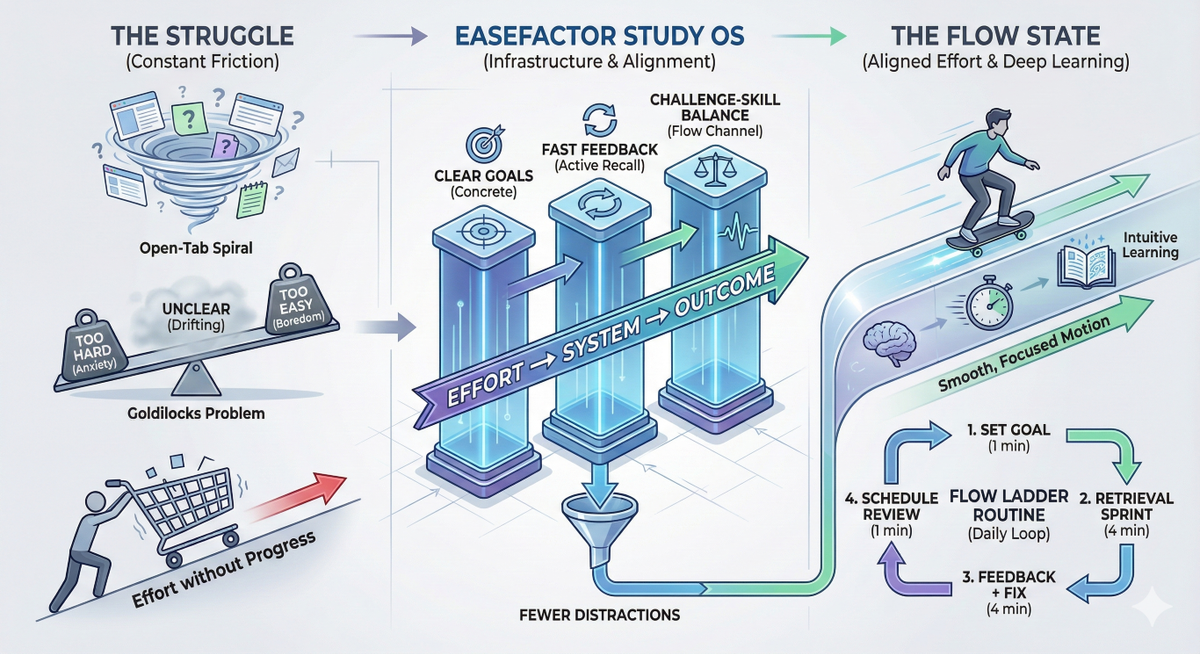
Most students don't struggle because they're lazy. They struggle because studying often feels like pushing a shopping cart with one broken wheel: lots of effort, constant friction, not much forward motion.
And then - once in a while - something different happens.
You start a chapter, solve a few problems, and suddenly you're in it. Your brain feels quiet and sharp. You're challenged, but not overwhelmed. Time passes fast. You finish with a strange feeling: "Wait… I actually learned."
That state has a name: flow - and it's one of the most reliable predictors of deep learning and better performance.
EaseFactor's job isn't to "motivate" students with hype. It's to build the conditions where flow becomes repeatable: Effort → System → Outcome.
Diagnosis: Why flow keeps slipping away
Symptom 1: The Open-Tab Spiral
You sit down to study, but your brain has to manage too many decisions: what to do first, what matters most, how to check if you're improving. You bounce between notes, videos, and worksheets - busy, but not steady.
Symptom 2: The Goldilocks Problem
The work is either:
- Too easy → boredom ("I already know this"), or
- Too hard → anxiety ("I'm not good at this"), or
- Unclear → drifting ("I don't know what 'done' looks like")
Flow lives in a narrow "just-right" channel. Most students aren't failing - they're simply operating outside that channel.
The insight: Flow is not relaxation. Flow is alignment.
Flow is often misunderstood as feeling calm. In reality, it's a high-focus state that happens when three things align:
- Clear goals (you know exactly what you're trying to do)
- Fast feedback (you can tell if it's working)
- Challenge slightly above skill (hard enough to matter, not hard enough to break you)
When those conditions show up together, effort starts to feel smoother - not because the work disappears, but because your brain stops fighting the environment.
Think of it like a treadmill workout:
- Too slow and you get bored.
- Too fast and you panic.
- Just right and you enter training mode.
Flow is the same - a training zone, not a comfort zone.
The science: What's happening in the brain during flow
During flow, attention becomes "locked on" and self-conscious noise drops. Researchers often describe this as a temporary quieting of the brain systems that produce overthinking and self-criticism, while focus and pattern recognition increase.
That's why flow feels like:
- time speeding up
- the "inner critic" turning down
- learning becoming more intuitive
- performance improving without extra strain
Importantly: flow is not magic. It's a predictable response to the right study conditions - which means you can design for it.
The system: How a Study OS makes flow repeatable
A lot of study advice tries to fix symptoms:
- "Try harder."
- "Focus more."
- "Stop procrastinating."
But those are like telling someone to "run faster" without giving them shoes.
A Study OS builds infrastructure - so good studying becomes the default, not the exception.
Here's how EaseFactor aligns to the flow conditions:
1) Clear goals → "Done means something"
Flow collapses when the goal is fuzzy ("Study science"). Flow strengthens when the goal is concrete:
- "I can explain photosynthesis in my own words."
- "I can solve 8 out of 10 linear equation questions without hints."
EaseFactor treats goals like an operating system treats processes: clear inputs, clear outputs, minimal confusion.
2) Fast feedback → tight learning loops
Flow needs quick signals:
- "Was my answer correct?"
- "What mistake pattern am I showing?"
- "What should I review next?"
This is where active recall (testing yourself) beats passive review (re-reading). Short quizzes, retrieval prompts, and reflection checkpoints turn studying into a feedback loop - not a guessing game.
3) Challenge–skill balance → the "flow channel"
If a student keeps getting everything right, they're often just practicing comfort. If they keep getting everything wrong, they're often just practicing panic.
EaseFactor's design intent is to keep learners in the flow channel by:
- revisiting material at the right time (spaced repetition)
- adjusting difficulty based on performance
- breaking work into smaller, finishable chunks
This is not about making work "easier." It's about making progress possible—which is the real driver of motivation.
4) Fewer distractions → less cognitive overhead
Flow is fragile. Even small interruptions can break it.
A Study OS reduces the mental clutter:
- fewer "what should I do next?" moments
- fewer messy transitions
- a cleaner sequence of tasks
When the environment is predictable, the mind can be fully present.
A concrete Tuesday example (what this looks like in real life)
Grade 7 Science | Tuesday, 6:20–6:35 PM (15 minutes)
Topic: Photosynthesis
Step 1 (2 min): Set the goal
"I will explain photosynthesis without notes in 5 sentences."
Step 2 (7 min): Retrieval first (no notes)
Answer 6 prompts:
- What do plants take in?
- What do they produce?
- Where does it happen in the cell?
- Why is sunlight needed?
- Write the word equation.
- One real-life example where this matters.
Step 3 (3 min): Feedback + fix
Check notes only after answering. Circle 2 weak spots.
Step 4 (3 min): Lock the next review
Schedule a 6-minute review for Thursday (spaced repetition).
Output: 6 answered prompts + 2 weak spots + next review scheduled.
This is how flow becomes a habit: small, measurable wins in the right challenge zone.
Try this today (10 minutes): The Flow Ladder Routine
This is a short routine designed to create flow conditions quickly.
Total time: 10 minutes
- 1 min — Clear goal
Write: "In 10 minutes, I will be able to ______." - 4 min — Retrieval sprint
Without notes, answer 4 questions (or solve 4 problems). - 2 min — Immediate feedback
Check answers. Mark mistakes as data, not identity. - 2 min — One targeted repair
Re-do only the missed item(s), slowly, correctly. - 1 min — Schedule the next review
Put a 5-minute review on your plan for 2 days later.
If you do this consistently, you're training the brain to associate studying with progress - and progress is what makes effort feel lighter.
TL;DR
- Flow isn't relaxation - it's focused work with clear goals, fast feedback, and the right challenge level.
- Most students don't lack motivation; they lack study infrastructure that keeps them in the flow channel.
- A Study OS makes flow repeatable through retrieval, spacing, and structured next steps.
Citations
- Mihaly Csikszentmihalyi — Flow theory (optimal experience)
- Vygotsky — Zone of Proximal Development (challenge just above skill)
- Roediger & Karpicke — Retrieval practice (active recall)
- Cepeda et al. — Spacing effect (spaced repetition)
- Shernoff et al. — Flow and student engagement in classrooms

Manoj Ganapathi
Founder and Builder of EaseFactor. Passionate about evidence-based learning and helping students build effective study habits through cognitive science principles.
Ready to Study Smarter?
EaseFactor uses these learning science principles to help you build lasting knowledge.