Bored in Class? Here's What's Really Happening (and What to Do About It)
 Manoj Ganapathi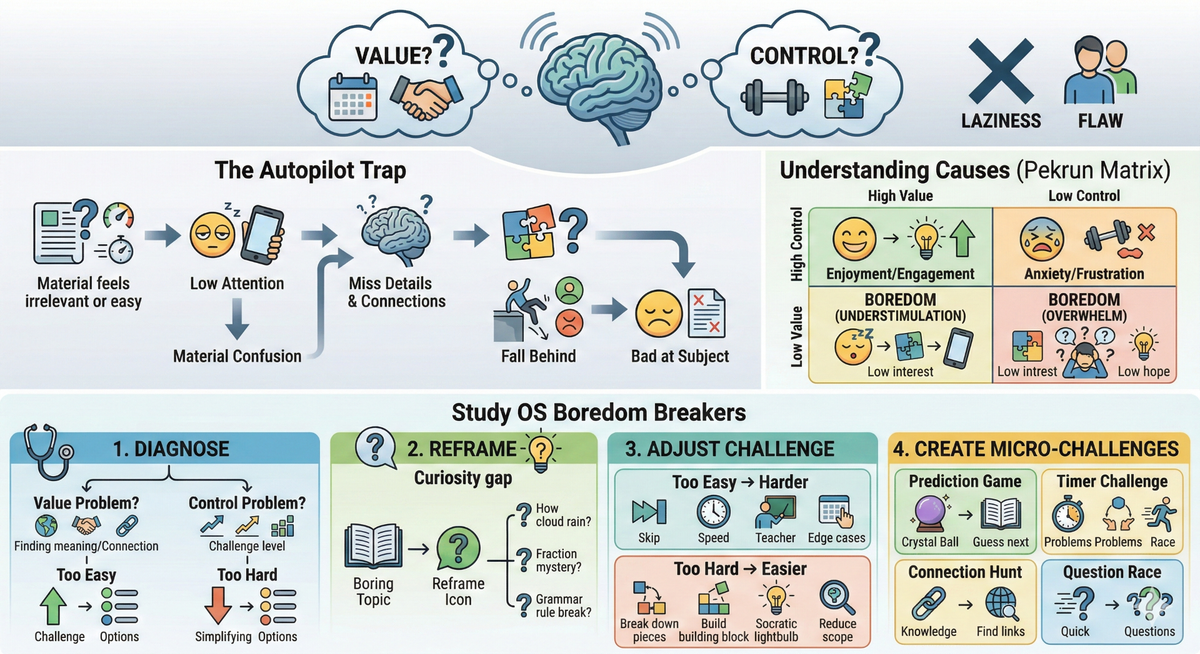
Why does the same student who can spend three hours building a Minecraft world lose focus after five minutes of social studies?
Here's what's actually going on: boredom isn't a character flaw. It's a signal.
When a student says "This is boring," they're not being lazy, difficult, or disrespectful. Their brain is sending a very specific message: I don't see why this matters, or I don't see how I can succeed at it.
The problem isn't the feeling itself. The problem is that nobody teaches students what boredom actually means - or what to do when it arrives.
Most students respond to boredom in one of three ways: zone out, act out, or check out. All three lead to the same result: less learning, less engagement, and a growing gap between what they could do and what they actually do.
EaseFactor exists to help students build infrastructure for every academic emotion - including the most common and most ignored one: boredom.
The named pattern: The Autopilot Trap
The Autopilot Trap: When your brain checks out because it sees no reason to engage - like a pilot who switches off manual controls because the flight looks routine, missing the turbulence ahead.
It looks like this:
- Material feels irrelevant or too easy -> Brain lowers attention
- Lower attention -> Student misses key details and connections
- Missed connections -> Material genuinely becomes confusing later
- Confusion without foundation -> Student falls behind
- Falling behind -> "I'm bad at this subject" (when the real issue was disengagement)
The Autopilot Trap is dangerous because it feels harmless in the moment. Unlike anxiety or frustration, boredom doesn't sound alarm bells. It just quietly erodes learning, one zoned-out class at a time.
Breaking the trap doesn't require the material to become exciting. It requires the student to change their relationship with the material.
Quick diagnosis: why "just pay attention" doesn't work
When a student is bored, the typical responses are:
- "Pay attention!" - Demands focus without giving a reason to focus
- "This will be on the test" - Threat-based motivation that fades as soon as the test is over
- "You need this for later" - Too vague and distant for a brain that operates in the present
None of these address the root cause. They're symptom management.
Common symptoms of the Autopilot Trap:
- Doodling, fidgeting, or phone-checking during lessons
- Completing work at minimum effort ("good enough to pass")
- Saying "I already know this" when they don't (really)
- High performance in some subjects, disengagement in others
- Starting the year strong, then gradually fading
What's actually missing:
- A way to find personal relevance even in required subjects
- A strategy to adjust the challenge level when material feels too easy or too hard
- A habit of generating questions instead of passively receiving answers
- A system for micro-challenges that keep the brain engaged
The science: why your brain gets bored (and what it's trying to tell you)
Three research traditions explain what's happening when learning feels boring - and they all point to solutions.
1. Control-Value Theory (Pekrun)
Psychologist Reinhard Pekrun's Control-Value Theory shows that every academic emotion comes from two mental calculations your brain makes automatically:
| Appraisal | What your brain asks |
|---|---|
| Value | "Does this matter to me?" |
| Control | "Can I do something about it?" |
Different combinations produce different emotions:
| Value | Control | Emotion |
|---|---|---|
| High | High | Enjoyment, engagement |
| High | Low | Anxiety, frustration |
| Low | High | Boredom (too easy, no point) |
| Low | Low | Boredom (why bother?) |
The key insight: Boredom is a value problem, a control problem, or both.
This means there are two different types of classroom boredom:
- Understimulation boredom: "I already get this. Why are we still doing it?" (High control, low value)
- Overwhelm boredom: "I'm so lost that I've stopped trying." (Low control, low value)
Both feel the same on the surface. The solutions are completely different.
2. Boredom Precursors (Daschmann, Goetz & Stupnisky)
Researchers Daschmann, Goetz, and Stupnisky studied 1,380 students in grades 5-10 to identify what actually triggers boredom. They found eight specific precursors:
| Precursor | What it sounds like |
|---|---|
| Monotony | "We do the same thing every day" |
| Lack of meaning | "When will I ever use this?" |
| Being over-challenged | "I don't understand any of this" |
| Being under-challenged | "This is way too easy" |
| Lack of involvement | "The teacher just talks at us" |
| Teacher disliking | "The teacher doesn't make it interesting" |
| Not being given a choice | "I have no say in how I learn this" |
| General tendency | "I get bored easily in school" |
The most powerful finding: Students and teachers agree on most of these causes - but teachers rarely realize they can address them. And students rarely realize they can address them either.
3. The Boredom-Achievement Link (Tze, Daniels & Klassen)
Virginia Tze's meta-analysis of 29 studies involving over 19,000 students found a significant negative relationship between boredom and academic outcomes (r = -0.24). Key findings:
- Boredom experienced in class has a stronger negative impact than boredom while studying alone
- The effect is significant across both secondary and post-secondary students
- Boredom doesn't just reduce performance - it undermines motivation and study strategies too
Bottom line: Boredom isn't just unpleasant. It actively damages learning. But because it's quiet and gradual, nobody sounds the alarm.
The Study OS approach: turning boredom into a signal you can use
A Study OS treats boredom like a dashboard light - not something to ignore or feel guilty about, but a signal that something specific needs adjusting.
1. Diagnose the type (value or control?)
Before fixing boredom, identify which kind it is:
| If you think... | The type is... | The fix is... |
|---|---|---|
| "This is pointless" | Low value | Find personal connection |
| "This is too easy" | Low challenge (high control, low value) | Increase difficulty |
| "I'm completely lost" | Low control | Simplify and scaffold |
| "We do this every day" | Monotony | Change the method |
Quick self-check: Ask yourself: "Am I bored because I don't care, or because I can't do it?"
2. Reframe value: find the puzzle
Curiosity is the natural antidote to boredom. Research on the curiosity gap (Loewenstein, 1994) shows that interest spikes when we notice a gap between what we know and what we could know.
The trick: turn passive content into active questions.
| Boring thought | Curiosity reframe |
|---|---|
| "I have to learn about the water cycle" | "How does a cloud know when to rain?" |
| "We're doing fractions again" | "Why does 1/3 + 1/3 not equal 2/6?" |
| "History is just dates" | "Why did this decision change everything?" |
| "Grammar rules are pointless" | "What happens if I break this rule on purpose?" |
You don't need the material to be inherently exciting. You need one question that your brain wants answered.
3. Adjust the challenge: find your edge
Boredom from understimulation means you need harder work. Boredom from overwhelm means you need a smaller step.
If too easy:
- Skip ahead to the hardest problem and work backward
- Set a speed challenge: "Can I finish in half the time?"
- Teach the concept to someone else (the Protege Effect forces deeper processing)
- Ask: "What's a way this could go wrong?" (edge cases require higher-level thinking)
If too hard:
- Break the topic into the smallest possible piece
- Find one thing you do understand and build from there
- Use the Socratic method: ask "What do I know about things similar to this?"
- Reduce scope: instead of "learn the chapter," try "understand one paragraph"
4. Create micro-challenges (make it a game)
The brain craves small, immediate feedback loops. When boredom strikes, create your own:
- The Prediction Game: Before reading a section, predict what it will say. Check yourself.
- The Timer Challenge: Set a 5-minute timer and see how many practice problems you can solve.
- The Connection Hunt: Find three ways this topic connects to something you already know.
- The Question Race: Write 5 questions about the material in 2 minutes. Then answer them.
These aren't distractions - they're attention re-engagement strategies that leverage the same reward circuitry the brain uses for games and puzzles.
5. Track your boredom patterns (make them visible)
Over time, students can learn:
- Which subjects trigger boredom most (and whether it's value-boredom or control-boredom)
- What time of day boredom hits hardest
- Which strategies work best for them
- Whether boredom is masking something else (confusion, anxiety, fatigue)
Visibility turns a vague feeling into actionable data.
A concrete Tuesday example (what this looks like in real life)
Grade 7 Social Studies (Ancient Civilizations), Tuesday 4:15-4:27 pm (12 minutes)
Goal: Study a topic that "feels boring" using the Boredom Breaker approach.
- 2 min - Diagnose the boredom
Write: "I'm bored because: [it's pointless / it's too easy / I'm lost / it's repetitive]"
Write: "One thing I'm curious about in this topic: ______"
Output: 1 boredom type + 1 curiosity question - 2 min - Find the puzzle
Turn the chapter heading into a question: "How did ancient Mesopotamians solve the same problems we have today?"
Write one "I wonder..." question about the material
Output: 2 curiosity questions - 5 min - Micro-challenge sprint
Set a timer. From memory, write down everything you remember about the topic (brain dump)
Then open your notes. Circle what you missed.
Pick the most surprising thing you missed and spend 2 minutes understanding it
Output: Brain dump + 1 surprise finding - 3 min - Create your receipt
Write: "Today I discovered: ______" (one sentence)
Write: "Next time, I want to find out: ______"
Schedule a 10-minute follow-up for Thursday
Output: 1 discovery + 1 open question + 1 scheduled session
Total output: Boredom diagnosis + 2 curiosity questions + brain dump + 1 discovery + next session scheduled
Try this today (5 minutes): The Boredom Breaker
Use this when a subject feels boring, pointless, or like a waste of time. The goal isn't to make it exciting - it's to find one reason your brain should care.
Total time: 5 minutes
Output: 1 curiosity question + 1 micro-challenge completed + 1 discovery sentence
Step 1: Diagnose it (30 seconds)
Ask yourself:
- "Am I bored because this doesn't matter, or because I can't do it?"
- Circle one: too easy / too hard / no point / same thing every day
Step 2: Find one puzzle (1 minute)
Turn the topic into a question your brain actually wants to answer.
Templates:
- "How does this connect to [something I care about]?"
- "What would happen if [this concept] didn't exist?"
- "Why did [person/civilization/process] do it this way instead of another?"
Write your question down.
Step 3: Set a micro-challenge (2 minutes)
Pick one:
- Prediction: Guess what the next section says. Read it. Were you right?
- Speed round: How many facts can you recall from memory in 60 seconds?
- Connection hunt: Find 2 links between this topic and another subject
Step 4: Capture the discovery (1.5 minutes)
Write:
- "One thing I didn't know before: ______"
- "One question I still have: ______"
For parents: how to support engagement without forcing interest
When your child says "This is so boring," the instinct might be to:
- Lecture about the importance of education
- Threaten consequences ("If you don't study...")
- Dismiss the feeling ("Stop complaining and just do it")
All three backfire. Here's what works:
- Validate the feeling first: "Yeah, some topics feel boring at first. What specifically feels pointless about it?" Naming the boredom type is step one.
- Help them find the puzzle, don't provide it: Instead of explaining why the topic matters, ask: "What's one question about this that would actually be interesting to you?" They'll engage more with their own question than with your lecture.
- Watch for overwhelm disguised as boredom: "This is boring" sometimes means "I'm lost and embarrassed to say so." If a student seems bored in a subject they used to engage with, dig deeper.
- Praise the strategy, not the enthusiasm: "You found a way to make that interesting - that's a real skill" is more powerful than "See, it's not so bad!"
The lighthouse approach: You can't make every topic exciting for your child. But you can help them build the skill of finding their own way in - and that skill transfers to every subject, every grade, every situation where interest isn't handed to them.
Calm next step: make engagement a skill, not a demand
Boredom is the most common academic emotion - and the most ignored. It quietly erodes learning, motivation, and confidence without anyone noticing until the gap is too wide.
A Study OS gives students the infrastructure to handle boredom productively:
- Diagnosis tools that identify whether boredom is a value problem or a control problem
- Curiosity prompts that turn passive content into active questions
- Micro-challenges that keep the brain engaged without requiring external entertainment
- Pattern tracking that turns "I'm always bored" into "I know when and why I disengage"
EaseFactor helps students build a system where boredom becomes a signal, not a sentence - so they can stay engaged even when the material doesn't come with a highlight reel.
TL;DR
- Boredom isn't laziness - it signals a value problem (why does this matter?) or a control problem (can I do this?) that your brain hasn't resolved.
- The Autopilot Trap quietly erodes learning: disengagement leads to missed connections, which leads to confusion, which leads to "I'm bad at this" - when the real issue was boredom all along.
- The fix is a system: diagnose the type of boredom, find one curiosity question, set a micro-challenge, and capture what you discover. Five minutes can change a boring session into a productive one.
Citations
- Pekrun, R. (2006, 2024): Control-Value Theory of achievement emotions - boredom arises from low perceived value, low perceived control, or both
- Tze, V. M. C., Daniels, L. M., & Klassen, R. M. (2016): Meta-analysis of 29 studies (19,000+ students) showing boredom significantly reduces academic outcomes (r = -0.24)
- Daschmann, E. C., Goetz, T., & Stupnisky, R. H. (2011): Precursors to Boredom Scales - eight predictors of academic boredom in grades 5-10
- Daschmann, E. C., Goetz, T., & Stupnisky, R. H. (2014): Teacher awareness study showing teachers and students agree on boredom causes but teachers rarely address them
- Loewenstein, G. (1994): Curiosity gap theory - interest increases when we notice a gap between what we know and what we want to know
- Pekrun, R. & Goetz, T. (2024): Updated research on epistemic emotions including curiosity as boredom antidote
- Hidi, S. & Renninger, K. A. (2006): Four-phase interest development model - from triggered situational interest to well-developed individual interest
- Csikszentmihalyi, M. (1990): Flow theory - optimal engagement requires challenge-skill balance, boredom results from low challenge

Manoj Ganapathi
Founder and Builder of EaseFactor. Passionate about evidence-based learning and helping students build effective study habits through cognitive science principles.
Ready to Study Smarter?
EaseFactor uses these learning science principles to help you build lasting knowledge.